Department of Materials Science and Engineering, University of California, Los Angeles, Los Angeles, CA, 90095, USA.
College of Chemistry and Chemical Engineering, Central South University, 410083, Changsha, China.
Nat Commun. 2019 Feb 4;10(1):570. doi: 10.1038/s41467-019-08386-9.
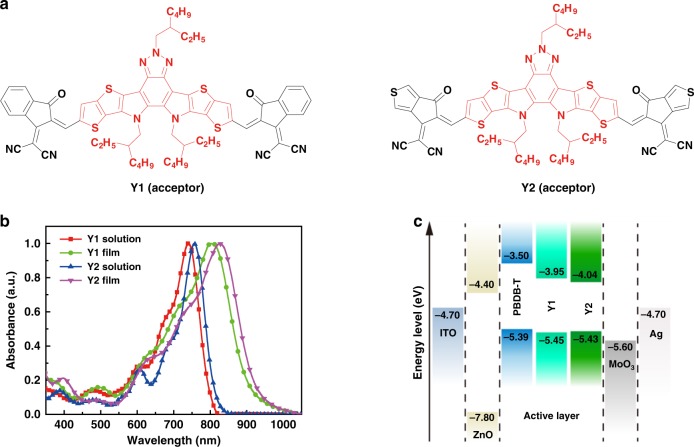
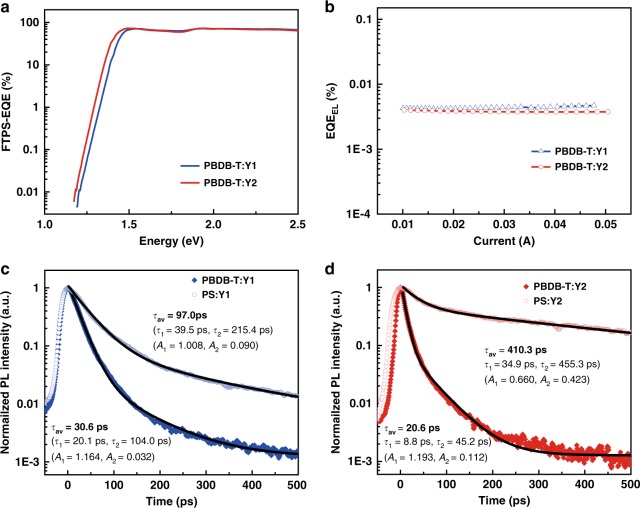
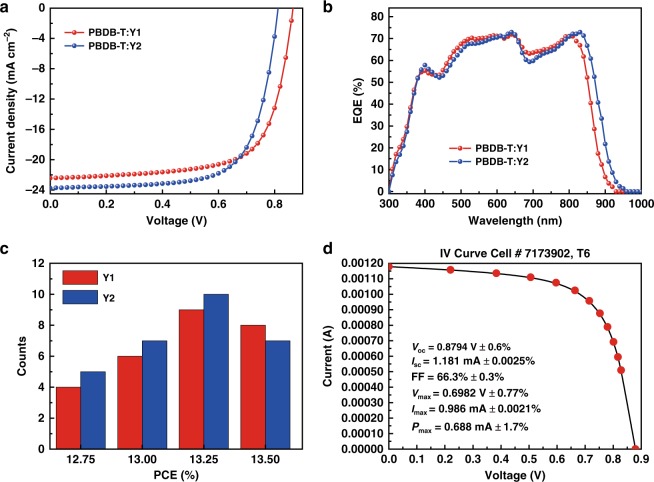
Despite significant development recently, improving the power conversion efficiency of organic photovoltaics (OPVs) is still an ongoing challenge to overcome. One of the prerequisites to achieving this goal is to enable efficient charge separation and small voltage losses at the same time. In this work, a facile synthetic strategy is reported, where optoelectronic properties are delicately tuned by the introduction of electron-deficient-core-based fused structure into non-fullerene acceptors. Both devices exhibited a low voltage loss of 0.57 V and high short-circuit current density of 22.0 mA cm, resulting in high power conversion efficiencies of over 13.4%. These unconventional electron-deficient-core-based non-fullerene acceptors with near-infrared absorption lead to low non-radiative recombination losses in the resulting organic photovoltaics, contributing to a certified high power conversion efficiency of 12.6%.
尽管最近取得了重大进展,但提高有机光伏电池(OPVs)的能量转换效率仍是一个需要克服的挑战。实现这一目标的前提之一是同时实现高效的电荷分离和小的电压损失。在这项工作中,报道了一种简便的合成策略,通过在非富勒烯受体中引入缺电子核基稠合结构来精细调节光电性能。这两个器件的电压损失都很低,只有 0.57V,短路电流密度很高,达到 22.0mA/cm,因此能量转换效率超过了 13.4%。这些具有近红外吸收的非传统缺电子核基非富勒烯受体导致所得有机光伏电池中的非辐射复合损耗较低,有助于获得认证的高能量转换效率 12.6%。