Department of Electrical and Electronic Engineering, Faculty of Engineering, The University of Hong Kong, Hong Kong.
Department of Mechanical Engineering, Faculty of Engineering, The University of Hong Kong, Hong Kong.
J Biophotonics. 2019 Jul;12(7):e201800479. doi: 10.1002/jbio.201800479. Epub 2019 Apr 1.
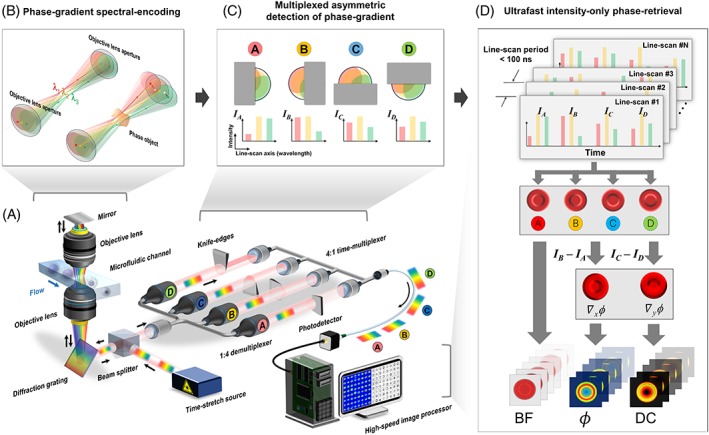
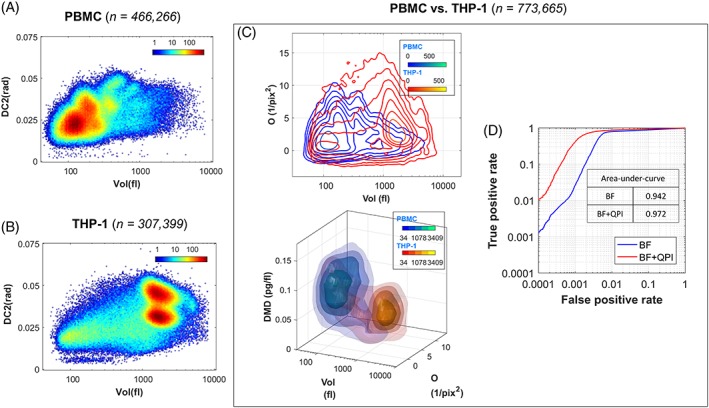
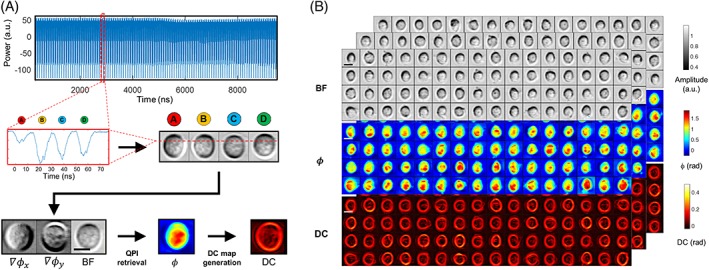
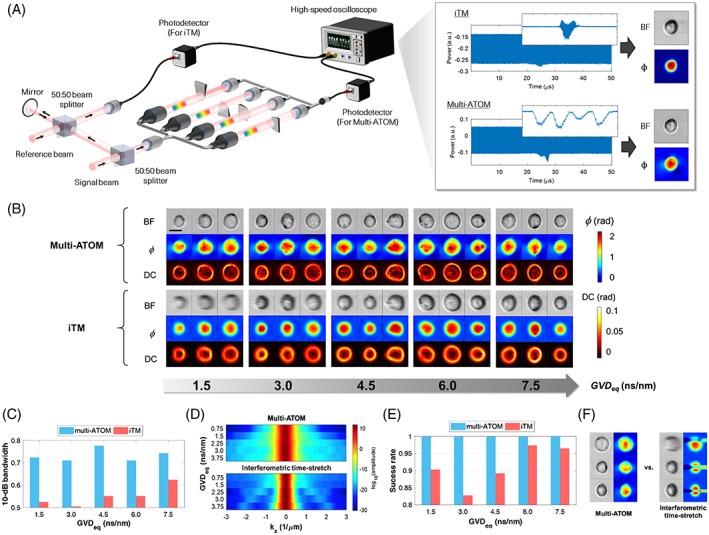
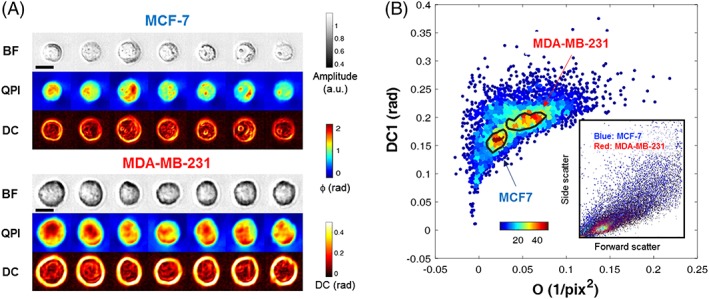
A growing body of evidence has substantiated the significance of quantitative phase imaging (QPI) in enabling cost-effective and label-free cellular assays, which provides useful insights into understanding the biophysical properties of cells and their roles in cellular functions. However, available QPI modalities are limited by the loss of imaging resolution at high throughput and thus run short of sufficient statistical power at the single-cell precision to define cell identities in a large and heterogeneous population of cells-hindering their utility in mainstream biomedicine and biology. Here we present a new QPI modality, coined multiplexed asymmetric-detection time-stretch optical microscopy (multi-ATOM) that captures and processes quantitative label-free single-cell images at ultrahigh throughput without compromising subcellular resolution. We show that multi-ATOM, based upon ultrafast phase-gradient encoding, outperforms state-of-the-art QPI in permitting robust phase retrieval at a QPI throughput of >10 000 cell/sec, bypassing the need for interferometry which inevitably compromises QPI quality under ultrafast operation. We employ multi-ATOM for large-scale, label-free, multivariate, cell-type classification (e.g. breast cancer subtypes, and leukemic cells vs peripheral blood mononuclear cells) at high accuracy (>94%). Our results suggest that multi-ATOM could empower new strategies in large-scale biophysical single-cell analysis with applications in biology and enriching disease diagnostics.
越来越多的证据证实了定量相位成像(QPI)在实现经济高效且无需标记的细胞分析方面的重要性,它为深入了解细胞的生物物理特性及其在细胞功能中的作用提供了有用的见解。然而,现有的 QPI 模式受到高通量下成像分辨率降低的限制,因此在单细胞精度方面缺乏足够的统计能力来定义大量异质细胞群体中的细胞身份,限制了其在主流生物医学和生物学中的应用。在这里,我们提出了一种新的 QPI 模式,称为复用非对称检测时拉伸光学显微镜(multi-ATOM),它可以在超高通量下捕获和处理定量无标记单细胞图像,而不会牺牲亚细胞分辨率。我们表明,基于超快相位梯度编码的 multi-ATOM 在允许在 >10000 个细胞/秒的 QPI 吞吐量下进行稳健的相位恢复方面优于最先进的 QPI,从而避免了干涉测量的需要,干涉测量在超快操作下不可避免地会影响 QPI 质量。我们使用 multi-ATOM 以高精度(>94%)进行大规模、无标记、多变量、细胞类型分类(例如乳腺癌亚型、白血病细胞与外周血单核细胞)。我们的结果表明,multi-ATOM 可以为大规模生物物理单细胞分析提供新的策略,在生物学和丰富疾病诊断方面有应用前景。