Bilanda Danielle Claude, Tcheutchoua Yannick Carlos, Djomeni Dzeufiet Paul Désiré, Fokou Daniel Lauré Dongmo, Fouda Yannick Bekono, Dimo Théophile, Kamtchouing Pierre
Department of Animal Biology and Physiology, Laboratory of Animal Physiology, University of Yaoundé I, P.O. Box 812, Yaoundé, Cameroon.
Evid Based Complement Alternat Med. 2019 Jan 6;2019:2897867. doi: 10.1155/2019/2897867. eCollection 2019.
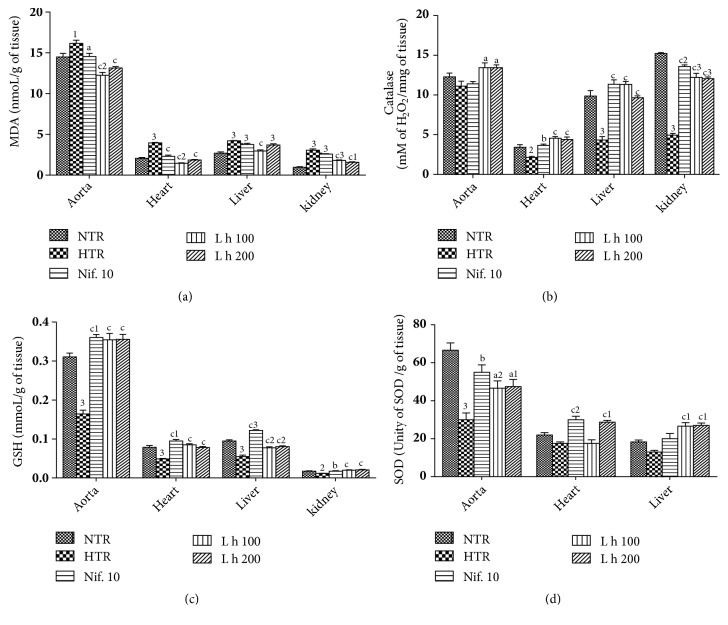
() is used in traditional medicine to treat many diseases including hypertension. This study aimed to evaluate the curative effects of the aqueous extract of on hypertension. Hypertension was induced in rats by oral administration of ethanol (5 g/kg/day) for five weeks. The animals were divided into 2 groups: one group of 5 rats receiving distilled water (10 mL/kg) and another group of 20 rats receiving ethanol. At the end of the 5 weeks of administration of ethanol, the animals were divided into 4 groups of 5 rats each: one group of hypertensive rats receiving distilled water (10 mL/kg), another one receiving nifedipine (10 mg/kg), and two groups of hypertensive rats receiving at doses of 100 and 200 mg/kg, respectively. The results showed that ethanol induced a significant increase in the mean arterial pressure (MAP) and heart rate of normotensive rats. The administration of the extract (100 and 200 mg/kg) or nifedipine caused a significant decrease of MAP compared to hypertensive rats. Ethanol induced a significant increase of lipid profile, the atherogenic index, creatinine, and transaminase activities. Ethanol also induced a significant decrease in serum HDL-cholesterol and antioxidant markers evaluated. Treatment of hypertensive rats with or nifedipine significantly improved lipid profile, hepatic and renal functions, and antioxidant status. The curative effect of extract on hypertension is probably related to its antihypertensive, hypolipidemic, and antioxidant activities, which justifies its empirical use in the treatment of hypertension.
()在传统医学中用于治疗包括高血压在内的多种疾病。本研究旨在评估()水提取物对高血压的疗效。通过口服乙醇(5克/千克/天)持续五周诱导大鼠患高血压。将动物分为两组:一组5只大鼠给予蒸馏水(10毫升/千克),另一组20只大鼠给予乙醇。在给予乙醇5周结束时,将动物分为4组,每组5只大鼠:一组高血压大鼠给予蒸馏水(10毫升/千克),另一组给予硝苯地平(10毫克/千克),两组高血压大鼠分别给予()剂量为100和200毫克/千克。结果表明,乙醇导致正常血压大鼠的平均动脉压(MAP)和心率显著升高。与高血压大鼠相比,提取物(100和200毫克/千克)或硝苯地平的给药导致MAP显著降低。乙醇导致脂质谱、动脉粥样硬化指数、肌酐和转氨酶活性显著升高。乙醇还导致评估的血清高密度脂蛋白胆固醇和抗氧化标志物显著降低。用()或硝苯地平治疗高血压大鼠显著改善了脂质谱、肝肾功能和抗氧化状态。()提取物对高血压的治疗作用可能与其降压、降血脂和抗氧化活性有关,这证明了其在高血压治疗中的经验性应用是合理的。