Department of Chemistry, University of Cambridge, Cambridge, CB2 1EW, UK.
Instituto de Tecnologia Química e Biológica António Xavier, Universidade Nova de Lisboa, Av. da República, 2780-157, Oeiras, Portugal.
Angew Chem Int Ed Engl. 2019 Mar 26;58(14):4601-4605. doi: 10.1002/anie.201814419. Epub 2019 Feb 22.
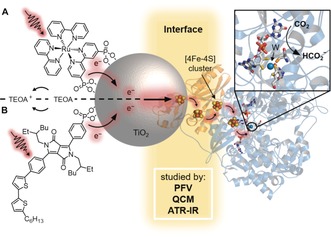
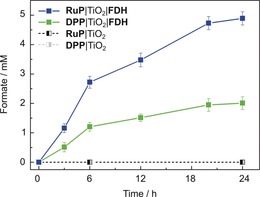
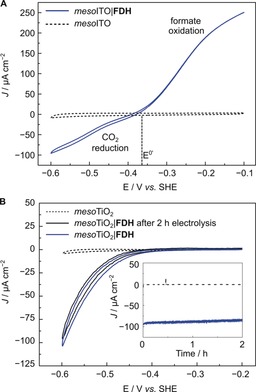
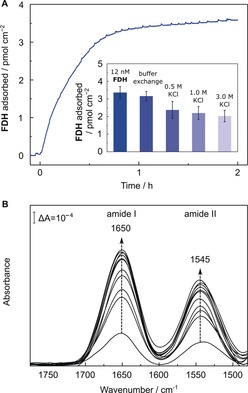
The integration of enzymes with synthetic materials allows efficient electrocatalysis and production of solar fuels. Here, we couple formate dehydrogenase (FDH) from Desulfovibrio vulgaris Hildenborough (DvH) to metal oxides for catalytic CO reduction and report an in-depth study of the resulting enzyme-material interface. Protein film voltammetry (PFV) demonstrates the stable binding of FDH on metal-oxide electrodes and reveals the reversible and selective reduction of CO to formate. Quartz crystal microbalance (QCM) and attenuated total reflection infrared (ATR-IR) spectroscopy confirm a high binding affinity for FDH to the TiO surface. Adsorption of FDH on dye-sensitized TiO allows for visible-light-driven CO reduction to formate in the absence of a soluble redox mediator with a turnover frequency (TOF) of 11±1 s . The strong coupling of the enzyme to the semiconductor gives rise to a new benchmark in the selective photoreduction of aqueous CO to formate.
酶与合成材料的结合可实现高效电催化和太阳能燃料的生产。在这里,我们将来自脱硫弧菌(Desulfovibrio vulgaris Hildenborough,DvH)的甲酸脱氢酶(FDH)与金属氧化物结合,用于催化 CO 还原,并对所得的酶-材料界面进行了深入研究。蛋白膜伏安法(PFV)证明了 FDH 在金属氧化物电极上的稳定结合,并揭示了 CO 向甲酸的可逆和选择性还原。石英晶体微天平(QCM)和衰减全反射红外(ATR-IR)光谱证实了 FDH 与 TiO 表面的高结合亲和力。FDH 在染料敏化 TiO 上的吸附可在没有可溶性氧化还原介体的情况下实现可见光驱动的 CO 还原为甲酸,其周转频率(TOF)为 11±1 s 。酶与半导体的强耦合为水相 CO 的选择性光还原为甲酸提供了一个新的基准。