• 文献检索
  • 文档翻译
  • 深度研究
  • 学术资讯
  • Suppr Zotero 插件Zotero 插件
  • 邀请有礼
  • 套餐&价格
  • 历史记录
应用&插件
Suppr Zotero 插件Zotero 插件浏览器插件Mac 客户端Windows 客户端微信小程序
定价
高级版会员购买积分包购买API积分包
服务
文献检索文档翻译深度研究API 文档MCP 服务
关于我们
关于 Suppr公司介绍联系我们用户协议隐私条款
关注我们

Suppr 超能文献

核心技术专利:CN118964589B侵权必究
粤ICP备2023148730 号-1Suppr @ 2026

文献检索

告别复杂PubMed语法,用中文像聊天一样搜索,搜遍4000万医学文献。AI智能推荐,让科研检索更轻松。

立即免费搜索

文件翻译

保留排版,准确专业,支持PDF/Word/PPT等文件格式,支持 12+语言互译。

免费翻译文档

深度研究

AI帮你快速写综述,25分钟生成高质量综述,智能提取关键信息,辅助科研写作。

立即免费体验

卷积神经网络可以准确区分数字切片中肺腺癌的四种组织学生长模式。

Convolutional neural networks can accurately distinguish four histologic growth patterns of lung adenocarcinoma in digital slides.

机构信息

Department of Surgery, Cedars-Sinai Medical Center, Los Angeles, California, USA.

Department of Pathology and Laboratory Medicine, Cedars-Sinai Medical Center, Los Angeles, California, USA.

出版信息

Sci Rep. 2019 Feb 6;9(1):1483. doi: 10.1038/s41598-018-37638-9.

DOI:10.1038/s41598-018-37638-9
PMID:30728398
原文链接:https://pmc.ncbi.nlm.nih.gov/articles/PMC6365499/
Abstract

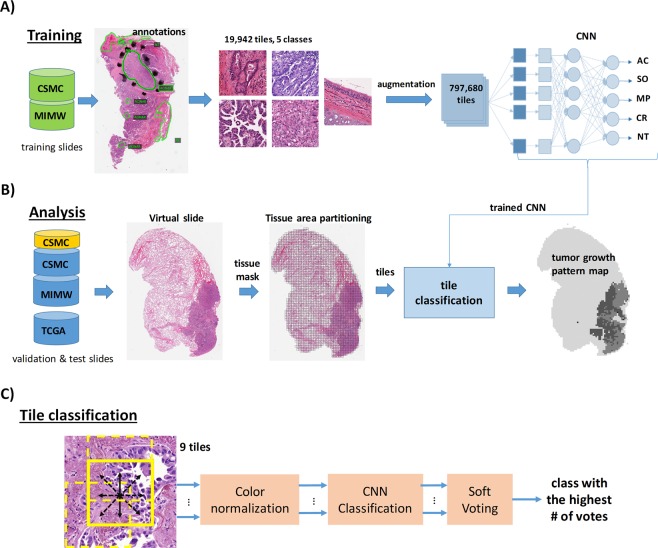
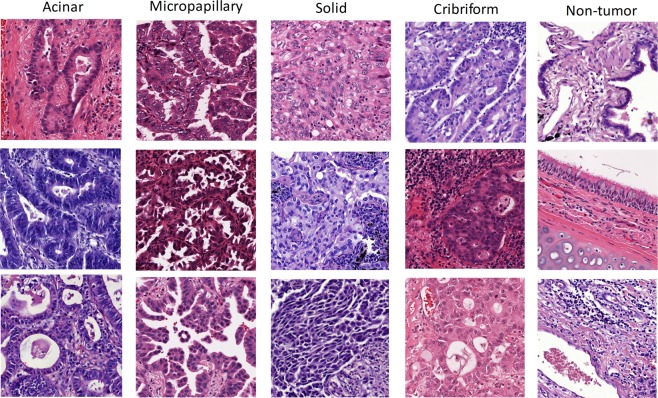
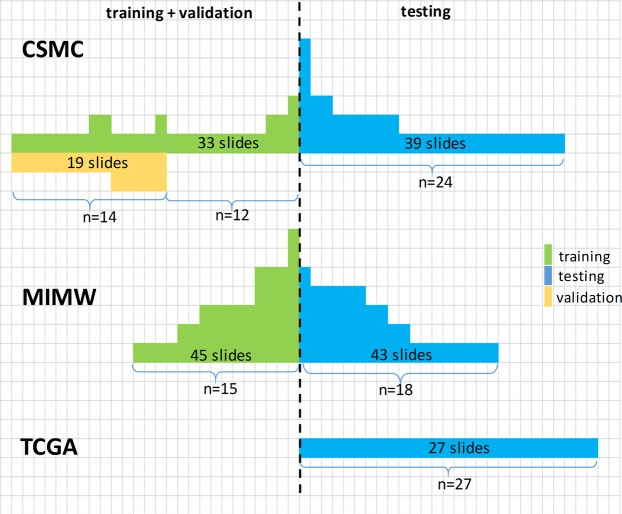
During the diagnostic workup of lung adenocarcinomas (LAC), pathologists evaluate distinct histological tumor growth patterns. The percentage of each pattern on multiple slides bears prognostic significance. To assist with the quantification of growth patterns, we constructed a pipeline equipped with a convolutional neural network (CNN) and soft-voting as the decision function to recognize solid, micropapillary, acinar, and cribriform growth patterns, and non-tumor areas. Slides of primary LAC were obtained from Cedars-Sinai Medical Center (CSMC), the Military Institute of Medicine in Warsaw and the TCGA portal. Several CNN models trained with 19,924 image tiles extracted from 78 slides (MIMW and CSMC) were evaluated on 128 test slides from the three sites by F1-score and accuracy using manual tumor annotations by pathologist. The best CNN yielded F1-scores of 0.91 (solid), 0.76 (micropapillary), 0.74 (acinar), 0.6 (cribriform), and 0.96 (non-tumor) respectively. The overall accuracy of distinguishing the five tissue classes was 89.24%. Slide-based accuracy in the CSMC set (88.5%) was significantly better (p < 2.3E-4) than the accuracy in the MIMW (84.2%) and TCGA (84%) sets due to superior slide quality. Our model can work side-by-side with a pathologist to accurately quantify the percentages of growth patterns in tumors with mixed LAC patterns.

摘要

在肺腺癌(LAC)的诊断工作中,病理学家评估不同的组织学肿瘤生长模式。多种切片上每种模式的百分比具有预后意义。为了协助量化生长模式,我们构建了一个配备卷积神经网络(CNN)和软投票作为决策函数的管道,以识别实体、微乳头状、腺泡和筛状生长模式以及非肿瘤区域。原发 LAC 的切片来自雪松西奈医疗中心(CSMC)、华沙军事医学研究所和 TCGA 门户。从 MIMW 和 CSMC 的 78 张切片中提取 19,924 个图像块,用多个 CNN 模型进行训练,然后用 F1 评分和病理学家手动肿瘤标注的准确性对来自三个地点的 128 个测试切片进行评估。最佳的 CNN 在实体(0.91)、微乳头状(0.76)、腺泡(0.74)、筛状(0.6)和非肿瘤(0.96)方面的 F1 评分分别为 0.91。区分这五个组织类别的总体准确率为 89.24%。CSMC 组的切片准确率(88.5%)明显优于 MIMW 组(84.2%)和 TCGA 组(84%),因为 CSMC 组的切片质量更高。我们的模型可以与病理学家并肩工作,准确地量化混合 LAC 模式肿瘤中生长模式的百分比。
https://cdn.ncbi.nlm.nih.gov/pmc/blobs/a1ad/6365499/8950ddfd31f9/41598_2018_37638_Fig4_HTML.jpg
https://cdn.ncbi.nlm.nih.gov/pmc/blobs/a1ad/6365499/1d1f7e96b1c0/41598_2018_37638_Fig1_HTML.jpg
https://cdn.ncbi.nlm.nih.gov/pmc/blobs/a1ad/6365499/dabaa3be1994/41598_2018_37638_Fig3_HTML.jpg
https://cdn.ncbi.nlm.nih.gov/pmc/blobs/a1ad/6365499/8950ddfd31f9/41598_2018_37638_Fig4_HTML.jpg
https://cdn.ncbi.nlm.nih.gov/pmc/blobs/a1ad/6365499/1d1f7e96b1c0/41598_2018_37638_Fig1_HTML.jpg
https://cdn.ncbi.nlm.nih.gov/pmc/blobs/a1ad/6365499/dabaa3be1994/41598_2018_37638_Fig3_HTML.jpg
https://cdn.ncbi.nlm.nih.gov/pmc/blobs/a1ad/6365499/8950ddfd31f9/41598_2018_37638_Fig4_HTML.jpg

相似文献

1
Convolutional neural networks can accurately distinguish four histologic growth patterns of lung adenocarcinoma in digital slides.卷积神经网络可以准确区分数字切片中肺腺癌的四种组织学生长模式。
Sci Rep. 2019 Feb 6;9(1):1483. doi: 10.1038/s41598-018-37638-9.
2
Pathologist-level classification of histologic patterns on resected lung adenocarcinoma slides with deep neural networks.利用深度神经网络对切除的肺腺癌切片进行病理学家级别的组织学模式分类。
Sci Rep. 2019 Mar 4;9(1):3358. doi: 10.1038/s41598-019-40041-7.
3
ConvPath: A software tool for lung adenocarcinoma digital pathological image analysis aided by a convolutional neural network.ConvPath:一种使用卷积神经网络辅助肺腺癌数字病理图像分析的软件工具。
EBioMedicine. 2019 Dec;50:103-110. doi: 10.1016/j.ebiom.2019.10.033. Epub 2019 Nov 22.
4
Deep Learning Facilitates Distinguishing Histologic Subtypes of Pulmonary Neuroendocrine Tumors on Digital Whole-Slide Images.深度学习有助于在数字全切片图像上区分肺神经内分泌肿瘤的组织学亚型。
Cancers (Basel). 2022 Mar 29;14(7):1740. doi: 10.3390/cancers14071740.
5
Transformaer-based model for lung adenocarcinoma subtypes.基于 Transformaer 的肺腺癌亚型模型。
Med Phys. 2024 Aug;51(8):5337-5350. doi: 10.1002/mp.17006. Epub 2024 Mar 1.
6
Pixel-Level Classification of Five Histologic Patterns of Lung Adenocarcinoma.肺腺癌五种组织学模式的像素级分类
Anal Chem. 2023 Feb 7;95(5):2664-2670. doi: 10.1021/acs.analchem.2c03020. Epub 2023 Jan 26.
7
A CNN-based active learning framework to identify mycobacteria in digitized Ziehl-Neelsen stained human tissues.一种基于卷积神经网络的主动学习框架,用于在数字化齐尔-尼尔森染色的人体组织中识别分枝杆菌。
Comput Med Imaging Graph. 2020 Sep;84:101752. doi: 10.1016/j.compmedimag.2020.101752. Epub 2020 Jul 25.
8
Classification of subtypes including LCNEC in lung cancer biopsy slides using convolutional neural network from scratch.使用卷积神经网络从头开始对肺癌活检切片中的亚型(包括 LCNEC)进行分类。
Sci Rep. 2022 Feb 3;12(1):1830. doi: 10.1038/s41598-022-05709-7.
9
Automated detection of cribriform growth patterns in prostate histology images.前列腺组织学图像中筛状生长模式的自动检测。
Sci Rep. 2020 Sep 10;10(1):14904. doi: 10.1038/s41598-020-71942-7.
10
Training high-performance deep learning classifier for diagnosis in oral cytology using diverse annotations.使用多种标注训练用于口腔细胞学诊断的高性能深度学习分类器。
Sci Rep. 2024 Jul 30;14(1):17591. doi: 10.1038/s41598-024-67879-w.

引用本文的文献

1
Artificial Intelligence in Thoracic Surgery: Transforming Diagnostics, Treatment, and Patient Outcomes.胸外科中的人工智能:变革诊断、治疗及患者预后
Diagnostics (Basel). 2025 Jul 8;15(14):1734. doi: 10.3390/diagnostics15141734.
2
Systematic scoping review of external validation studies of AI pathology models for lung cancer diagnosis.人工智能肺癌诊断病理模型外部验证研究的系统综述
NPJ Precis Oncol. 2025 Jun 7;9(1):166. doi: 10.1038/s41698-025-00940-7.
3
Global bibliometric mapping of the research trends in artificial intelligence-based digital pathology for lung cancer over the past two decades.

本文引用的文献

1
Epithelium segmentation using deep learning in H&E-stained prostate specimens with immunohistochemistry as reference standard.使用深度学习对 H&E 染色前列腺标本进行上皮分割,以免疫组织化学作为参考标准。
Sci Rep. 2019 Jan 29;9(1):864. doi: 10.1038/s41598-018-37257-4.
2
Machine Learning Methods for Histopathological Image Analysis.用于组织病理学图像分析的机器学习方法
Comput Struct Biotechnol J. 2018 Feb 9;16:34-42. doi: 10.1016/j.csbj.2018.01.001. eCollection 2018.
3
Classification and mutation prediction from non-small cell lung cancer histopathology images using deep learning.
过去二十年基于人工智能的肺癌数字病理学研究趋势的全球文献计量图谱。
Digit Health. 2024 Sep 2;10:20552076241277735. doi: 10.1177/20552076241277735. eCollection 2024 Jan-Dec.
4
Decoding pathology: the role of computational pathology in research and diagnostics.解读病理学:计算病理学在研究与诊断中的作用。
Pflugers Arch. 2025 Apr;477(4):555-570. doi: 10.1007/s00424-024-03002-2. Epub 2024 Aug 3.
5
Exploring the Impact of Artificial Intelligence and Machine Learning in the Diagnosis and Management of Esthesioneuroblastomas: A Comprehensive Review.探索人工智能和机器学习在嗅神经母细胞瘤诊断与管理中的影响:一项综合综述。
Cureus. 2024 Jun 19;16(6):e62683. doi: 10.7759/cureus.62683. eCollection 2024 Jun.
6
Deep-GenMut: Automated genetic mutation classification in oncology: A deep learning comparative study.深度基因变异(Deep-GenMut):肿瘤学中的自动基因突变分类:一项深度学习比较研究。
Heliyon. 2024 May 31;10(11):e32279. doi: 10.1016/j.heliyon.2024.e32279. eCollection 2024 Jun 15.
7
Development and deployment of a histopathology-based deep learning algorithm for patient prescreening in a clinical trial.基于组织病理学的深度学习算法的开发和应用,用于临床试验中的患者预筛选。
Nat Commun. 2024 Jun 1;15(1):4690. doi: 10.1038/s41467-024-49153-9.
8
Deceptive learning in histopathology.组织病理学中的欺骗性学习。
Histopathology. 2024 Jul;85(1):116-132. doi: 10.1111/his.15180. Epub 2024 Mar 31.
9
Computational pathology: A survey review and the way forward.计算病理学:综述与未来发展方向
J Pathol Inform. 2024 Jan 14;15:100357. doi: 10.1016/j.jpi.2023.100357. eCollection 2024 Dec.
10
The Molecular Twin artificial-intelligence platform integrates multi-omic data to predict outcomes for pancreatic adenocarcinoma patients.分子双生子人工智能平台整合多组学数据,预测胰腺导管腺癌患者的结局。
Nat Cancer. 2024 Feb;5(2):299-314. doi: 10.1038/s43018-023-00697-7. Epub 2024 Jan 22.
基于深度学习的非小细胞肺癌组织病理学图像分类和突变预测。
Nat Med. 2018 Oct;24(10):1559-1567. doi: 10.1038/s41591-018-0177-5. Epub 2018 Sep 17.
4
Comprehensive analysis of lung cancer pathology images to discover tumor shape and boundary features that predict survival outcome.全面分析肺癌病理图像,发现预测生存结果的肿瘤形状和边界特征。
Sci Rep. 2018 Jul 10;8(1):10393. doi: 10.1038/s41598-018-27707-4.
5
Predicting cancer outcomes from histology and genomics using convolutional networks.使用卷积网络从组织学和基因组学预测癌症结局。
Proc Natl Acad Sci U S A. 2018 Mar 27;115(13):E2970-E2979. doi: 10.1073/pnas.1717139115. Epub 2018 Mar 12.
6
Deep learning based tissue analysis predicts outcome in colorectal cancer.基于深度学习的组织分析预测结直肠癌的预后。
Sci Rep. 2018 Feb 21;8(1):3395. doi: 10.1038/s41598-018-21758-3.
7
Deep Convolutional Neural Networks Enable Discrimination of Heterogeneous Digital Pathology Images.深度卷积神经网络能够区分异质数字病理学图像。
EBioMedicine. 2018 Jan;27:317-328. doi: 10.1016/j.ebiom.2017.12.026. Epub 2017 Dec 28.
8
Diagnostic Assessment of Deep Learning Algorithms for Detection of Lymph Node Metastases in Women With Breast Cancer.用于检测乳腺癌女性患者淋巴结转移的深度学习算法的诊断评估
JAMA. 2017 Dec 12;318(22):2199-2210. doi: 10.1001/jama.2017.14585.
9
A novel machine learning approach reveals latent vascular phenotypes predictive of renal cancer outcome.一种新的机器学习方法揭示了预测肾癌预后的潜在血管表型。
Sci Rep. 2017 Oct 16;7(1):13190. doi: 10.1038/s41598-017-13196-4.
10
Deep convolutional neural networks for automatic classification of gastric carcinoma using whole slide images in digital histopathology.基于数字病理切片全场图像的深度学习卷积神经网络用于胃癌的自动分类。
Comput Med Imaging Graph. 2017 Nov;61:2-13. doi: 10.1016/j.compmedimag.2017.06.001. Epub 2017 Jun 16.