Department of Virology, Faculty of Veterinary Medicine, Suez Canal University, Ismailia 41522, Egypt.
Food Animal Health Research Program, Department of Veterinary Preventive Medicine, Ohio Agricultural Research and Development Center, The Ohio State University, Wooster, 44691 OH, USA.
Viruses. 2019 Feb 6;11(2):139. doi: 10.3390/v11020139.
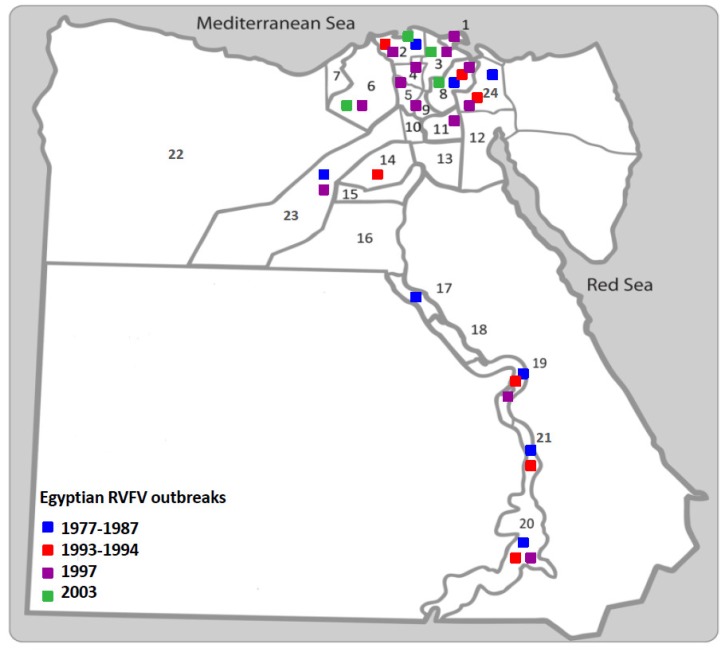
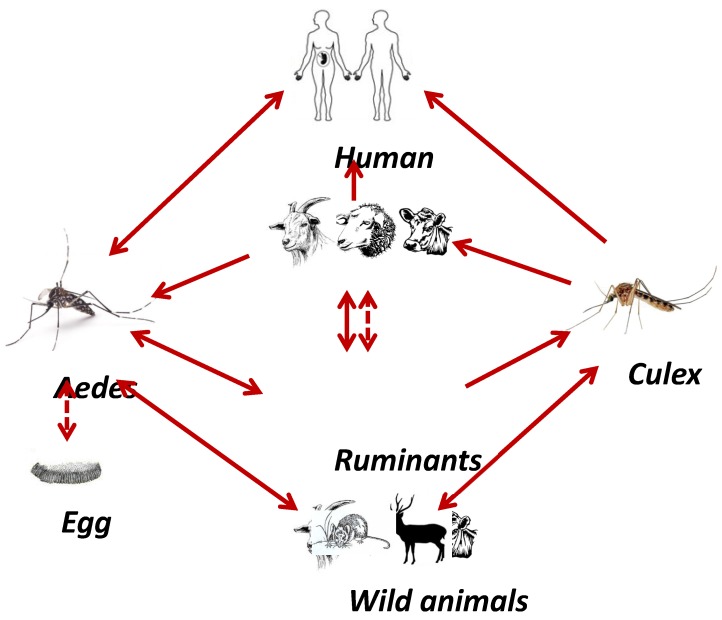
Rift Valley fever (RVF) is an emerging transboundary, mosquito-borne, zoonotic viral disease caused high morbidity and mortality in both human and ruminant populations. It is considered an important threat to both agriculture and public health in African and the Middle Eastern countries including Egypt. Five major RVF epidemics have been reported in Egypt (1977, 1993, 1994, 1997, and 2003). The virus is transmitted in Egypt by different mosquito's genera such as , , , and , leading to abortions in susceptible animal hosts especially sheep, goat, cattle, and buffaloes. Recurrent RVF outbreaks in Egypt have been attributed in part to the lack of routine surveillance for the virus. These periodic epizootics have resulted in severe economic losses. We posit that there is a critical need for new approaches to RVF control that will prevent or at least reduce future morbidity and economic stress. One Health is an integrated approach for the understanding and management of animal, human, and environmental determinants of complex problems such as RVF. Employing the One Health approach, one might engage local communities in surveillance and control of RVF efforts, rather than continuing their current status as passive victims of the periodic RVF incursions. This review focuses upon endemic and epidemic status of RVF in Egypt, the virus vectors and their ecology, transmission dynamics, risk factors, and the ecology of the RVF at the animal/human interface, prevention, and control measures, and the use of environmental and climate data in surveillance systems to predict disease outbreaks.
裂谷热(RVF)是一种新兴的跨界、蚊媒、人畜共患病毒性疾病,在人类和反刍动物群体中造成高发病率和死亡率。它被认为是对包括埃及在内的非洲和中东国家的农业和公共卫生的重要威胁。埃及曾报告过五次重大 RVF 疫情(1977 年、1993 年、1994 年、1997 年和 2003 年)。在埃及,该病毒由不同的蚊子属传播,如、、、和,导致易感动物宿主(尤其是绵羊、山羊、牛和水牛)流产。埃及反复发生 RVF 疫情部分归因于缺乏对该病毒的常规监测。这些周期性的动物疫情导致了严重的经济损失。我们认为,迫切需要新的 RVF 控制方法,以预防或至少减少未来的发病率和经济压力。“One Health”是一种综合方法,用于理解和管理动物、人类和环境因素对复杂问题(如 RVF)的影响。采用“One Health”方法,人们可以让当地社区参与 RVF 的监测和控制工作,而不是让他们继续成为周期性 RVF 疫情的被动受害者。本综述重点关注埃及 RVF 的地方性和流行状况、病毒媒介及其生态学、传播动态、风险因素以及动物/人类界面的 RVF 生态学、预防和控制措施,以及利用环境和气候数据在监测系统中预测疾病爆发。