Fan Jiamin, Zheng Xueli, Wang Hongyong, Qi Hong, Jiang Benmo, Qiao Meiping, Zhou Jianwen, Bu Shuhai
College of Life Sciences, Northwest A&F University, Yangling 712100, Shaanxi, China.
College of Forestry, Northwest A&F University, Yangling 712100, Shaanxi, China.
G3 (Bethesda). 2019 Apr 9;9(4):1037-1044. doi: 10.1534/g3.119.400001.
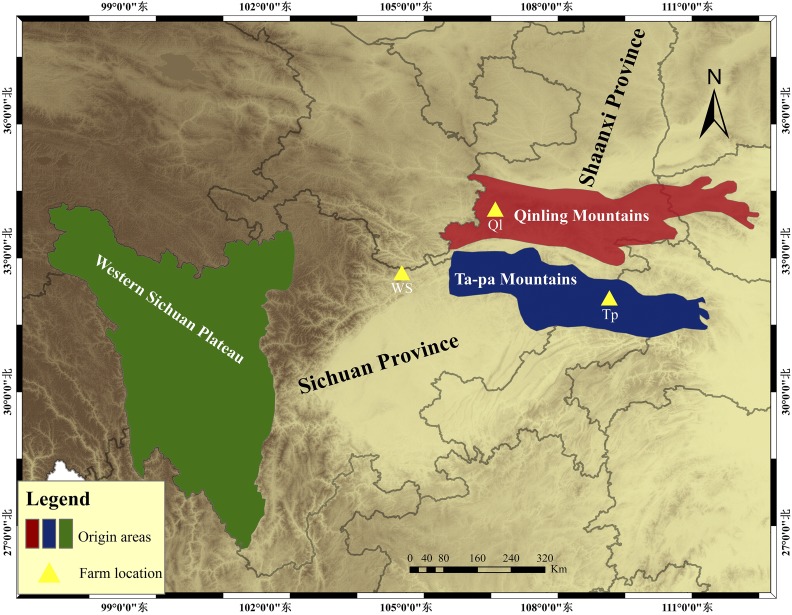
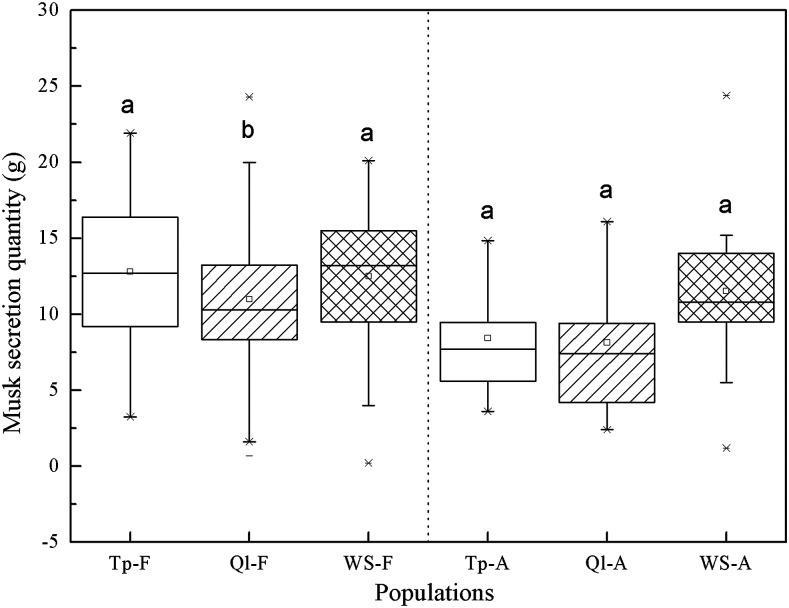
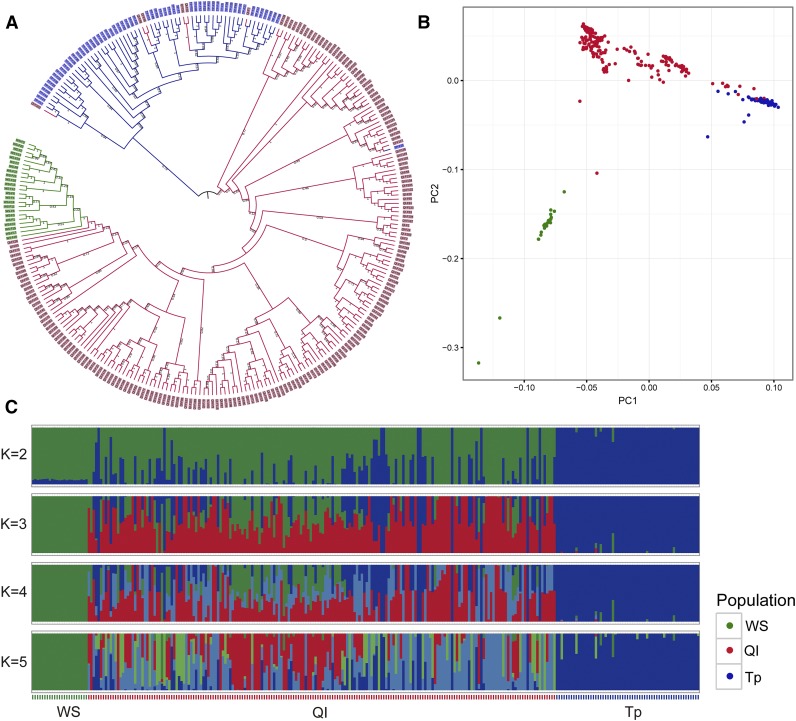
Musk deer (Moschidae), whose secretion is an expensive and irreplaceable component of traditional medicine, have become endangered in the wild due to habitat fragmentation and over-exploitation. In recent years, China has had success in the artificial breeding of forest musk deer, thus relieving the pressure on wild populations. However, many farmed populations are experiencing degradation, and little genetic information is available for conservation management. In this study, we selected 274 individuals from three typical captive populations (originated from the Ta-pa Mountains (Tp), the midrange of the Qinling Mountains (Ql) and the Western Sichuan Plateau (WS), respectively) to evaluate the genetic variations. A total of more than 3.15 billion high-quality clean reads and 4.37 million high-quality SNPs were generated by RAD sequencing. Based on the analysis, we found that captive forest musk deer populations exhibit a relatively low level of genetic diversity. Ql displayed a higher level of genetic diversity than the Tp and WS populations. Tp and WS had experienced population bottlenecks in the past as inferred from the values of Tajima's D. There were high levels of heterozygote deficiency caused by inbreeding within the three populations. Population structure analysis suggested that the three populations have evolved independently, and a moderate amount of genetic differentiation has developed, although there was a low level of gene flow between the Ql and Tp populations. Furthermore, the average quantities of musk secreted by musk deer in the Tp and WS populations were significantly higher than that in the Ql population. The present genetic information should be considered in management plans for the conservation and utilization of musk deer from captive breeding.
麝(麝科),其分泌物是传统医学中一种昂贵且不可替代的成分,由于栖息地破碎化和过度开发,在野外已濒临灭绝。近年来,中国在林麝人工养殖方面取得了成功,从而缓解了野生种群的压力。然而,许多养殖种群正面临退化,且可用于保护管理的遗传信息很少。在本研究中,我们从三个典型的圈养种群(分别来自大巴山(Tp)、秦岭中段(Ql)和川西高原(WS))中选取了274只个体来评估遗传变异。通过RAD测序共产生了超过31.5亿条高质量的clean reads和437万个高质量的SNP。基于分析,我们发现圈养林麝种群的遗传多样性水平相对较低。Ql种群的遗传多样性水平高于Tp和WS种群。从Tajima's D值推断,Tp和WS过去经历过种群瓶颈。三个种群内部由于近亲繁殖导致杂合子缺乏程度较高。种群结构分析表明,尽管Ql和Tp种群之间的基因流水平较低,但这三个种群已独立进化,并且已经产生了一定程度的遗传分化。此外,Tp和WS种群中麝分泌麝香的平均量显著高于Ql种群。在制定圈养麝保护和利用的管理计划时应考虑当前的遗传信息。