Utah Center for Advanced Imaging Research (UCAIR), Department of Radiology and Imaging Sciences, University of Utah, Salt Lake City, Utah, United States of America.
Department of Physics and Astronomy, University of Utah, Salt Lake City, Utah, United States of America.
PLoS One. 2019 Feb 11;14(2):e0211738. doi: 10.1371/journal.pone.0211738. eCollection 2019.
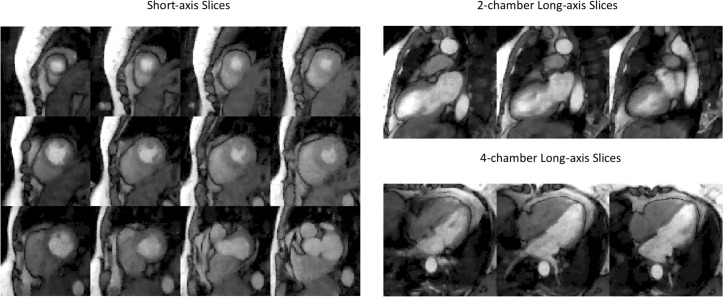
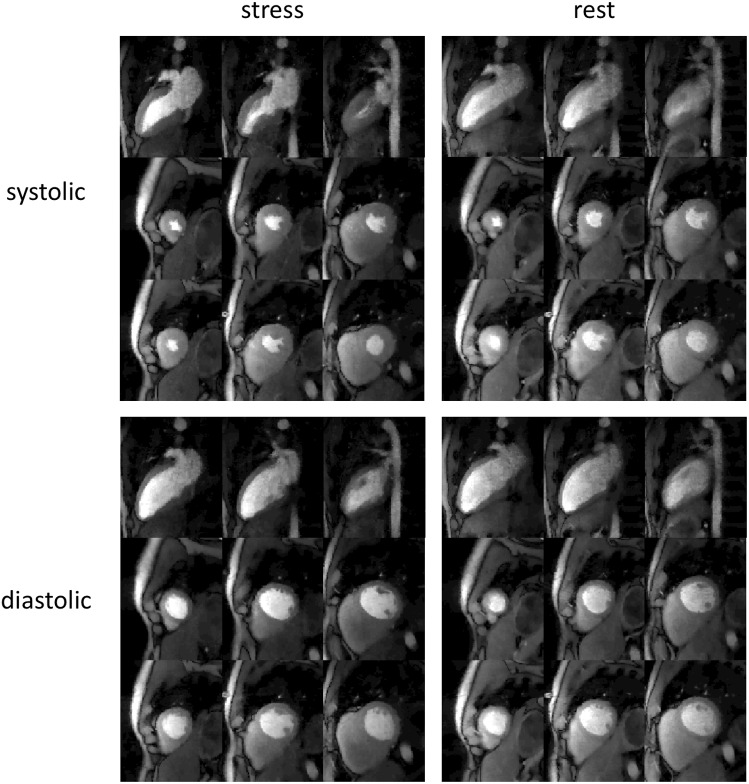
Dynamic contrast enhanced MRI of the heart typically acquires 2-4 short-axis (SA) slices to detect and characterize coronary artery disease. This acquisition scheme is limited by incomplete coverage of the left ventricle. We studied the feasibility of using radial simultaneous multi-slice (SMS) technique to achieve SA, 2-chamber and/or 4-chamber long-axis (2CH LA and/or 4CH LA) coverage with and without electrocardiography (ECG) gating using a motion-robust reconstruction framework.
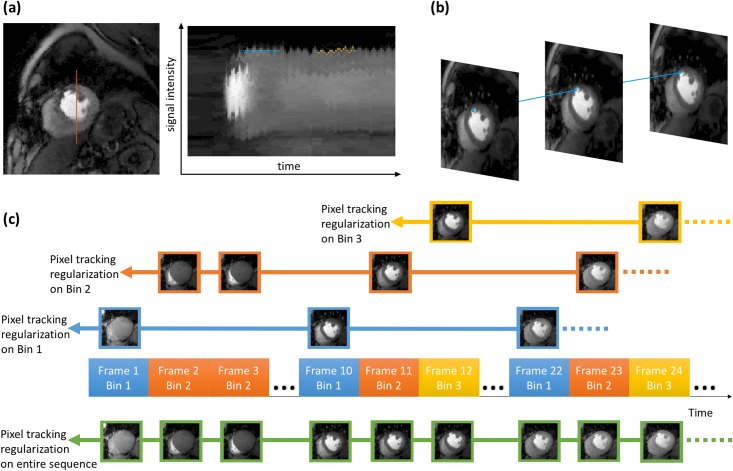
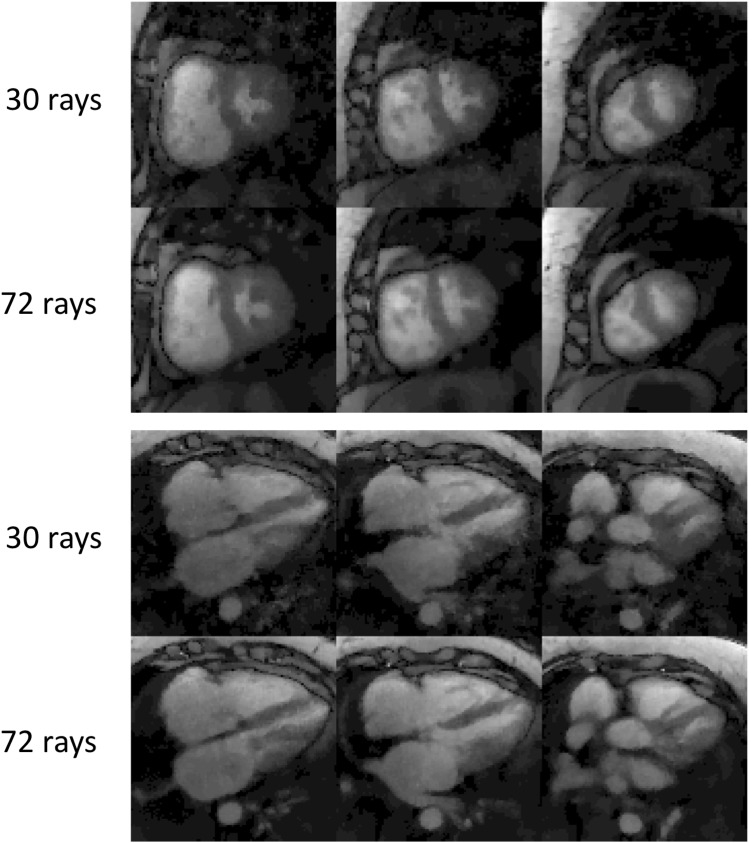
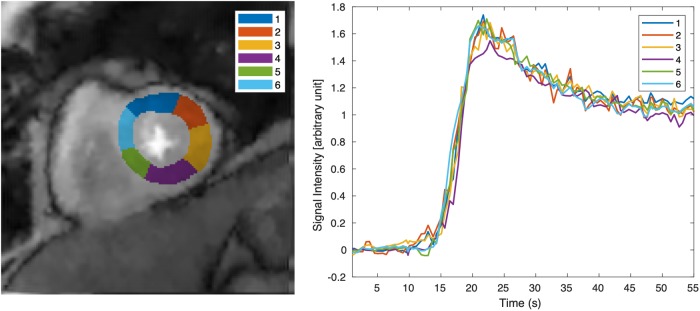
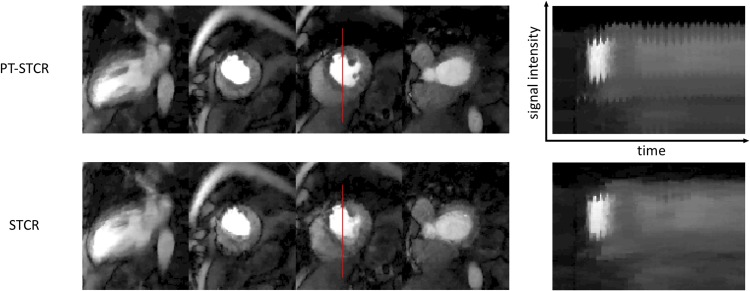
12 subjects were scanned at rest and/or stress, free breathing, with or without ECG gating. Multiple sets of radial SMS k-space were acquired within each cardiac cycle, and each SMS set sampled 3 parallel slices that were either SA, 2CH LA, or 4CH LA slices. The radial data was interpolated onto Cartesian space using an SMS GRAPPA operator gridding method. Self-gating and respiratory states binning of the data were done. The binning information as well as a pixel tracking spatiotemporal constrained reconstruction method were applied to obtain motion-robust image reconstructions. Reconstructions with and without the pixel tracking method were compared for signal-to-noise ratio and contrast-to-noise ratio.
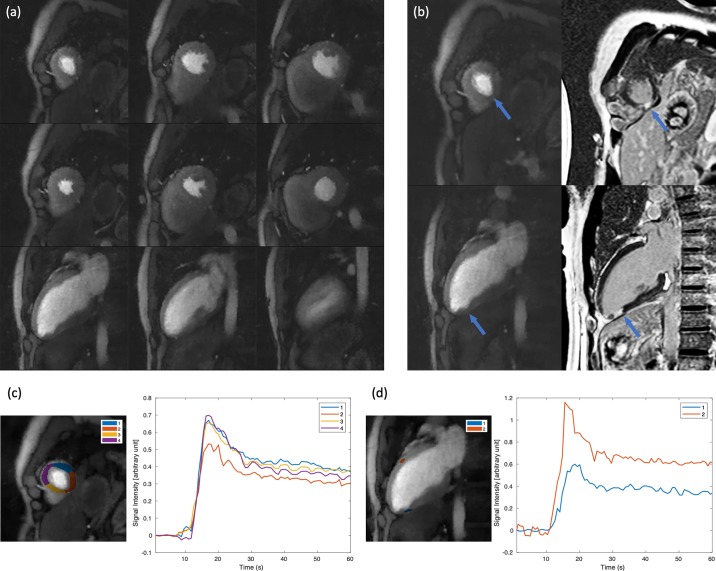
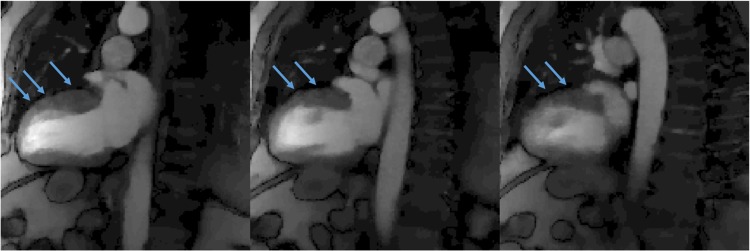
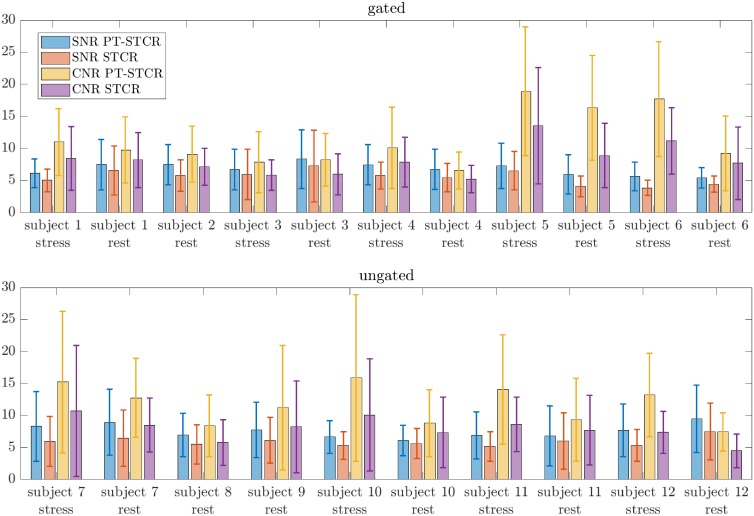
Full coverage of the heart (at least 3 SA and 3 LA slices) during the first pass of contrast at every heartbeat was achieved by using the radial SMS acquisition. The proposed pixel tracking reconstruction improves the average SNR and CNR by 21% and 30% respectively, and reduces temporal blurring for both gated and ungated acquisitions.
Acquiring simultaneous multi-slice SA, 2CH LA and/or 4CH LA myocardial perfusion images in every heartbeat is feasible in both gated and ungated acquisitions. This can add confidence when detecting and characterizing coronary artery disease by revealing ischemia in different views, and by providing apical coverage that is improved relative to SA slices alone. The proposed pixel tracking framework improves the reconstruction while adding little computational cost.
心脏动态对比增强磁共振成像通常采集 2-4 个短轴(SA)切片,以检测和表征冠状动脉疾病。这种采集方案受到左心室不完全覆盖的限制。我们研究了使用径向同时多层(SMS)技术在有无心电图(ECG)门控的情况下实现 SA、2 腔和/或 4 腔长轴(2CH LA 和/或 4CH LA)覆盖的可行性,使用运动稳健重建框架。
12 名受试者在休息和/或应激、自由呼吸、有或无心电图门控的情况下进行扫描。在每个心动周期内采集多组径向 SMS k 空间,并且每个 SMS 组采集 3 个平行切片,这些切片是 SA、2CH LA 或 4CH LA 切片。使用 SMS GRAPPA 算子网格化方法将径向数据内插到笛卡尔空间。对数据进行自我门控和呼吸状态分箱。应用分箱信息和像素跟踪时空约束重建方法获得运动稳健的图像重建。比较了有无像素跟踪方法的重建的信噪比和对比噪声比。
通过使用径向 SMS 采集,在每个心跳的造影剂第一通过期间实现了心脏(至少 3 个 SA 和 3 个 LA 切片)的完全覆盖。所提出的像素跟踪重建方法分别提高了平均 SNR 和 CNR 21%和 30%,并减少了门控和非门控采集的时间模糊。
在门控和非门控采集的每个心跳中都可以获取同时多层的 SA、2CH LA 和/或 4CH LA 心肌灌注图像是可行的。这可以通过在不同视图中显示缺血并提供相对于单独的 SA 切片改善的顶叶覆盖来增加检测和表征冠状动脉疾病的信心。所提出的像素跟踪框架在提高重建质量的同时,几乎没有增加计算成本。