Yoon Yousang, Lee Jusin, Ra Moonsoo, Gwon Hyeokshin, Lee Seungwon, Kim Min Young, Yoo Ki-Chun, Sul Onejae, Kim Chul Geun, Kim Whoi-Yul, Park Jea-Gun, Lee Su-Jae, Lee Young Yiul, Choi Ho Soon, Lee Seung-Beck
Department of Electronic Engineering, Hanyang University College of Engineering, 222 Wangsimni-ro, Seongdong-gu, Seoul 04763, Korea.
Department of Life Science and Research Institute for Natural Sciences, Hanyang University College of Natural Sciences, 222 Wangsimni-ro, Seongdong-gu, Seoul 04763, Korea.
Cancers (Basel). 2019 Feb 10;11(2):200. doi: 10.3390/cancers11020200.
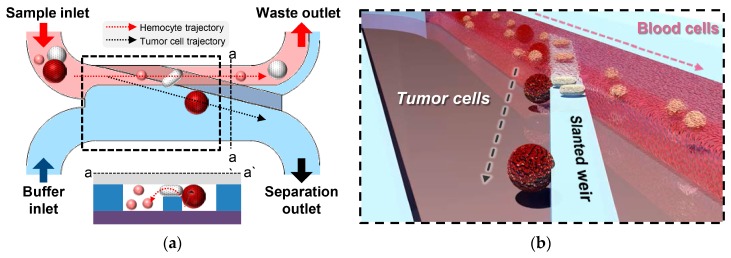
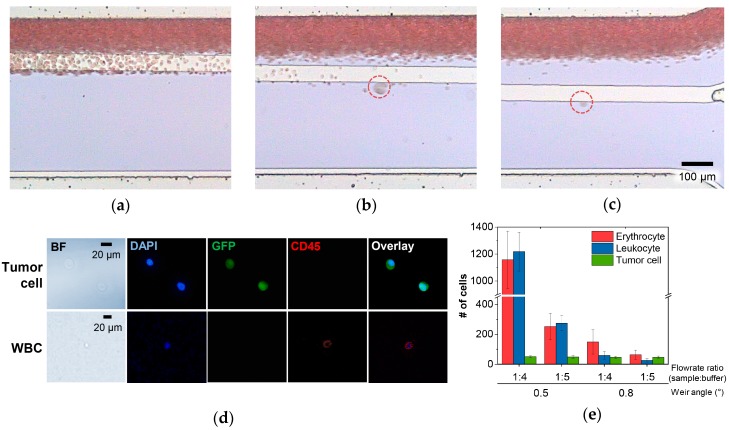
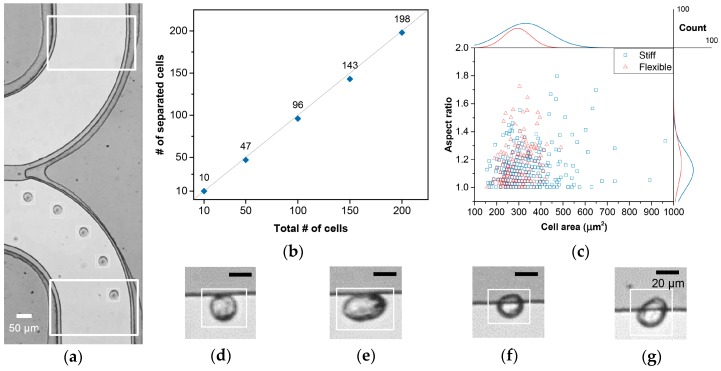
The separation of circulating tumor cells (CTCs) from the peripheral blood is an important issue that has been highlighted because of their high clinical potential. However, techniques that depend solely on tumor-specific surface molecules or just the larger size of CTCs are limited by tumor heterogeneity. Here, we present a slanted weir microfluidic device that utilizes the size and deformability of CTCs to separate them from the unprocessed whole blood. By testing its ability using a highly invasive breast cancer cell line, our device achieved a 97% separation efficiency, while showing an 8-log depletion of erythrocytes and 5.6-log depletion of leukocytes. We also developed an image analysis tool that was able to characterize the various morphologies and differing deformability of the separating cells. From the results, we believe our system possesses a high potential for liquid biopsy, aiding future cancer research.
从外周血中分离循环肿瘤细胞(CTC)是一个因具有高临床潜力而备受关注的重要问题。然而,仅依赖肿瘤特异性表面分子或仅依据CTC较大尺寸的技术受到肿瘤异质性的限制。在此,我们展示了一种倾斜堰式微流控装置,该装置利用CTC的大小和可变形性将其从未经处理的全血中分离出来。通过使用一种高侵袭性乳腺癌细胞系测试其能力,我们的装置实现了97%的分离效率,同时红细胞减少了8个对数级,白细胞减少了5.6个对数级。我们还开发了一种图像分析工具,该工具能够对分离细胞的各种形态和不同的可变形性进行表征。基于这些结果,我们相信我们的系统在液体活检方面具有很高的潜力,有助于未来的癌症研究。