Department of Medicine, Columbia University Irving Medical Center, New York, NY, USA.
Institute of Human Nutrition, Columbia University Irving Medical Center, New York, NY, USA.
Curr Atheroscler Rep. 2019 Feb 12;21(3):11. doi: 10.1007/s11883-019-0772-z.
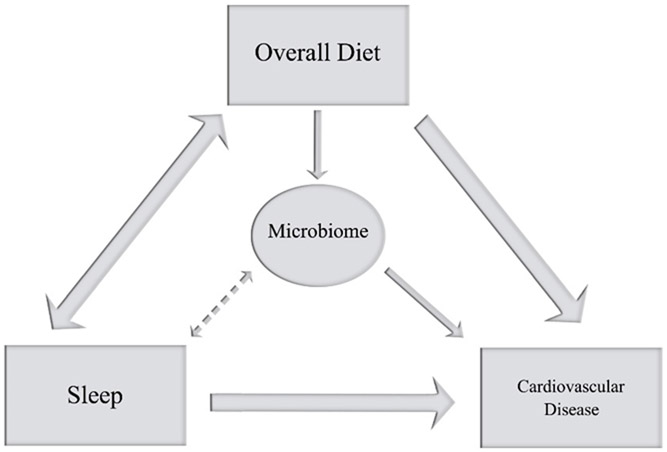
This review investigates the potential bi-directional relation between sleep and diet in considering their contribution to cardiovascular health. We further explore the involvement of the gut microbiome in the relationships between poor sleep and dietary intakes and increased cardiovascular disease (CVD) risk.
There is strong evidence that sleep restriction leads to unhealthy food choices and increased energy intake. The diet may impact sleep, as well. Epidemiological studies show that higher adherence to a Mediterranean dietary pattern predicts healthier sleep. One factor that could underlie these relationships is the gut microbiome. Although data are mixed, there is some evidence that sleep restriction can influence the composition of the gut microbiome in humans. Similarly, Mediterranean diets and other plant-rich diets are related to increased diversity of the microbiota. At present, few studies have investigated the influence of the microbiome on sleep; however, limited evidence from epidemiological and intervention studies suggest that the composition of the microbiome may relate to sleep quality. More research is needed to better understand the role of the microbiome in the multi-directional relationship between sleep, diet, and CVD. There is growing evidence of a bi-directional relationship between sleep and the diet, which could act in concert to influence CVD risk. Diets such as the Mediterranean diet, comprised of high intakes of fruits, vegetables, and other plant-based foods, may promote healthy sleep and beneficial gut microflora. The gut microbiome may then underlie the relation between diet, sleep, and CVD risk.
本综述研究了睡眠和饮食之间潜在的双向关系,以考虑它们对心血管健康的贡献。我们进一步探讨了肠道微生物组在睡眠不良和饮食摄入增加与心血管疾病 (CVD) 风险增加之间的关系中的作用。
有强有力的证据表明,睡眠限制会导致不健康的食物选择和能量摄入增加。饮食也可能影响睡眠。流行病学研究表明,更高程度地遵循地中海饮食模式可预测更健康的睡眠。这些关系的一个潜在因素是肠道微生物组。尽管数据参差不齐,但有一些证据表明,睡眠限制会影响人体肠道微生物组的组成。同样,地中海饮食和其他富含植物的饮食与微生物群的多样性增加有关。目前,很少有研究调查微生物组对睡眠的影响;然而,来自流行病学和干预研究的有限证据表明,微生物组的组成可能与睡眠质量有关。需要进一步的研究来更好地了解微生物组在睡眠、饮食和 CVD 之间的多向关系中的作用。越来越多的证据表明睡眠和饮食之间存在双向关系,它们可能协同作用影响 CVD 风险。地中海饮食等饮食,包括大量摄入水果、蔬菜和其他植物性食物,可能会促进健康的睡眠和有益的肠道微生物群。肠道微生物组可能是饮食、睡眠和 CVD 风险之间关系的基础。