Guracho Yonas Deressa, Bifftu Berhanu Boru
Pawi Health Science College, Health.
University of Gondar, Nursing.
Afr Health Sci. 2018 Dec;18(4):1255-1266. doi: 10.4314/ahs.v18i4.47.
Domestic violence (DV) is a global public problem that touches all levels of society and socio-economic status. Identifying women's attitudes towards domestic violence is an important first step in the prevention and control of its consequence. Thus, this systematic review and meta-analysis aimed: (i) to synthesize women's reasons for justifying domestic violence and (ii) to determine the pooled prevalence of women's attitude towards domestic violence in Ethiopia.
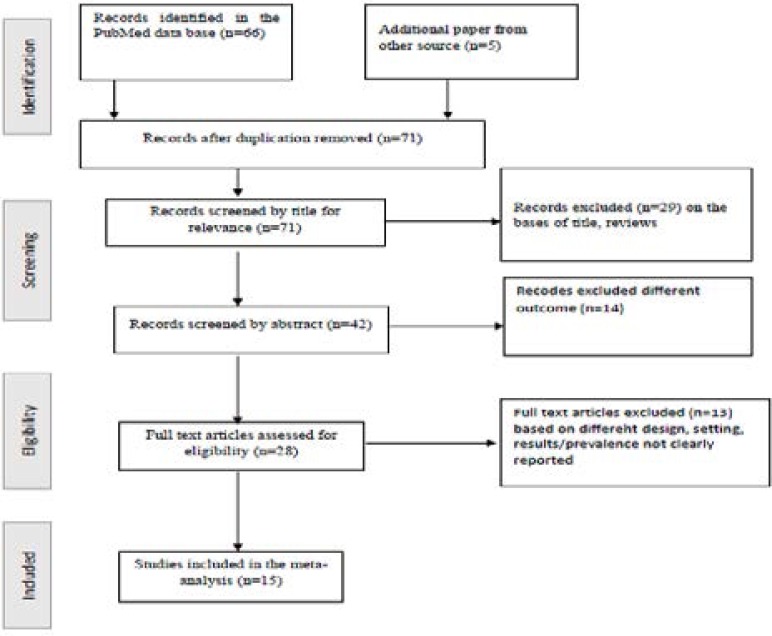
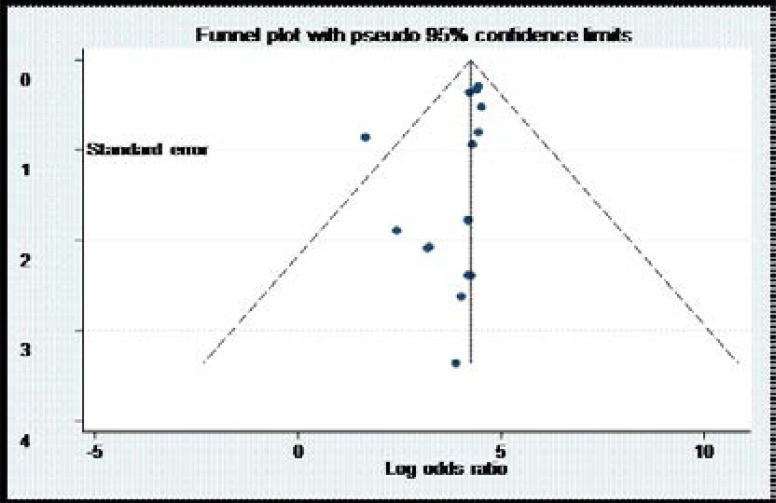
Pub-Med and google scholar data bases searched for quantitative cross-sectional studies. The study quality was assessed with the Newcastle-Ottawa quality assessment tool. Heterogeneity test and evidence of publication bias were assessed. Pooled prevalence of women's attitude was calculated with 95%CI using random effects model.
A total of 15 articles were included in the study. The pooled prevalence of women's attitude towards justifying domestic violence was found to be 57% (95% CI; 47.0%-67.2%). Reasons for justifying were: burning food, argues with husband, goes out without telling, neglects children, refuses sex, unfaithful, disobeys and suspects infidelity.
More than half of women accept domestic violence. Authors' suggest strengthening of women's awareness toward norms that justify wife beating.
家庭暴力是一个全球性的公共问题,涉及社会各阶层和社会经济地位。确定女性对家庭暴力的态度是预防和控制其后果的重要第一步。因此,本系统评价和荟萃分析旨在:(i)综合女性为家庭暴力辩护的原因,以及(ii)确定埃塞俄比亚女性对家庭暴力态度的合并患病率。
在PubMed和谷歌学术数据库中检索定量横断面研究。使用纽卡斯尔-渥太华质量评估工具评估研究质量。评估异质性检验和发表偏倚的证据。使用随机效应模型计算女性态度的合并患病率及95%置信区间。
该研究共纳入15篇文章。发现女性为家庭暴力辩护态度的合并患病率为57%(95%置信区间;47.0%-67.2%)。辩护的原因包括:烧饭、与丈夫争吵、不告知就外出、忽视孩子、拒绝性行为、不忠、不听话和怀疑不忠。
超过一半的女性接受家庭暴力。作者建议加强女性对为殴打妻子辩护的规范的认识。