Sallem Fadoua, Haji Rihab, Vervandier-Fasseur Dominique, Nury Thomas, Maurizi Lionel, Boudon Julien, Lizard Gérard, Millot Nadine
Laboratoire Interdisciplinaire Carnot de Bourgogne (ICB), UMR 6303 CNRS/Université Bourgogne Franche-Comté, 21000 Dijon, France.
Institut de Chimie Moléculaire de l'Université de Bourgogne (ICMUB), UMR 6302 CNRS/Université Bourgogne Franche-Comté, 21000 Dijon, France.
Nanomaterials (Basel). 2019 Feb 18;9(2):287. doi: 10.3390/nano9020287.
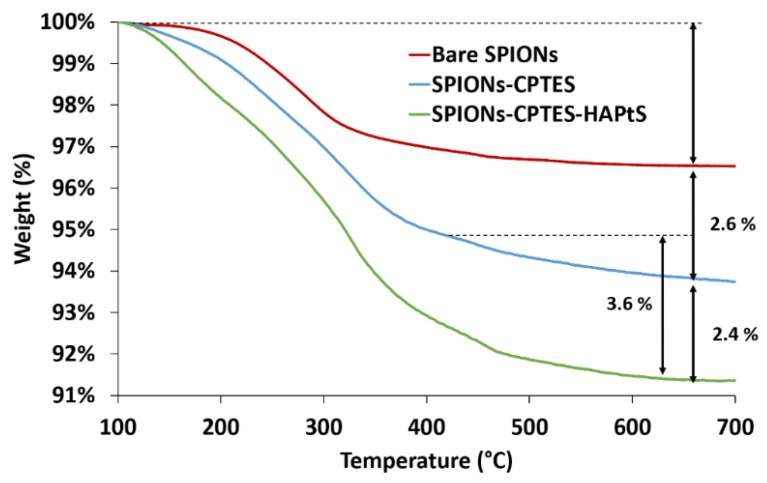
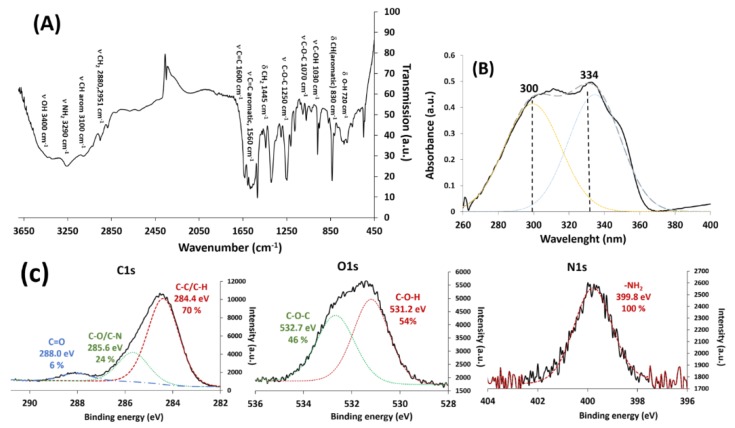
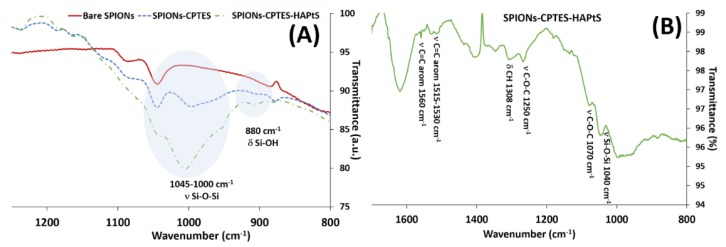
In this work, new nanohybrids based on superparamagnetic iron oxide nanoparticles (SPIONs) were elaborated and discussed for the first time as nanovectors of a derivative molecule of trans-resveratrol (RSV), a natural antioxidant molecule, which can be useful for brain disease treatment. The derivative molecule was chemically synthesized (4'-hydroxy-4-(3-aminopropoxy) trans-stilbene: HAPtS) and then grafted onto SPIONs surface using an organosilane coupling agent, which is 3-chloropropyltriethoxysilane (CPTES) and based on nucleophilic substitution reactions. The amount of HAPtS loaded onto SPIONs surface was estimated by thermogravimetric analysis (TGA) and X-ray photoelectron spectroscopy (XPS) analyses at 116 µmol·g SPIONs. The synthesized HAPtS molecule, as well as the associated nanohybrids, were fully characterized by transmission electron microscopy (TEM), XPS, TGA, infrared (IR) and UV-visible spectroscopies, dynamic light scattering (DLS), and zeta potential measurements. The in vitro biological assessment of the synthesized nanohybrid's efficiency was carried out on C6 glioma cells and showed that the nanovector SPIONs-CPTES-HAPtS do not affect the mitochondrial metabolism (MTT test), but damage the plasma membrane (FDA test), which could contribute to limiting the proliferation of cancerous cells (clonogenic test) at a HAPtS concentration of 50 µM. These nanoparticles have a potential cytotoxic effect that could be used to eliminate cancer cells.
在这项工作中,首次阐述并讨论了基于超顺磁性氧化铁纳米颗粒(SPIONs)的新型纳米杂化物,它们作为反式白藜芦醇(RSV)衍生物分子的纳米载体,RSV是一种天然抗氧化分子,可能有助于脑部疾病的治疗。该衍生物分子通过化学合成得到(4'-羟基-4-(3-氨基丙氧基)反式芪:HAPtS),然后使用有机硅烷偶联剂3-氯丙基三乙氧基硅烷(CPTES),基于亲核取代反应将其接枝到SPIONs表面。通过热重分析(TGA)和X射线光电子能谱(XPS)分析估计,接枝到SPIONs表面的HAPtS量为116 µmol·g SPIONs。合成的HAPtS分子以及相关的纳米杂化物通过透射电子显微镜(TEM)、XPS、TGA、红外(IR)和紫外可见光谱、动态光散射(DLS)以及zeta电位测量进行了全面表征。对合成的纳米杂化物的效率进行了体外生物学评估,该评估在C6胶质瘤细胞上进行,结果表明纳米载体SPIONs-CPTES-HAPtS不影响线粒体代谢(MTT试验),但会损伤质膜(FDA试验),这可能有助于在HAPtS浓度为50 µM时限制癌细胞的增殖(克隆形成试验)。这些纳米颗粒具有潜在的细胞毒性作用,可用于消除癌细胞。