Computational Neuroscience Outcomes Center, Brigham and Women's Hospital, Harvard Medical School, Boston, Massachusetts, USA.
Department of Biostatistics, Harvard T. H. Chan School of Public Health, Boston, Massachusetts, USA.
World Neurosurg. 2019 Jun;126:e241-e249. doi: 10.1016/j.wneu.2019.01.297. Epub 2019 Feb 22.
To identify trends in mobility and daily pain levels among a cohort of patients with clinically diagnosed spine disease.
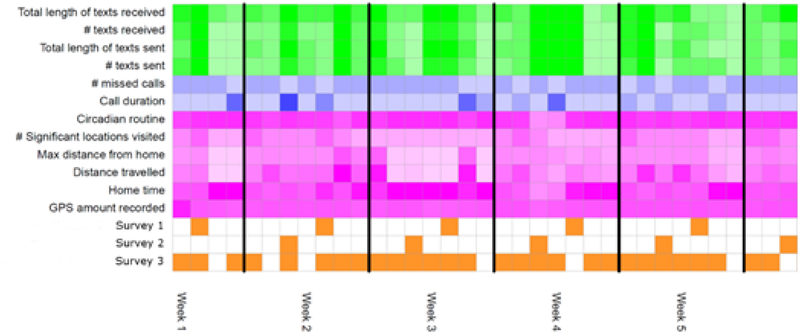
Participants with spine disease were enrolled from a general neurosurgical clinic and installed a smartphone application (Beiwe) designed for digital phenotyping to their personal smartphone. This application collected passive meta-data on a minute-to-minute basis, including global positioning system (GPS), WiFi, accelerometer, text and telephone logs, and screen on and off time. The application also administered daily visual analog scale pain surveys. A linear mixed model framework was used to test for associations between self-reported pain and mobility and sociability from the passively collected data.
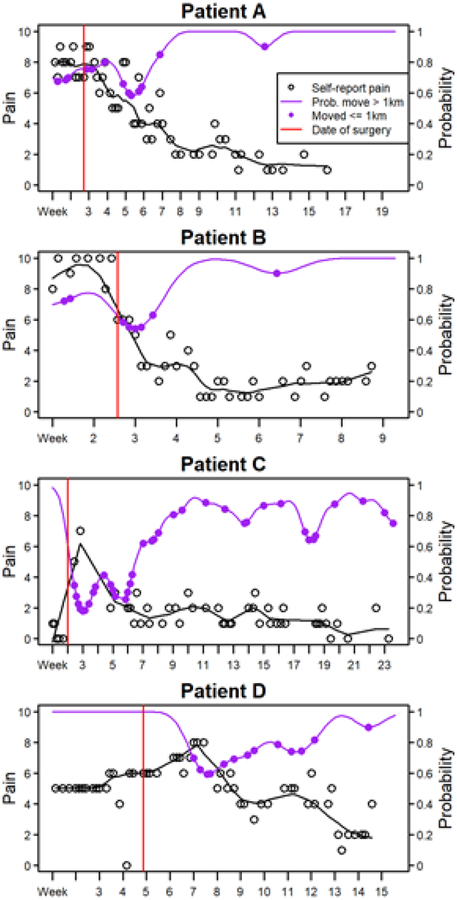
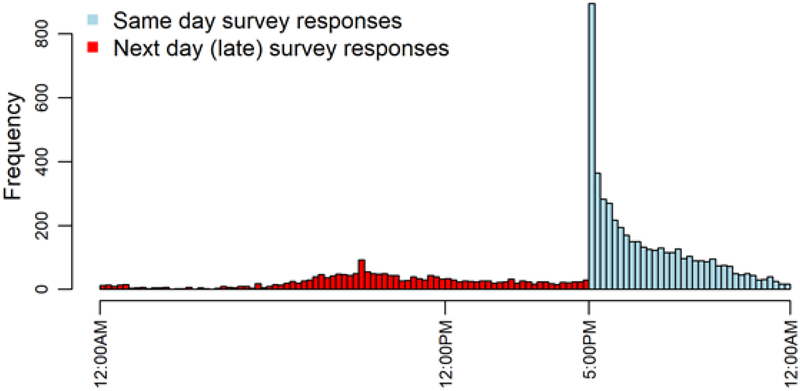
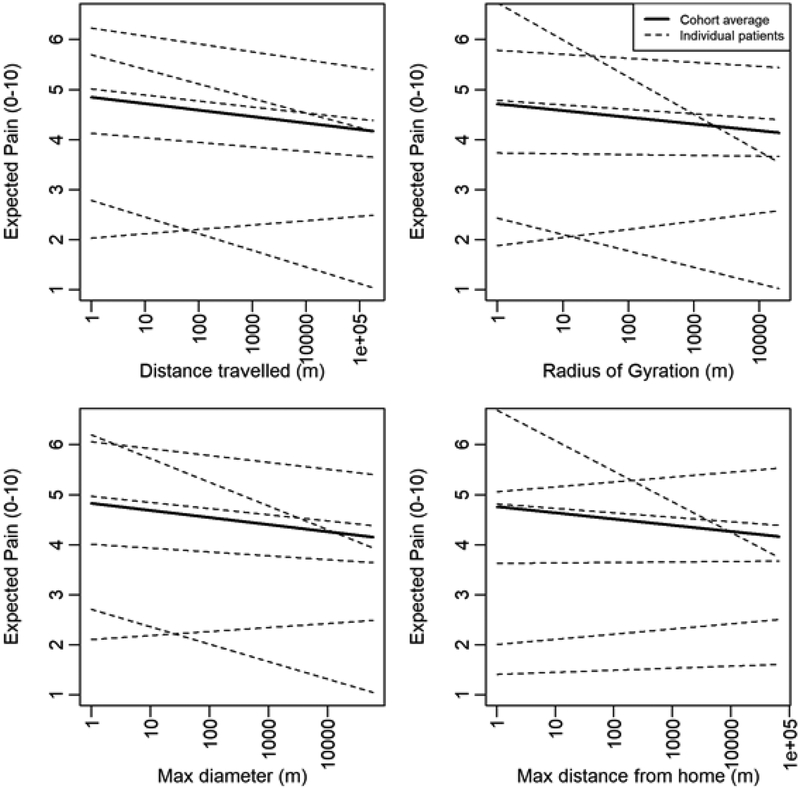
A total of 105 patients were enrolled, with a median follow-up time of 94.5 days; 55 patients underwent a surgical intervention during the follow-up period. The weekly pain survey response rate was 73.2%. By the end of follow-up, the mean change in pain for all patients was -1.3 points (4.96 at the start of follow-up to 3.66 by the end of follow-up). Increased pain was significantly associated with reduced patient mobility as measured using 3 daily GPS summary statistics (i.e., average flight length, maximum diameter travelled, total distance travelled).
Patients with spine disease who reported greater pain had reduced mobility, as measured by the passively collected smartphone GPS data. Smartphone-based digital phenotyping appears to be a promising and scalable approach to assess mobility and quality of life of patients with spine disease.
确定患有临床诊断脊柱疾病的患者队列中移动性和日常疼痛水平的趋势。
从普通神经外科诊所招募患有脊柱疾病的参与者,并在个人智能手机上安装专为数字表型学设计的智能手机应用程序(Beiwe)。该应用程序每分钟收集被动元数据,包括全球定位系统(GPS)、Wi-Fi、加速度计、文本和电话记录以及屏幕开启和关闭时间。该应用程序还进行了每日视觉模拟量表疼痛调查。使用线性混合模型框架测试自我报告的疼痛与被动收集数据中的移动性和社交性之间的关联。
共纳入 105 名患者,中位随访时间为 94.5 天;55 名患者在随访期间接受了手术干预。每周疼痛调查的回复率为 73.2%。随访结束时,所有患者的平均疼痛变化为-1.3 分(随访开始时为 4.96,随访结束时为 3.66)。疼痛增加与患者的移动性显著相关,这是通过 3 项日常 GPS 汇总统计数据(即平均飞行长度、最大直径、总距离)来衡量的。
报告疼痛更大的脊柱疾病患者的移动性降低,这是通过被动收集的智能手机 GPS 数据来衡量的。基于智能手机的数字表型学似乎是一种很有前途且可扩展的方法,可以评估脊柱疾病患者的移动性和生活质量。