School of Dentistry (DODT), Post-Graduate Program in Dentistry (PPGO), Federal University of Santa Catarina (UFSC), Campus Trindade, 88040-900 Florianópolis, SC, Brazil.
Ceramic and Composite Materials Research Group (CERMAT), Federal University of Santa Catarina (UFSC), Campus Trindade, 88040-900, Florianópolis, SC, Brazil.
Mater Sci Eng C Mater Biol Appl. 2019 May;98:1294-1305. doi: 10.1016/j.msec.2019.01.062. Epub 2019 Jan 16.
Zirconia has emerged as a versatile dental material due to its excellent aesthetic outcomes such as color and opacity, unique mechanical properties that can mimic the appearance of natural teeth and decrease peri-implant inflammatory reactions.
The aim of this review was to critically explore the state of art of zirconia surface treatment to enhance the biological and osseointegration behavior of zirconia in implant dentistry.
An electronic search in PubMed database was carried out until May 2018 using the following combination of key words and MeSH terms without time periods: "zirconia surface treatment" or "zirconia surface modification" or "zirconia coating" and "osseointegration" or "biological properties" or "bioactivity" or "functionally graded properties".
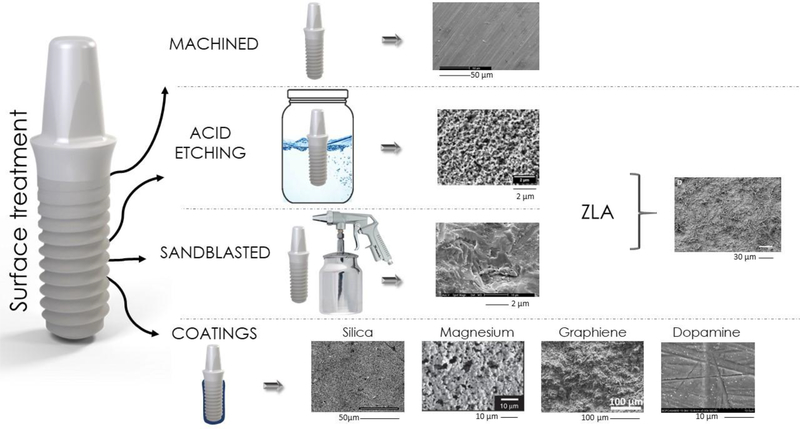
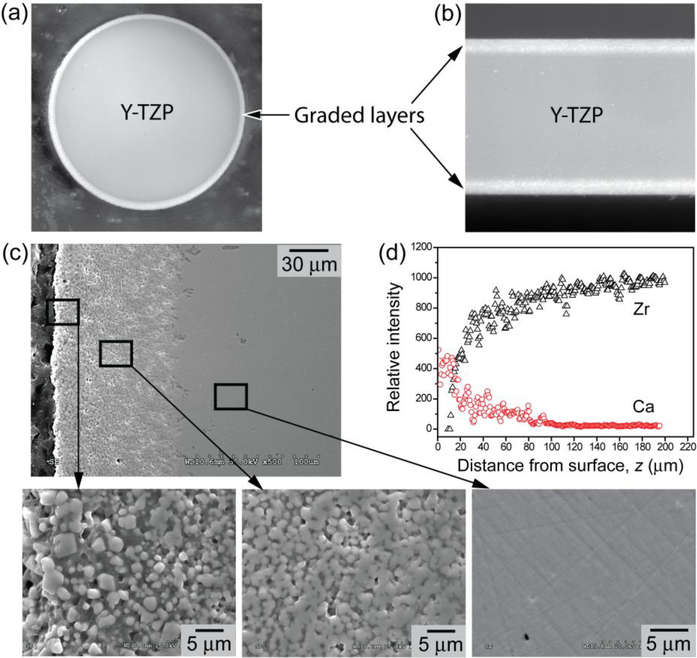
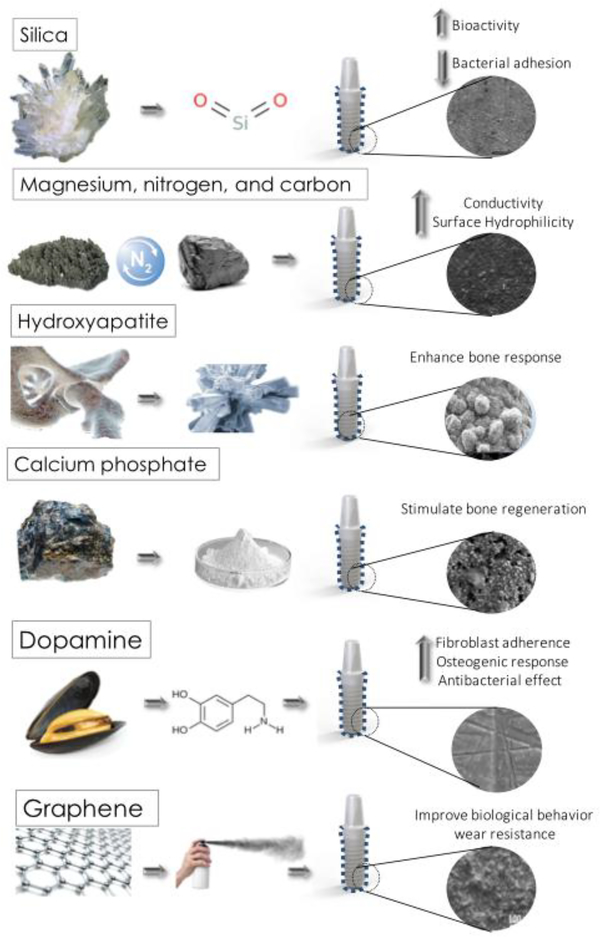
Previous studies have reported the influence of zirconia-based implant surface on the adhesion, proliferation, and differentiation of osteoblast and fibroblasts at the implant to bone interface during the osseointegration process. A large number of physicochemical methods have been used to change the implant surfaces and therefore to improve the early and late bone-to-implant integration, namely: acid etching, gritblasting, laser treatment, UV light, CVD, and PVD. The development of coatings composed of silica, magnesium, graphene, dopamine, and bioactive molecules has been assessed although the development of a functionally graded material for implants has shown encouraging mechanical and biological behavior.
Modified zirconia surfaces clearly demonstrate faster osseointegration than that on untreated surfaces. However, there is no consensus regarding the surface treatment and consequent morphological aspects of the surfaces to enhance osseointegration.
氧化锆因其出色的美学效果(如颜色和不透明度)、独特的机械性能(可模拟天然牙齿的外观并减少种植体周围炎症反应)而成为一种多功能牙科材料。
本综述旨在批判性地探讨氧化锆表面处理技术的最新进展,以增强氧化锆在种植体牙科中的生物和骨整合性能。
在 2018 年 5 月之前,我们在 PubMed 数据库中进行了电子检索,使用了以下无时间限制的关键词和 MeSH 术语组合:“氧化锆表面处理”或“氧化锆表面改性”或“氧化锆涂层”和“骨整合”或“生物学特性”或“生物活性”或“功能梯度特性”。
先前的研究报告了氧化锆基种植体表面对成骨细胞和纤维细胞在骨整合过程中在种植体与骨界面处的黏附、增殖和分化的影响。已经使用了大量物理化学方法来改变种植体表面,从而改善早期和晚期的骨-种植体整合,即:酸蚀、喷砂、激光处理、UV 光、CVD 和 PVD。已经评估了由二氧化硅、镁、石墨烯、多巴胺和生物活性分子组成的涂层的开发,尽管用于植入物的功能梯度材料的开发显示出令人鼓舞的机械和生物学行为。
改性氧化锆表面明显比未处理表面具有更快的骨整合。然而,关于表面处理和增强骨整合的表面形态方面还没有共识。