• 文献检索
  • 文档翻译
  • 深度研究
  • 学术资讯
  • Suppr Zotero 插件Zotero 插件
  • 邀请有礼
  • 套餐&价格
  • 历史记录
应用&插件
Suppr Zotero 插件Zotero 插件浏览器插件Mac 客户端Windows 客户端微信小程序
定价
高级版会员购买积分包购买API积分包
服务
文献检索文档翻译深度研究API 文档MCP 服务
关于我们
关于 Suppr公司介绍联系我们用户协议隐私条款
关注我们

Suppr 超能文献

核心技术专利:CN118964589B侵权必究
粤ICP备2023148730 号-1Suppr @ 2026

文献检索

告别复杂PubMed语法,用中文像聊天一样搜索,搜遍4000万医学文献。AI智能推荐,让科研检索更轻松。

立即免费搜索

文件翻译

保留排版,准确专业,支持PDF/Word/PPT等文件格式,支持 12+语言互译。

免费翻译文档

深度研究

AI帮你快速写综述,25分钟生成高质量综述,智能提取关键信息,辅助科研写作。

立即免费体验

能量密度的增加和减少都会导致学龄前儿童在 5 天内持续改变其能量摄入。

Both increases and decreases in energy density lead to sustained changes in preschool children's energy intake over 5 days.

机构信息

Department of Nutritional Sciences, The Pennsylvania State University, University Park, PA, USA.

Department of Nutritional Sciences, The Pennsylvania State University, University Park, PA, USA; Department of Food Science, The Pennsylvania State University, University Park, PA, USA.

出版信息

Physiol Behav. 2019 May 15;204:210-218. doi: 10.1016/j.physbeh.2019.02.042. Epub 2019 Mar 1.

DOI:10.1016/j.physbeh.2019.02.042
PMID:30831180
原文链接:https://pmc.ncbi.nlm.nih.gov/articles/PMC6475467/
Abstract

BACKGROUND AND OBJECTIVE

To investigate preschool children's ability to self-regulate their energy intake, we assessed their response to increases or decreases in dietary energy density (ED) over 5 consecutive days, a period likely long enough for compensatory behavior.

METHODS

Using a crossover design, over 3 periods we served the same 5 daily menus to 49 children aged 3-5 y in their childcare centers. During each 5-day period, 3 main dishes and 1 snack per day were systematically varied in ED, from baseline ED to either higher ED (increased by 20%) or lower ED (decreased by 20%). All of the served items were weighed to determine individual intakes.

RESULTS

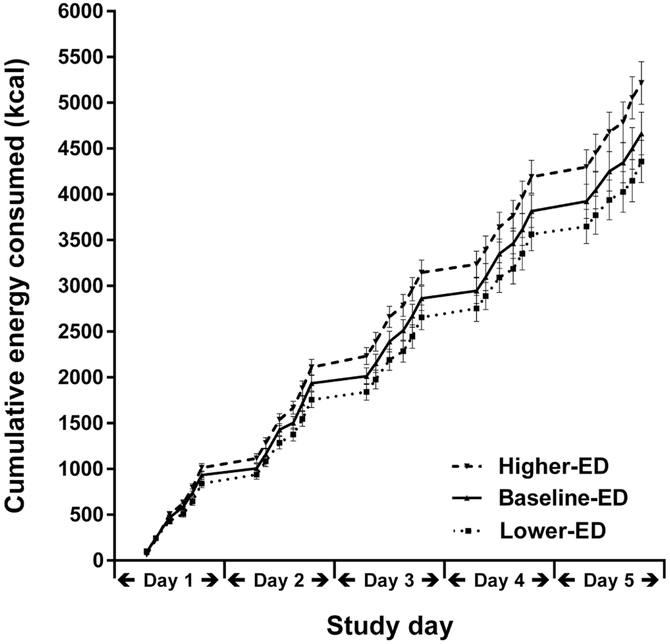
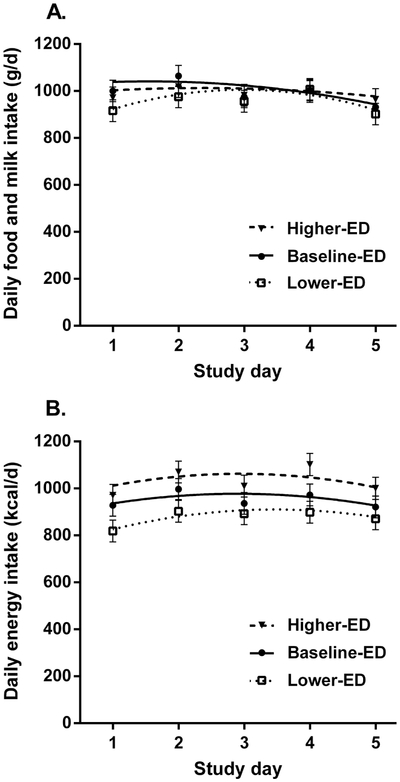
Modifying the ED of 4 dishes per day had a significant and sustained effect on preschool children's daily energy intake across 5 days. In the baseline condition, children's intakes were similar to daily energy needs (98 ± 2%), but serving higher-ED foods increased energy intake by 84 ± 16 kcal/d (to 105 ± 2% of needs) and serving lower-ED foods decreased energy intake by 72 ± 17 kcal/d (to 89 ± 2% of needs; both P < .0001). The patterns of daily energy intake over the 5 days did not differ across conditions (P = .20), thus there was no evidence that either surfeits or deficits in energy intake led to adjustment over this time period. Furthermore, the response to ED varied, as children with a higher weight status had greater amounts of overconsumption when served higher-ED foods and of underconsumption when served lower-ED foods compared to children with a lower weight status.

CONCLUSIONS

These findings counter the suggestion that preschool children's regulatory systems can be relied on to adjust intake in response to energy imbalances. Increasing or decreasing the ED of several foods per day leads to sustained changes in the energy intake of preschool children.

摘要

背景与目的

为了研究学龄前儿童自我调节能量摄入的能力,我们评估了他们在连续 5 天内对膳食能量密度(ED)增加或减少的反应,这一时期可能足够长,足以产生补偿行为。

方法

使用交叉设计,我们在 3 个时期内将相同的 5 种日常菜单提供给他们的儿童保育中心的 49 名 3-5 岁儿童。在每个为期 5 天的期间内,每天的 3 道主菜和 1 道小吃的 ED 系统地从基线 ED 增加到更高 ED(增加 20%)或降低 ED(降低 20%)。所有供应的食物都称重以确定个人摄入量。

结果

每天改变 4 道菜的 ED 对学龄前儿童的每日能量摄入有显著且持续的影响,持续 5 天。在基线条件下,儿童的摄入量与每日能量需求相似(98±2%),但供应高 ED 食物会使能量摄入增加 84±16 kcal/d(达到需求的 105±2%),供应低 ED 食物会使能量摄入减少 72±17 kcal/d(达到需求的 89±2%;均 P<0.0001)。在不同条件下,5 天内的每日能量摄入模式没有差异(P=0.20),因此没有证据表明在这段时间内,能量摄入的过剩或不足会导致调整。此外,ED 的反应因人而异,与体重较低的儿童相比,体重较高的儿童在摄入高 ED 食物时会过度摄入更多的食物,而在摄入低 ED 食物时会摄入更少的食物。

结论

这些发现与认为学龄前儿童的调节系统可以依靠来调节摄入以应对能量失衡的观点相悖。每天增加或减少几种食物的 ED 会导致学龄前儿童的能量摄入持续变化。
https://cdn.ncbi.nlm.nih.gov/pmc/blobs/95d6/6475467/cff2fed89ce3/nihms-1523771-f0002.jpg
https://cdn.ncbi.nlm.nih.gov/pmc/blobs/95d6/6475467/679eae28c40c/nihms-1523771-f0001.jpg
https://cdn.ncbi.nlm.nih.gov/pmc/blobs/95d6/6475467/cff2fed89ce3/nihms-1523771-f0002.jpg
https://cdn.ncbi.nlm.nih.gov/pmc/blobs/95d6/6475467/679eae28c40c/nihms-1523771-f0001.jpg
https://cdn.ncbi.nlm.nih.gov/pmc/blobs/95d6/6475467/cff2fed89ce3/nihms-1523771-f0002.jpg

相似文献

1
Both increases and decreases in energy density lead to sustained changes in preschool children's energy intake over 5 days.能量密度的增加和减少都会导致学龄前儿童在 5 天内持续改变其能量摄入。
Physiol Behav. 2019 May 15;204:210-218. doi: 10.1016/j.physbeh.2019.02.042. Epub 2019 Mar 1.
2
Portion size has sustained effects over 5 days in preschool children: a randomized trial.连续 5 天改变幼儿的食物份量会产生持续影响:一项随机试验。
Am J Clin Nutr. 2019 May 1;109(5):1361-1372. doi: 10.1093/ajcn/nqy383.
3
Reducing the energy density of multiple meals decreases the energy intake of preschool-age children.降低多餐的能量密度可减少学龄前儿童的能量摄入。
Am J Clin Nutr. 2008 Dec;88(6):1459-68. doi: 10.3945/ajcn.2008.26522.
4
Double trouble: Portion size and energy density combine to increase preschool children's lunch intake.双重麻烦:食物分量和能量密度共同作用增加了学龄前儿童的午餐摄入量。
Physiol Behav. 2016 Aug 1;162:18-26. doi: 10.1016/j.physbeh.2016.02.019. Epub 2016 Feb 12.
5
Children's Energy Intake Generally Increases in Response to the Energy Density of Meals but Varies with the Amounts and Types of Foods Served.儿童的能量摄入通常会随着膳食的能量密度而增加,但也会因所提供的食物数量和种类而有所不同。
Am J Clin Nutr. 2024 Jan;119(1):185-195. doi: 10.1016/j.ajcnut.2023.10.019. Epub 2023 Oct 27.
6
Food Properties and Individual Characteristics Influence Children's Intake Across Multiple Days of Weighed Assessments in Childcare Programs.食物特性和个体特征影响儿童在多天称重评估中在日托计划中的摄入量。
J Nutr. 2023 May;153(5):1646-1655. doi: 10.1016/j.tjnut.2023.03.025. Epub 2023 Mar 24.
7
Does milk matter: Is children's intake affected by the type or amount of milk served at a meal?牛奶重要吗:儿童的摄入量会受到用餐时所提供牛奶的类型或数量的影响吗?
Appetite. 2016 Oct 1;105:509-18. doi: 10.1016/j.appet.2016.06.022. Epub 2016 Jun 21.
8
Reductions in entrée energy density increase children's vegetable intake and reduce energy intake.降低主餐能量密度可增加儿童蔬菜摄入量并减少能量摄入。
Obesity (Silver Spring). 2008 Jul;16(7):1559-65. doi: 10.1038/oby.2008.257. Epub 2008 May 1.
9
Reducing the energy density of an entrée decreases children's energy intake at lunch.降低主菜的能量密度可减少儿童午餐时的能量摄入量。
J Am Diet Assoc. 2008 Jan;108(1):41-8. doi: 10.1016/j.jada.2007.10.015.
10
External influences on children's self-served portions at meals.儿童用餐时自助部分受到的外部影响。
Int J Obes (Lond). 2013 Jul;37(7):954-60. doi: 10.1038/ijo.2012.216. Epub 2013 Jan 8.

引用本文的文献

1
Effects of apple form on satiety in 4-6 year-old children: possible evidence of sex differences.苹果形状对4至6岁儿童饱腹感的影响:性别差异的可能证据。
Appetite. 2025 Aug 13;216:108269. doi: 10.1016/j.appet.2025.108269.
2
Energy Density and Level of Processing of Packaged Food and Beverages Intended for Consumption by Australian Children.供澳大利亚儿童食用的包装食品和饮料的能量密度及加工水平
Nutrients. 2025 Jul 11;17(14):2293. doi: 10.3390/nu17142293.
3
Association between fruit intake and abdominal adiposity in 1,707 randomly selected U.S. children.

本文引用的文献

1
Combating Excessive Eating: A Role for Four Evidence-Based Remedies.对抗过度进食:四种基于证据的疗法的作用。
Obesity (Silver Spring). 2018 Oct;26 Suppl 3:S18-S24. doi: 10.1002/oby.22280.
2
Behaviour, energy balance, obesity and capitalism.行为、能量平衡、肥胖与资本主义。
Eur J Clin Nutr. 2018 Sep;72(9):1305-1309. doi: 10.1038/s41430-018-0231-x. Epub 2018 Sep 5.
3
Response to Energy Dilution in the Short Term: Evidence of Nutritional Wisdom in Young Children?短期应对能量稀释:幼儿营养智慧的证据?
1707名随机抽取的美国儿童的水果摄入量与腹部肥胖之间的关联。
Front Nutr. 2025 Jun 4;12:1592654. doi: 10.3389/fnut.2025.1592654. eCollection 2025.
4
"The Big Three" properties of food that drive intake.驱动食物摄入的食物“三大”特性。
Physiol Behav. 2025 Oct 1;299:114994. doi: 10.1016/j.physbeh.2025.114994. Epub 2025 Jun 11.
5
Eating Habits and Lifestyle Factors Related to Childhood Obesity Among Children Aged 5-6 Years: Cluster Analysis of Panel Survey Data in Korea.与 5-6 岁儿童肥胖相关的饮食习惯和生活方式因素:韩国面板调查数据的聚类分析。
JMIR Public Health Surveill. 2024 Apr 5;10:e51581. doi: 10.2196/51581.
6
Validation of the Comprehensive Feeding Practices Questionnaire (CFPQ) with Portuguese Caregivers of 2-to-8-Year-Olds.针对2至8岁儿童葡萄牙语照料者的综合喂养行为问卷(CFPQ)的验证
Children (Basel). 2023 Dec 14;10(12):1924. doi: 10.3390/children10121924.
7
Children's Energy Intake Generally Increases in Response to the Energy Density of Meals but Varies with the Amounts and Types of Foods Served.儿童的能量摄入通常会随着膳食的能量密度而增加,但也会因所提供的食物数量和种类而有所不同。
Am J Clin Nutr. 2024 Jan;119(1):185-195. doi: 10.1016/j.ajcnut.2023.10.019. Epub 2023 Oct 27.
8
Food Properties and Individual Characteristics Influence Children's Intake Across Multiple Days of Weighed Assessments in Childcare Programs.食物特性和个体特征影响儿童在多天称重评估中在日托计划中的摄入量。
J Nutr. 2023 May;153(5):1646-1655. doi: 10.1016/j.tjnut.2023.03.025. Epub 2023 Mar 24.
9
Impact of energy density on energy intake in children and adults: a systematic review and meta-analysis of randomized controlled trials.能量密度对儿童和成人能量摄入的影响:一项随机对照试验的系统评价和荟萃分析。
Eur J Nutr. 2023 Apr;62(3):1059-1076. doi: 10.1007/s00394-022-03054-z. Epub 2022 Dec 2.
10
Associations between Emotion Regulation, Feeding Practices, and Preschoolers' Food Consumption.情绪调节、喂养行为与学龄前儿童食物消费的关系。
Nutrients. 2022 Oct 8;14(19):4184. doi: 10.3390/nu14194184.
Nutr Neurosci. 2000;3(5):321-9. doi: 10.1080/1028415X.2000.11747329.
4
Removing energy from a beverage influences later food intake more than the same energy addition.从饮料中去除能量比添加相同的能量对随后的食物摄入影响更大。
Appetite. 2016 Oct 1;105:549-56. doi: 10.1016/j.appet.2016.06.030. Epub 2016 Jun 26.
5
Double trouble: Portion size and energy density combine to increase preschool children's lunch intake.双重麻烦:食物分量和能量密度共同作用增加了学龄前儿童的午餐摄入量。
Physiol Behav. 2016 Aug 1;162:18-26. doi: 10.1016/j.physbeh.2016.02.019. Epub 2016 Feb 12.
6
The Cross-Sectional Association of Energy Intake and Dietary Energy Density with Body Composition of Children in Southwest China.中国西南部儿童能量摄入和膳食能量密度与身体成分的横断面关联
Nutrients. 2015 Jul 3;7(7):5396-412. doi: 10.3390/nu7075228.
7
Usual Dietary Energy Density Distribution Is Positively Associated with Excess Body Weight in Mexican Children.墨西哥儿童的日常饮食能量密度分布与超重呈正相关。
J Nutr. 2015 Jul;145(7):1524-30. doi: 10.3945/jn.114.206359. Epub 2015 Apr 29.
8
Impact of adiposity, age, sex and maternal feeding practices on eating in the absence of hunger and caloric compensation in preschool children.肥胖、年龄、性别及母亲喂养方式对学龄前儿童在不饥饿时进食及热量补偿的影响。
Int J Obes (Lond). 2015 Jun;39(6):925-30. doi: 10.1038/ijo.2015.30. Epub 2015 Mar 17.
9
Individual differences in susceptibility to large portion sizes among obese and normal-weight children.肥胖和正常体重儿童对大份量食物的易感性存在个体差异。
Obesity (Silver Spring). 2015 Apr;23(4):808-14. doi: 10.1002/oby.21014. Epub 2015 Feb 13.
10
Impact of energy density on liking for sweet beverages and caloric-adjustment conditioning in children.能量密度对儿童喜爱甜味饮料和热量调节条件作用的影响。
Am J Clin Nutr. 2014 Oct;100(4):1052-8. doi: 10.3945/ajcn.114.087452. Epub 2014 Aug 13.