Unit IV-Plant Genomics, Institute of Plant Genetics, Leibniz Universität Hannover, Herrenhäuser Str. 2, D-30419, Hannover, Germany.
Department of Food, Environmental and Nutritional Sciences, Università degli Studi di Milano, Via Mangiagalli 25, 20133, Milano, Italy.
Sci Rep. 2019 Mar 4;9(1):3360. doi: 10.1038/s41598-019-40214-4.
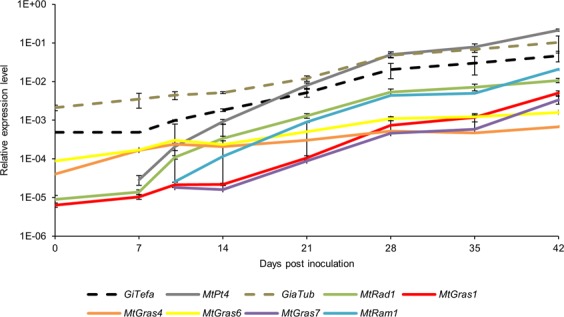
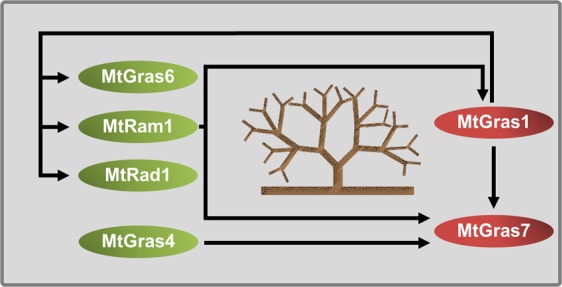
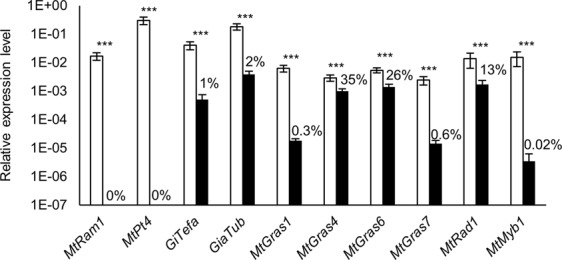
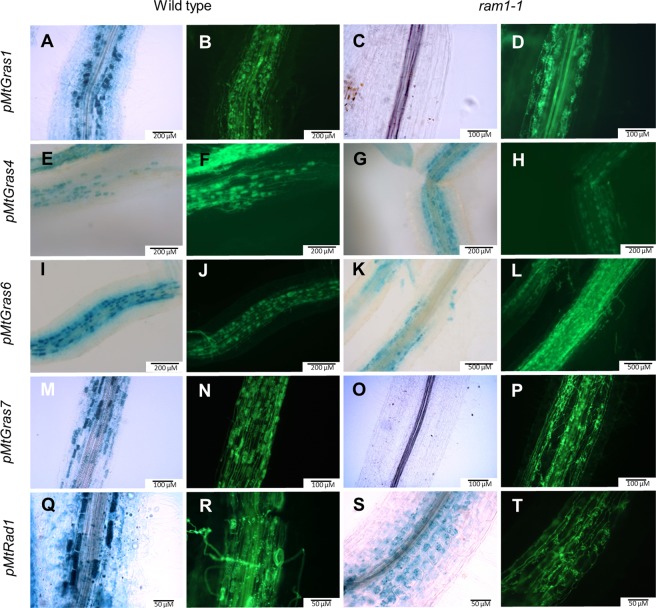
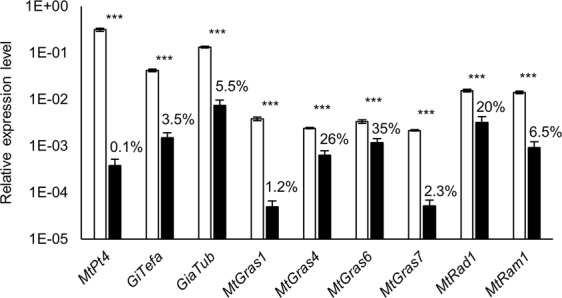
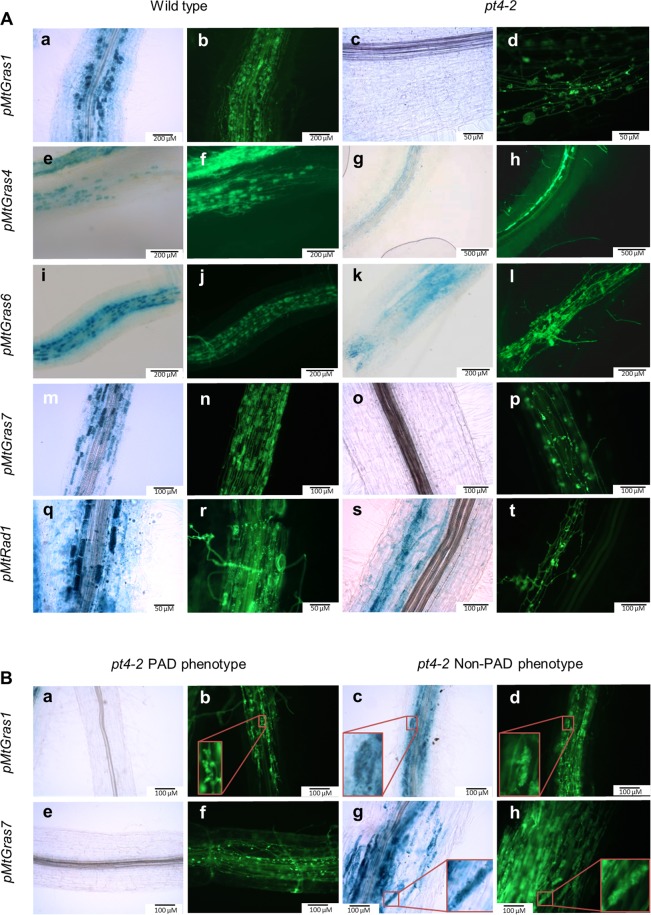
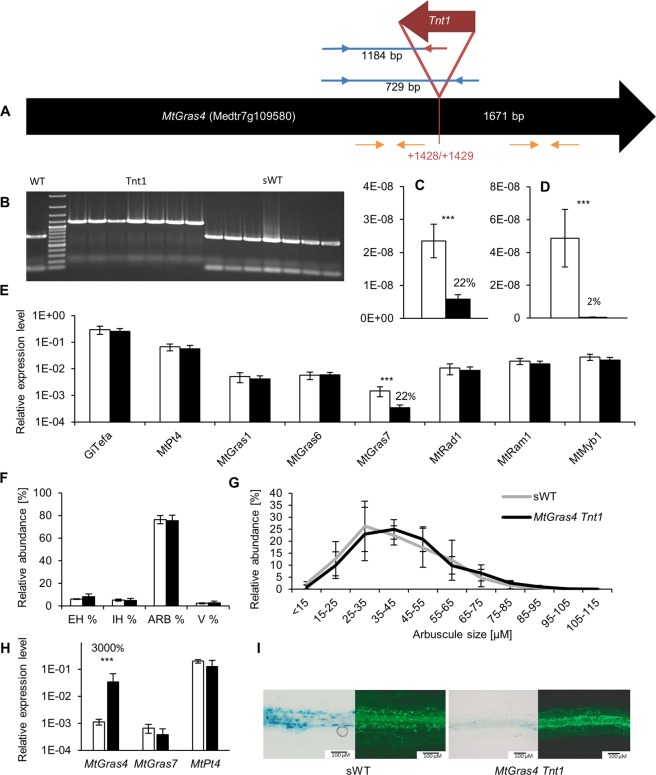
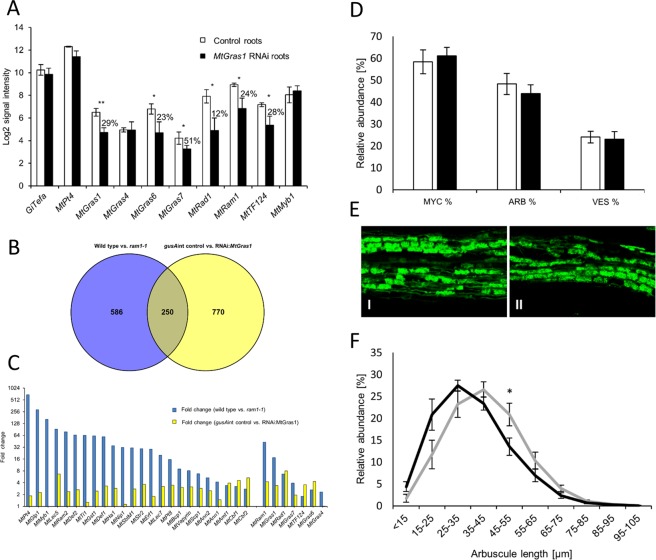
To improve access to limiting nutrients, the vast majority of land plants forms arbuscular mycorrhizal (AM) symbioses with Glomeromycota fungi. We show here that AM-related GRAS transcription factors from different subgroups are upregulated during a time course of mycorrhization. Based on expression studies in mutants defective in arbuscule branching (ram1-1, with a deleted MtRam1 GRAS transcription factor gene) or in the formation of functional arbuscules (pt4-2, mutated in the phosphate transporter gene MtPt4), we demonstrate that the five AM-related GRAS transcription factor genes MtGras1, MtGras4, MtGras6, MtGras7, and MtRad1 can be differentiated by their dependency on MtRAM1 and MtPT4, indicating that the network of AM-related GRAS transcription factors consists of at least two regulatory modules. One module involves the MtRAM1- and MtPT4-independent transcription factor MtGRAS4 that activates MtGras7. Another module is controlled by the MtRAM1- and MtPT4-dependent transcription factor MtGRAS1. Genome-wide expression profiles of mycorrhized MtGras1 knockdown and ram1-1 roots differ substantially, indicating different targets. Although an MtGras1 knockdown reduces transcription of AM-related GRAS transcription factor genes including MtRam1 and MtGras7, MtGras1 overexpression alone is not sufficient to activate MtGras genes. MtGras1 knockdown roots display normal fungal colonization, with a trend towards the formation of smaller arbuscules.
为了改善限制营养物质的获取,绝大多数陆地植物与 Glomeromycota 真菌形成丛枝菌根(AM)共生体。我们在这里展示,不同亚组的与 AM 相关的 GRAS 转录因子在共生体形成的时间过程中被上调。基于在分支菌(ram1-1,其 MtRam1 GRAS 转录因子基因缺失)或功能性菌根(pt4-2,磷酸盐转运蛋白基因 MtPt4 突变)缺陷突变体中的表达研究,我们证明了五个与 AM 相关的 GRAS 转录因子基因 MtGras1、MtGras4、MtGras6、MtGras7 和 MtRad1 可以通过它们对 MtRAM1 和 MtPT4 的依赖性来区分,表明与 AM 相关的 GRAS 转录因子网络至少由两个调节模块组成。一个模块涉及 MtRAM1 和 MtPT4 不依赖的转录因子 MtGras4,它激活 MtGras7。另一个模块由 MtRAM1 和 MtPT4 依赖的转录因子 MtGras1 控制。共生体 MtGras1 敲低和 ram1-1 根的全基因组表达谱有很大差异,表明有不同的靶点。尽管 MtGras1 敲低降低了包括 MtRam1 和 MtGras7 在内的 AM 相关 GRAS 转录因子基因的转录,但 MtGras1 过表达本身不足以激活 MtGras 基因。MtGras1 敲低根显示正常的真菌定殖,菌根变小的趋势。