Behavioral Genetics Unit, Department of Genetics, King Faisal Specialist Hospital and Research Centre, P.O Box 3354, Riyadh, 11211, Saudi Arabia.
Saudi Human Genome Program, King Abdulaziz City for Science and Technology, P.O Box 6086, Riyadh, 11442, Saudi Arabia.
Sci Rep. 2019 Mar 4;9(1):3344. doi: 10.1038/s41598-019-40102-x.
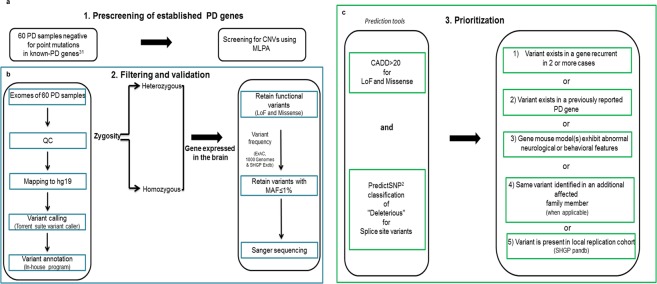
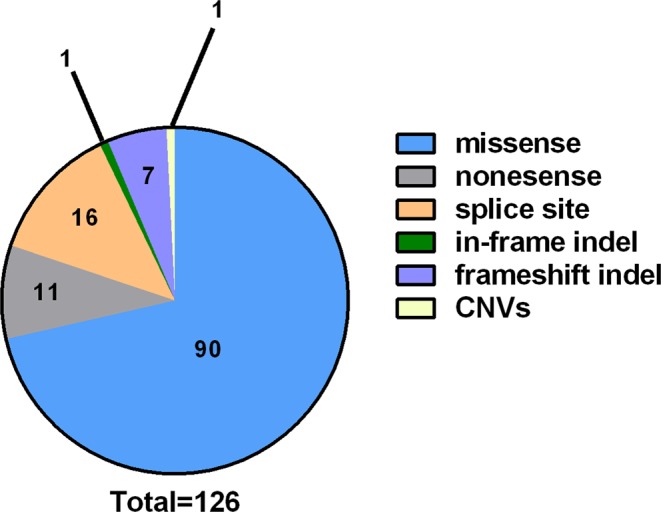
Genetic studies of the familial forms of Parkinson's disease (PD) have identified a number of causative genes with an established role in its pathogenesis. These genes only explain a fraction of the diagnosed cases. The emergence of Next Generation Sequencing (NGS) expanded the scope of rare variants identification in novel PD related genes. In this study we describe whole exome sequencing (WES) genetic findings of 60 PD patients with 125 variants validated in 51 of these cases. We used strict criteria for variant categorization that generated a list of variants in 20 genes. These variants included loss of function and missense changes in 18 genes that were never previously linked to PD (NOTCH4, BCOR, ITM2B, HRH4, CELSR1, SNAP91, FAM174A, BSN, SPG7, MAGI2, HEPHL1, EPRS, PUM1, CLSTN1, PLCB3, CLSTN3, DNAJB9 and NEFH) and 2 genes that were previously associated with PD (EIF4G1 and ATP13A2). These genes either play a critical role in neuronal function and/or have mouse models with disease related phenotypes. We highlight NOTCH4 as an interesting candidate in which we identified a deleterious truncating and a splice variant in 2 patients. Our combined molecular approach provides a comprehensive strategy applicable for complex genetic disorders.
对家族性帕金森病(PD)的遗传研究已经确定了一些在发病机制中具有明确作用的致病基因。这些基因只能解释已诊断病例的一小部分。下一代测序(NGS)的出现扩大了在新型 PD 相关基因中鉴定罕见变异的范围。在这项研究中,我们描述了 60 名 PD 患者的外显子组测序(WES)遗传发现,其中 125 个变体在其中 51 个病例中得到了验证。我们使用了严格的分类标准,对 20 个基因中的变体进行了分类。这些变体包括从未与 PD 相关的 18 个基因的功能丧失和错义变化(NOTCH4、BCOR、ITM2B、HRH4、CELSR1、SNAP91、FAM174A、BSN、SPG7、 MAGI2、HEPHL1、EPRS、PUM1、CLSTN1、PLCB3、CLSTN3、DNAJB9 和 NEFH)和 2 个先前与 PD 相关的基因(EIF4G1 和 ATP13A2)。这些基因要么在神经元功能中发挥关键作用,要么在具有疾病相关表型的小鼠模型中。我们强调 NOTCH4 是一个有趣的候选基因,我们在 2 名患者中发现了一个有害的截断和剪接变体。我们的综合分子方法提供了一种适用于复杂遗传疾病的综合策略。