Laboratorio de Integral de Investigación de Alimentos, Tecnológico Nacional de México/Instituto Tecnológico de Tepic, Av. Tecnológico 2595, Lagos del Country, Tepic 63175, Mexico.
Tecnológico Nacional de México/Instituto Tecnológico de Tuxtepec. Depto. de Ingeniería Química y Bioquímica-Maestría en Ciencias en Alimentos, Av. Dr. Víctor Bravo Ahuja S/N. Col. 5 de Mayo, Tuxtepec 68350, Mexico.
Molecules. 2019 Mar 5;24(5):904. doi: 10.3390/molecules24050904.
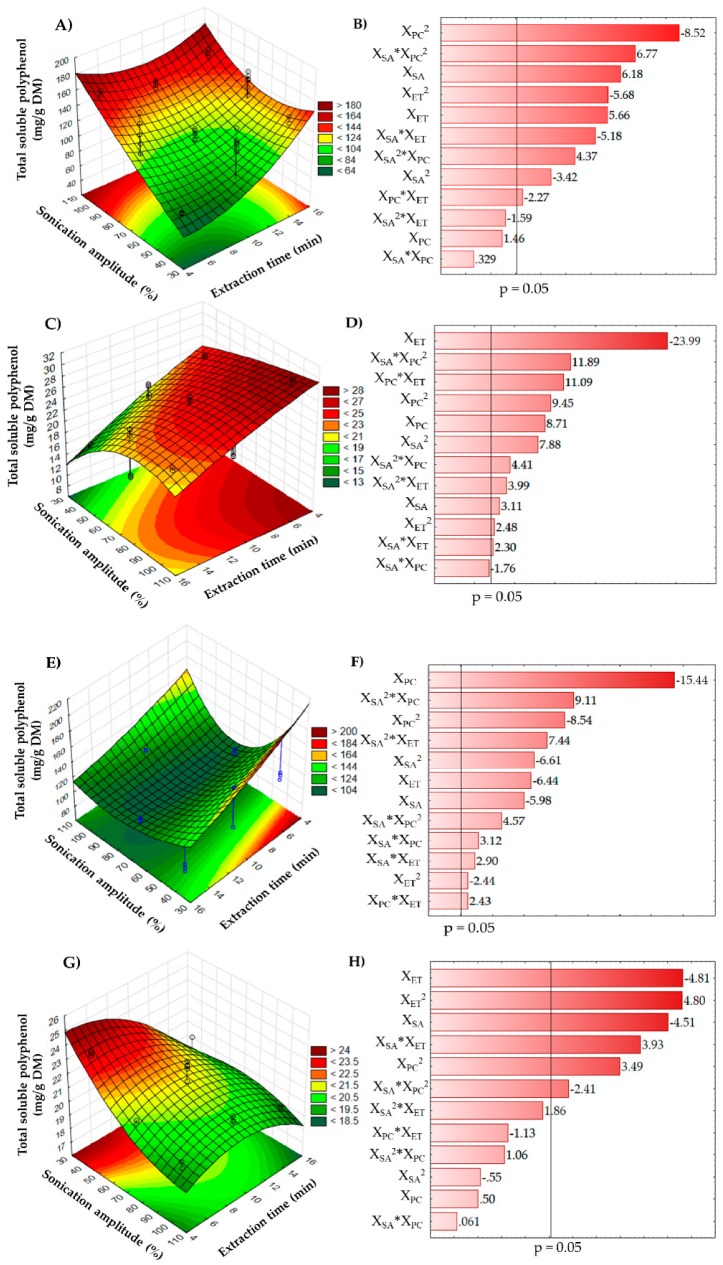
Ultrasound-assisted extraction (UAE) is widely used; however, the efficiency of extraction depends on the raw materials. Therefore, optimization of UAE must be investigated for each type of plant material. By-products from soursop fruit have not been studied as a source of bioactive compounds. In this work, the optimization of UAE conditions (extraction time (5, 10, and 15 min), pulse cycle (0.4, 0.7, and 1 s), and sonication amplitude (40%, 70%, and 100%)) for the extraction of phenolic compounds (soluble, hydrolyzable, condensed tannins, and total polyphenols) from soursop by-products (seed, peel, and columella) and pulp was evaluated using response surface methodology. The optimal conditions for UAE to obtain the highest total polyphenol content from by-products and pulp was dependent on the raw material. Peel resulted in the highest content of total polyphenols (187.32 mg/g dry matter [DM]) followed by columella (164.14 mg/g DM), seed (36.15 mg/g DM), and pulp (33.24 mg/g DM). The yield of polyphenolic content from peel and columella obtained with UAE was higher (32⁻37%) than conventional extraction for 2 h under stirring (14⁻16%). The contents of gallic acid (0.36⁻15.86 µg/g DM), coumaric acid (0.07⁻1.37 µg/g DM), and chlorogenic acid (9.18⁻32.67 µg/g DM) in the different parts of the fruit were higher in the extracts obtained by UAE compared with a conventional extraction method (0.08⁻0.61, 0.05⁻0.08, 3.15⁻13.08 µg/g DM, respectively), although it was dependent on the raw materials. Soursop by-products can be functionally important if they are used to extract bioactive compounds by UAE; a technology with high potential for commercial extraction on a large scale.
超声辅助提取 (UAE) 被广泛应用;然而,提取效率取决于原材料。因此,必须针对每种植物材料优化 UAE。目前尚未研究过神仙果的副产物作为生物活性化合物的来源。在这项工作中,通过响应面法优化了 UAE 条件(提取时间(5、10 和 15 分钟)、脉冲周期(0.4、0.7 和 1 秒)和超声幅度(40%、70%和 100%)),以从神仙果副产物(种子、果皮和果心)和果肉中提取酚类化合物(可溶、可水解、缩合单宁和总多酚)。使用响应面法评估了超声辅助提取从副产物和果肉中获得最高总多酚含量的最佳条件。最佳 UAE 条件取决于原材料,果皮产生的总多酚含量最高(187.32mg/g 干物质[DM]),其次是果心(164.14mg/g DM)、种子(36.15mg/g DM)和果肉(33.24mg/g DM)。与传统搅拌提取 2 小时(14-16%)相比,UAE 从果皮和果心获得的多酚含量的产率更高(32-37%)。通过 UAE 获得的不同水果部分中没食子酸(0.36-15.86μg/g DM)、香豆酸(0.07-1.37μg/g DM)和绿原酸(9.18-32.67μg/g DM)的含量高于传统提取方法(0.08-0.61、0.05-0.08、3.15-13.08μg/g DM),尽管这取决于原材料。如果将神仙果副产物用于通过 UAE 提取生物活性化合物,那么它们可能具有重要的功能;这是一种具有大规模商业提取潜力的技术。