Health services and Research Group, Kenya Medical Research Institute/Wellcome Trust Research Programme, PO Box 43640, Nairobi, 00100, Kenya.
Nuffield Department of Medicine and Department of Paediatrics, University of Oxford, Oxford, United Kingdom.
Hum Resour Health. 2019 Mar 6;17(1):18. doi: 10.1186/s12960-019-0352-x.
Nursing practice is a key driver of quality care and can influence newborn health outcomes where nurses are the primary care givers to this highly dependent group. However, in sub-Saharan Africa, nursing work environments are characterized by heavy workloads, insufficient staffing and regular medical emergencies, which compromise the ability of nurses to provide quality care. Task shifting has been promoted as one strategy for making efficient use of human resources and addressing these issues.
We aimed to understand the nature and practice of neonatal nursing in public hospitals in Nairobi so as to determine what prospect there might be for relieving pressure by shifting nurses' work to others.
This paper is based on an 18-month qualitative study of three newborn units of three public hospitals-all located in Nairobi county-using an ethnographic approach. We draw upon a mix of 32 interviews, over 250 h' observations, field notes and informal conversations. Data were collected from senior nursing experts in newborn nursing, neonatal nurse in-charges, neonatal nurses, nursing students and support staff.
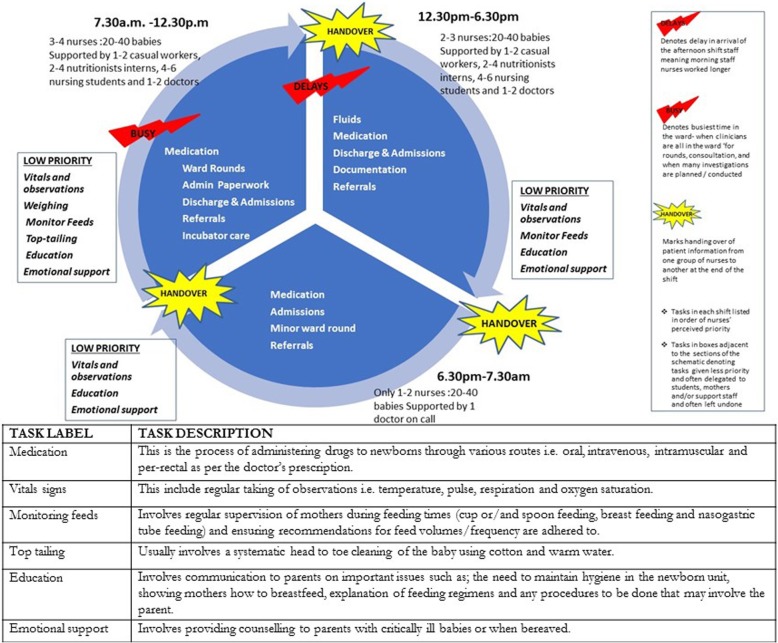
To cope with difficult work conditions characterized by resource challenges and competing priorities, nurses have developed a ritualized schedule and a form of 'subconscious triage'. Informal, organic task shifting was already taking place whereby particular nursing tasks were delegated to students, mothers and support staff, often without any structured supervision. Despite this practice, nurses were agnostic about formal institutionalization of task shifting due to concerns around professional boundaries and the practicality of integrating a new cadre into an already stressed health system.
Our findings revealed a routine template of neonatal nursing work which nurses used to control unpredictability. We found that this model of nursing encouraged delegation of less technical tasks to subordinates, parents and other staff through the process of 'subconscious triage'. The rich insights we gained from this organic form of task shifting can inform more formal task-shifting projects as they seek to identify tasks most easily delegated, and how best to support and work with busy nurses.
护理实践是提供高质量护理的关键驱动力,并且可以影响到新生儿的健康结果,因为护士是这群高度依赖护理的新生儿的主要照护者。然而,在撒哈拉以南非洲,护理工作环境的特点是工作量大、人手不足和经常出现医疗紧急情况,这影响了护士提供高质量护理的能力。任务转移已被推广为一种有效利用人力资源和解决这些问题的策略。
我们旨在了解内罗毕公立医院新生儿护理的性质和实践,以便确定通过将护士的工作转移给其他人来缓解压力的前景。
本文基于对三家公立医院的三个新生儿病房进行的为期 18 个月的定性研究,采用民族志方法。我们借鉴了新生儿护理高级护理专家、新生儿护士长、新生儿护士、护理学生和支持人员的 32 次访谈、250 多小时的观察、实地笔记和非正式对话。
为了应对资源挑战和竞争优先事项所带来的困难工作条件,护士们制定了一种例行的时间表和一种“潜意识分诊”形式。非正式、有机的任务转移已经在进行,即特定的护理任务被分配给学生、母亲和支持人员,通常没有任何结构化的监督。尽管有这种做法,但护士们对正式的任务转移制度化持怀疑态度,因为他们担心专业界限和将新人员纳入已经紧张的卫生系统的实际问题。
我们的研究结果揭示了一种常规的新生儿护理工作模板,护士们用它来控制不可预测性。我们发现,这种护理模式通过“潜意识分诊”过程鼓励将较少技术的任务委托给下属、父母和其他工作人员。我们从这种有机形式的任务转移中获得的丰富见解可以为更正式的任务转移项目提供信息,因为它们试图确定最容易委托的任务,以及如何最好地支持和与忙碌的护士合作。