Biometris, Department for Mathematical and Statistical Methods, Wageningen University, Wageningen, The Netherlands.
PLoS One. 2019 Mar 7;14(3):e0213188. doi: 10.1371/journal.pone.0213188. eCollection 2019.
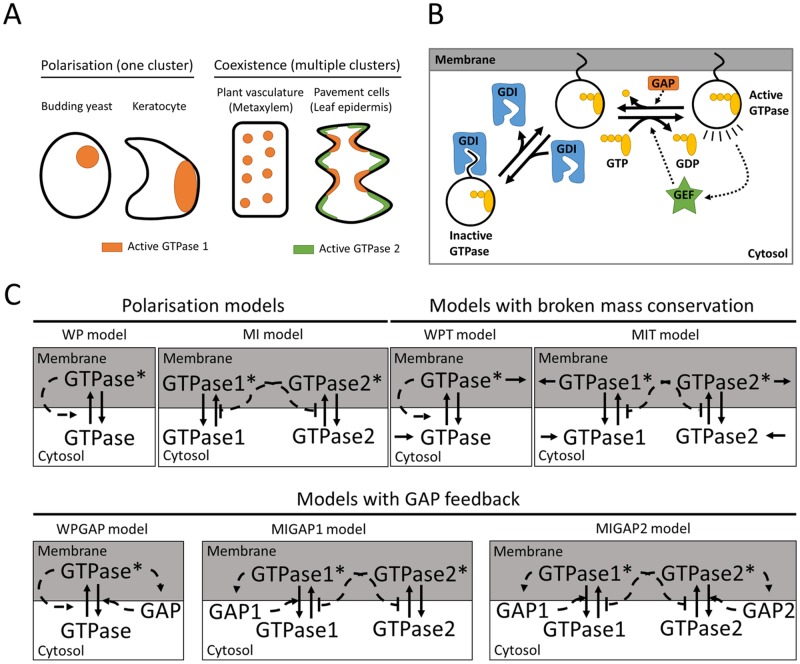
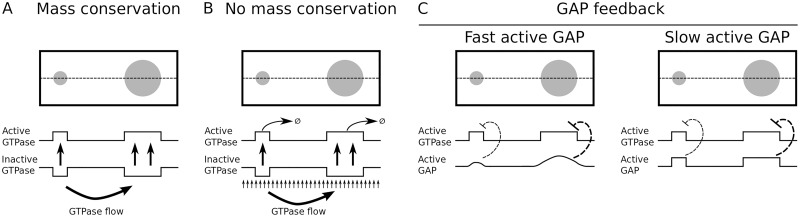
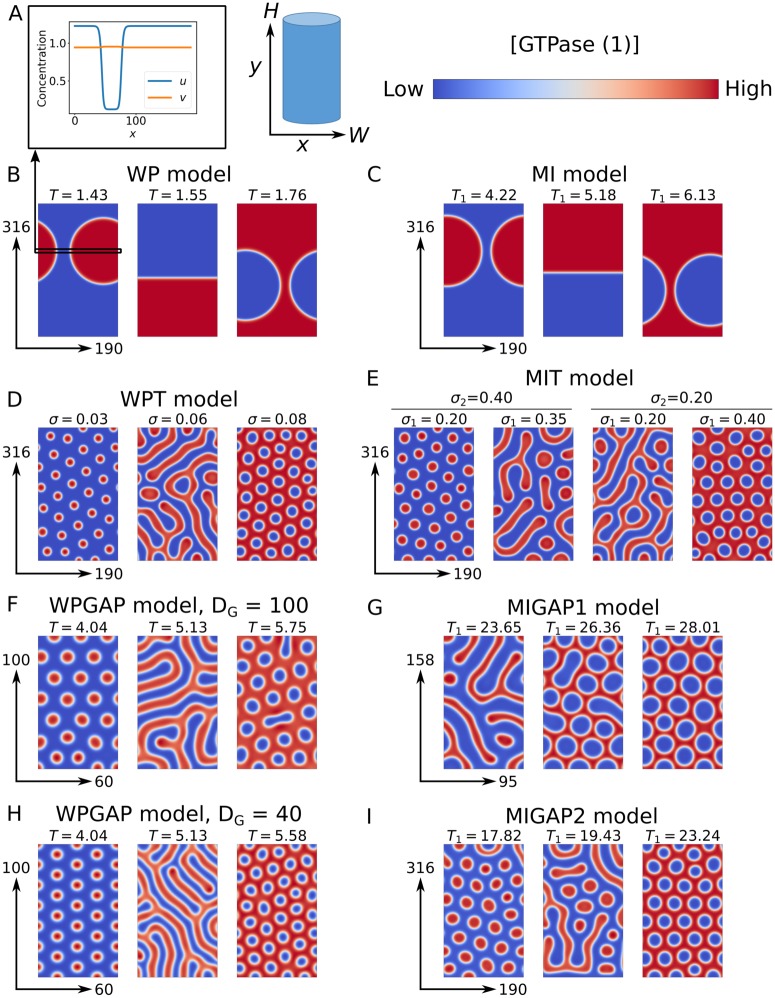
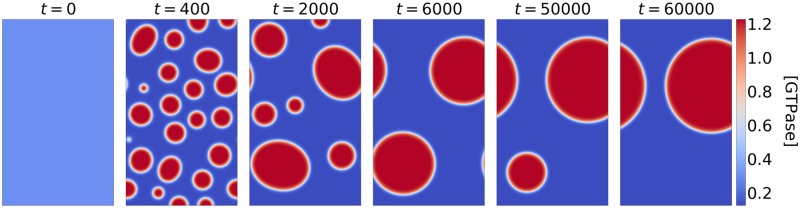
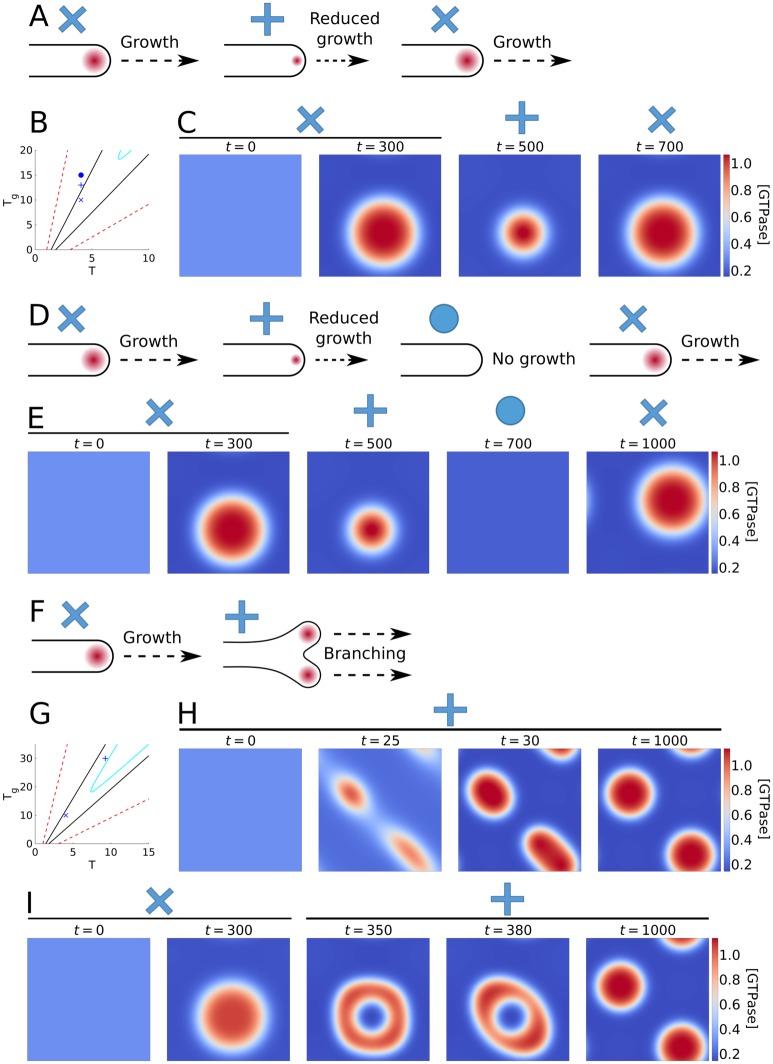
Many biological processes have to occur at specific locations on the cell membrane. These locations are often specified by the localised activity of small GTPase proteins. Some processes require the formation of a single cluster of active GTPase, also called unipolar polarisation (here "polarisation"), whereas others need multiple coexisting clusters. Moreover, sometimes the pattern of GTPase clusters is dynamically regulated after its formation. This raises the question how the same interacting protein components can produce such a rich variety of naturally occurring patterns. Most currently used models for GTPase-based patterning inherently yield polarisation. Such models may at best yield transient coexistence of at most a few clusters, and hence fail to explain several important biological phenomena. These existing models are all based on mass conservation of total GTPase and some form of direct or indirect positive feedback. Here, we show that either of two biologically plausible modifications can yield stable coexistence: including explicit GTPase turnover, i.e., breaking mass conservation, or negative feedback by activation of an inhibitor like a GAP. Since we start from two different polarising models our findings seem independent of the precise self-activation mechanism. By studying the net GTPase flows among clusters, we provide insight into how these mechanisms operate. Our coexistence models also allow for dynamical regulation of the final pattern, which we illustrate with examples of pollen tube growth and the branching of fungal hyphae. Together, these results provide a better understanding of how cells can tune a single system to generate a wide variety of biologically relevant patterns.
许多生物过程必须在细胞膜上的特定位置发生。这些位置通常由小 GTPase 蛋白的局部活性指定。一些过程需要形成一个单一的活性 GTPase 簇,也称为单极极化(此处为“极化”),而其他过程则需要多个共存的簇。此外,有时 GTPase 簇的模式在形成后会被动态调节。这就提出了一个问题,即相同的相互作用蛋白成分如何产生如此丰富的自然发生的模式。目前基于 GTPase 的模式形成的大多数模型本质上都会产生极化。这些模型最多只能产生暂时共存的几个簇,因此无法解释几个重要的生物学现象。这些现有的模型都是基于总 GTPase 的质量守恒和某种形式的直接或间接正反馈。在这里,我们表明两种生物学上合理的修改中的任何一种都可以产生稳定的共存:包括明确的 GTPase 周转,即打破质量守恒,或通过激活 GAP 等抑制剂的负反馈。由于我们从两个不同的极化模型开始,因此我们的发现似乎与精确的自我激活机制无关。通过研究簇之间的净 GTPase 流动,我们深入了解了这些机制的运作方式。我们的共存模型还允许对最终模式进行动态调节,我们用花粉管生长和真菌菌丝分支的例子来说明这一点。总之,这些结果提供了对细胞如何调整单个系统以产生广泛的生物学相关模式的更好理解。