Nossal Institute for Global Health, University of Melbourne, Level 5, 333 Exhibition St, Parkville, 3010, Australia.
The World Bank, 1818 H Street, NW, Washington, DC, 20433, United States of America.
Hum Resour Health. 2019 Mar 7;17(1):19. doi: 10.1186/s12960-019-0351-y.
The 2013-2014 West African Ebola outbreak highlighted how the world's weakest health systems threaten global health security and heralded huge support for their recovery. All three Ebola-affected countries had large shortfalls and maldistribution in their health workforce before the crisis, which were made worse by the epidemic. This paper analyzes the investment plans in Liberia, Sierra Leone, and Guinea to strengthen their health workforces and assesses their potential contribution to the re-establishment and strengthening of their health systems. The analysis calculates the plans' costs and compares those to likely fiscal space, to assess feasibility.
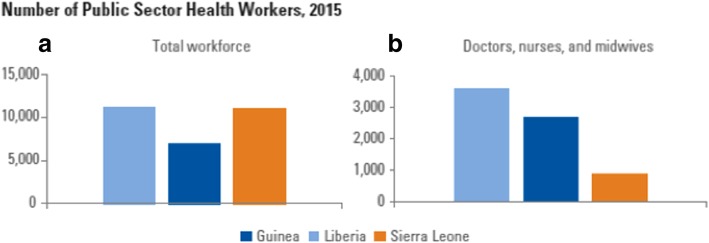
Public sector payroll data from 2015 from each country was used for the workforce analysis and does not include the private sector. Data were coded into the major cadres defined by the International Standard Classification of Occupations (ISCO-88). We estimated health worker training numbers and costs to meet international health worker density targets in the future and used sensitivity analysis to model hypothetical alternate estimates of attrition, drop-outs, and employment rates.
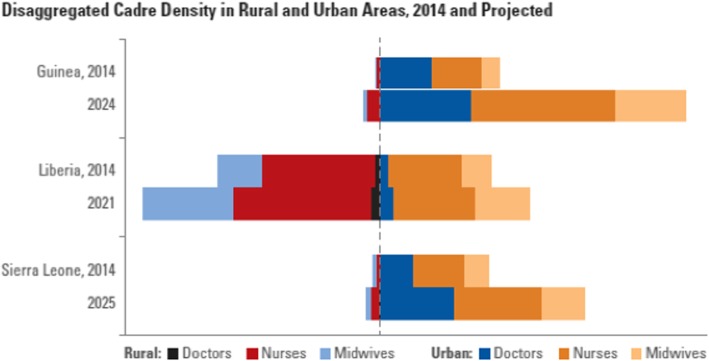
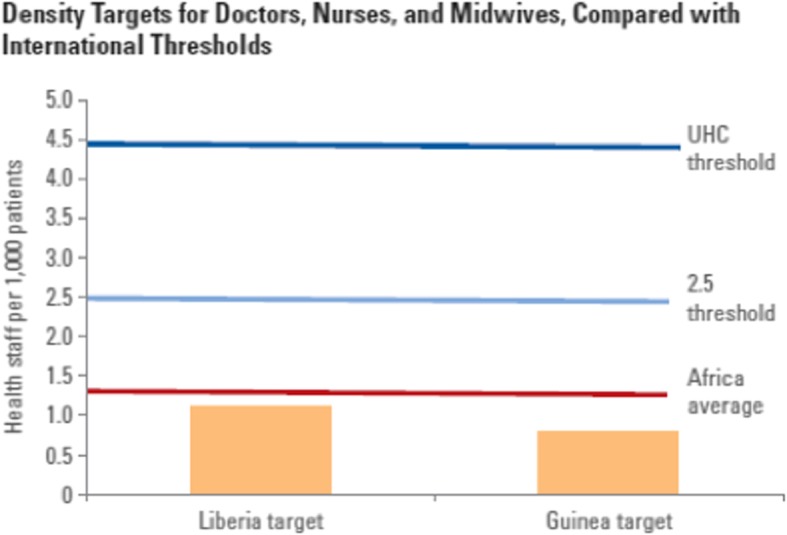
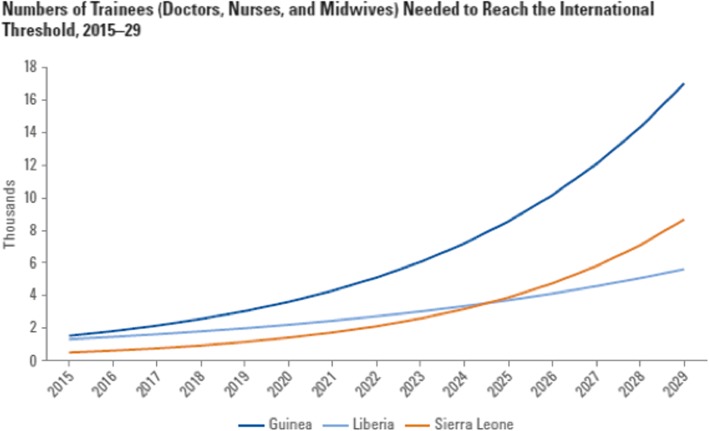
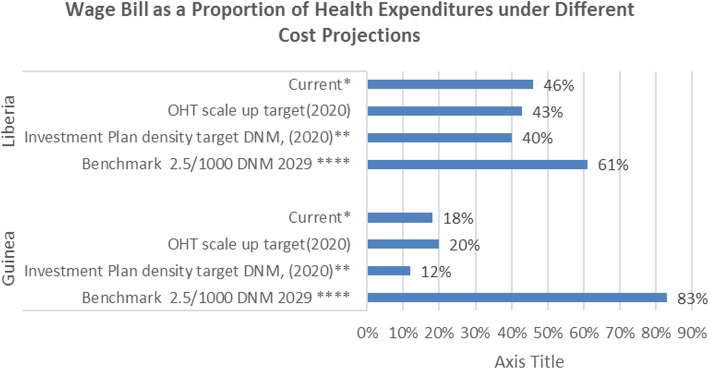
Health worker-to-population density targets per 1000 population for doctors, nurses, and midwives are only specified in Liberia (1.12) and Guinea's (0.78) investment plans and fall far short of the regional average for Africa (1.33) or international benchmarks of 2.5 per 1000 population and 4.45 for universal health coverage. Even these modest targets translate into substantial scaling-up requirements with Liberia having to almost double, Guinea quadruple, and Sierra Leone having to increase its workforce by seven to tenfold to achieve Liberia and Guinea's targets. Costs per capita to meet the 2.5 per 1000 population density targets with 5% attrition, 10% drop-out, and 75% employment rate range from US$4.2 in Guinea to US$7.9 in Liberia in 2029, with projected fiscal space being adequate to accommodate the proposed scaling-up targets in both countries.
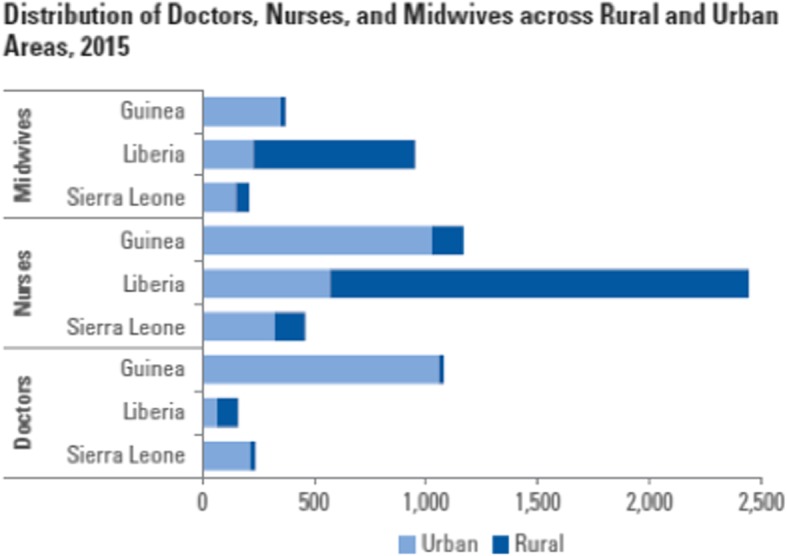
Achieving even a modest scale-up of health workforce will require a steady growth in health budgets, a long-term horizon and substantial scale-up of current training institution capacity. Increasing value-for-money in health workforce investments will require more efficient geographical distribution of the health workforce and more consideration to the mix of cadres to be scaled-up.
2013-2014 年西非埃博拉疫情凸显了全球最薄弱的卫生系统如何威胁全球卫生安全,并为其复苏带来了巨大支持。在疫情爆发之前,所有三个受埃博拉影响的国家的卫生人力都存在大量短缺和分布不均的情况,而疫情使这种情况更加恶化。本文分析了利比里亚、塞拉利昂和几内亚加强其卫生人力的投资计划,并评估了这些计划对重建和加强其卫生系统的潜在贡献。该分析计算了计划的成本,并将其与可能的财政空间进行比较,以评估可行性。
使用每个国家 2015 年的公共部门工资数据进行劳动力分析,不包括私营部门。数据被编码为国际标准职业分类(ISCO-88)定义的主要干部。我们估计了未来满足国际卫生人力密度目标所需的卫生工作者培训人数和成本,并使用敏感性分析对假设的人员更替、辍学和就业率进行了模型化。
医生、护士和助产士每 1000 人口的卫生工作者-人口密度目标仅在利比里亚(1.12)和几内亚的投资计划中规定,远远低于非洲(1.33)的区域平均水平或 2.5 人/1000 人口和 4.45 人/1000 人口的国际基准,以实现全民健康覆盖。即使是这些适度的目标也需要大量的扩大规模要求,利比里亚需要几乎翻一番,几内亚需要翻两番,塞拉利昂需要将其劳动力增加七到十倍,才能实现利比里亚和几内亚的目标。以 5%的人员更替率、10%的辍学率和 75%的就业率实现每 1000 人口 2.5 人/1000 人口密度目标的人均成本,从 2029 年几内亚的 4.2 美元到利比里亚的 7.9 美元不等,两国的预计财政空间足以容纳拟议的扩大规模目标。
即使是适度扩大卫生人力规模也需要卫生预算的稳步增长、长期的视野和当前培训机构能力的大幅扩大。要提高卫生人力投资的性价比,就需要更有效地在地理上分配卫生人力,并更多地考虑要扩大的干部组合。