Nestlé Purina Research, St. Louis, MO.
Immun Inflamm Dis. 2019 Jun;7(2):68-73. doi: 10.1002/iid3.244. Epub 2019 Mar 9.
Fel d1 is the most important allergen from cats. Fel d1 is produced primarily in saliva and spread to the haircoat during grooming and then transferred to the environment via hair and dander.
A novel approach to reducing allergenic Fel d1 exposure was evaluated, involving binding the Fel d1 with an anti-Fel d1 polyclonal egg IgY antibody. The hypothesis was that hair from cats who had been fed foods containing anti-Fel d1 IgY would show a significant reduction in active Fel d1 (aFel d1).
Hair collected from 105 cats completing a 12-week study was evaluated for aFel d1 via ELISA. Hair was collected four times over a 2-week baseline period, then weekly during the 10 week treatment period during which cats consumed a food containing the anti-Fel d1 IgY.
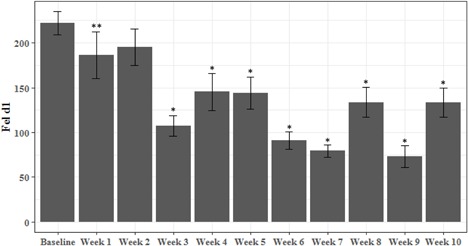
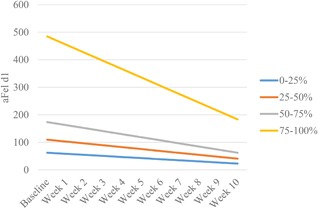
Baseline aFel d1 (μg/g hair) varied greatly among the cats in this study. From week 3, there was a significant reduction in mean aFel d1 with an overall average decrease of 47% by week 10, ranging from a 33-71% decrease vs baseline. Cats with the highest baseline aFel d1 showed the greatest decrease in aFel d1.
CONCLUSIONS & CLINICAL IMPLICATIONS: Feeding anti-Fel d1 IgY to cats successfully reduced aFel d1 on their haircoat with the greatest decreases observed in cats with initially high levels. Feeding a diet with anti Fel d1 IgY significantly reduced the active Fel d1 on the hair of cats.
Fel d1 是猫最重要的过敏原。Fel d1 主要在唾液中产生,并在梳理时散布到毛发上,然后通过毛发和皮屑转移到环境中。
评估了一种减少过敏原 Fel d1 暴露的新方法,涉及用抗 Fel d1 多克隆卵 IgY 抗体结合 Fel d1。假设用含有抗 Fel d1 IgY 的食物喂养的猫的毛发会显示出活性 Fel d1(aFel d1)的显著减少。
通过 ELISA 评估来自完成 12 周研究的 105 只猫的毛发中的 aFel d1。在 2 周的基线期内收集毛发四次,然后在 10 周的治疗期内每周收集一次,在此期间猫食用含有抗 Fel d1 IgY 的食物。
本研究中,猫的基线 aFel d1(μg/g 毛发)差异很大。从第 3 周开始,平均 aFel d1 有显著降低,到第 10 周总体平均降低 47%,范围从 33%至 71%与基线相比。基线 aFel d1 最高的猫显示出 aFel d1 的最大减少。
向猫喂食抗 Fel d1 IgY 成功地减少了其毛发上的 aFel d1,在最初水平较高的猫中观察到的减少最大。用含有抗 Fel d1 IgY 的饮食喂养显著降低了猫毛发上的活性 Fel d1。