School of Electrical and Computer Engineering, Cornell University, Ithaca, New York, 14853, USA.
Institute for Computational Engineering and Sciences, The University of Texas at Austin, Austin, Texas, 78712, USA.
Sci Rep. 2019 Mar 11;9(1):4086. doi: 10.1038/s41598-019-40608-4.
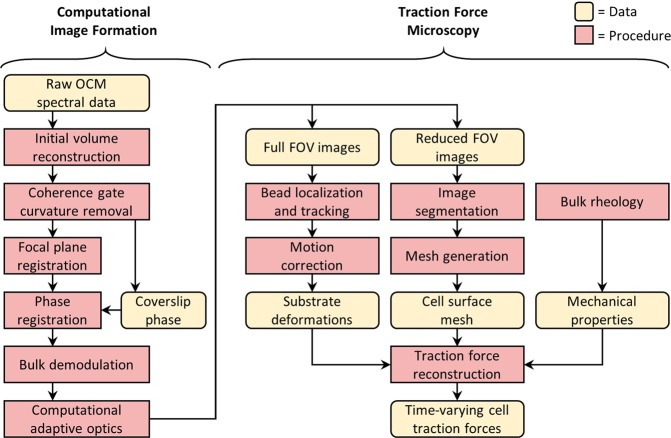
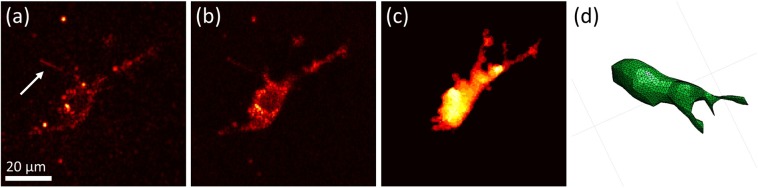
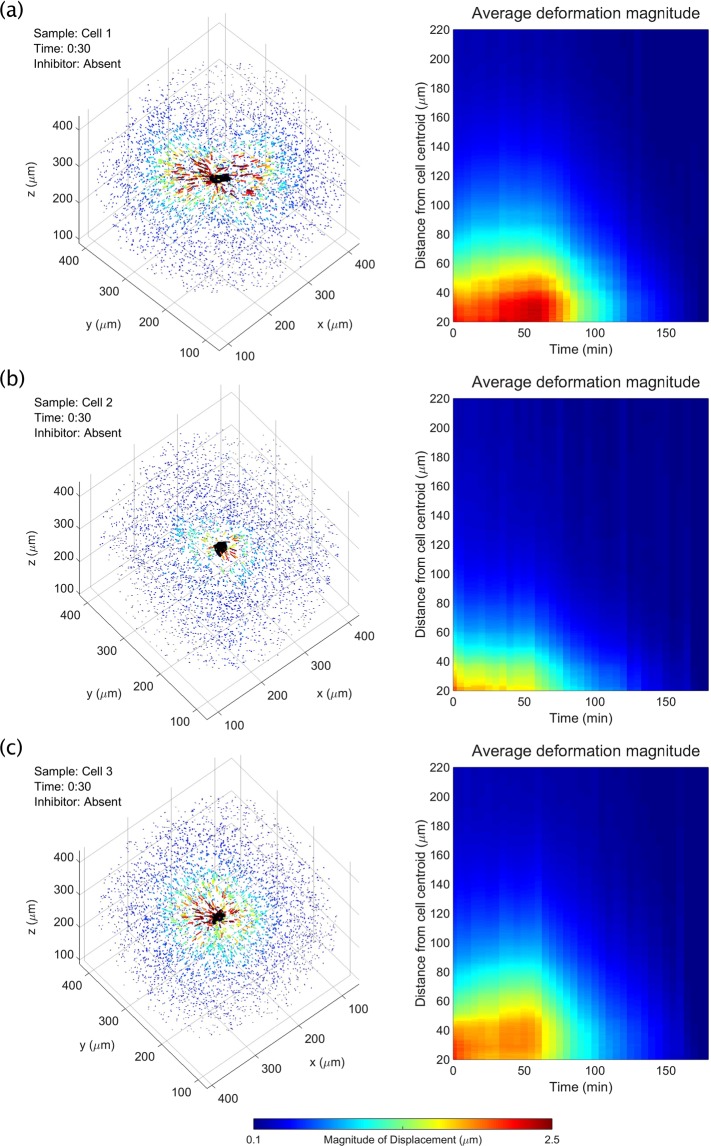
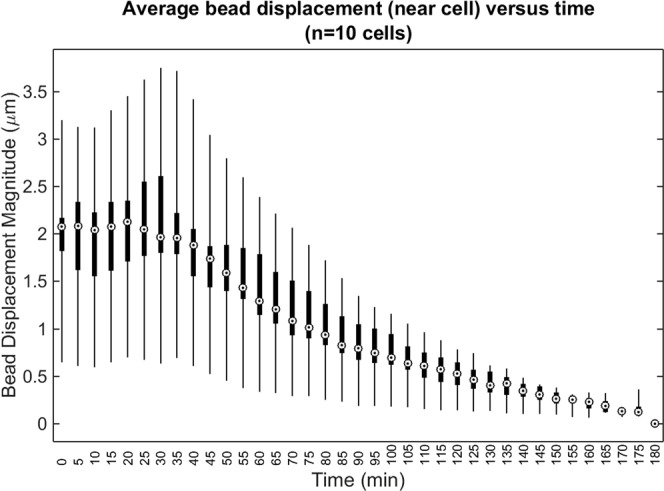
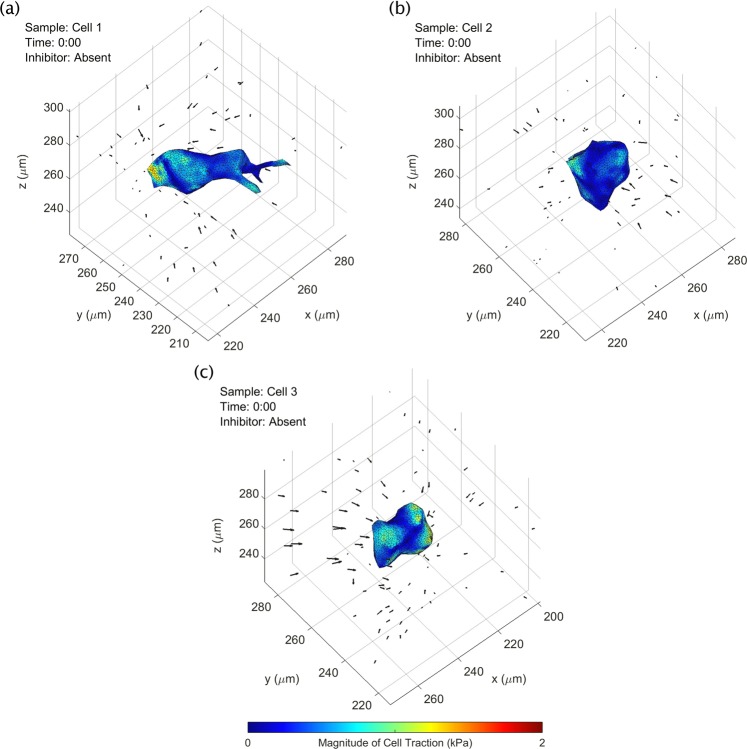
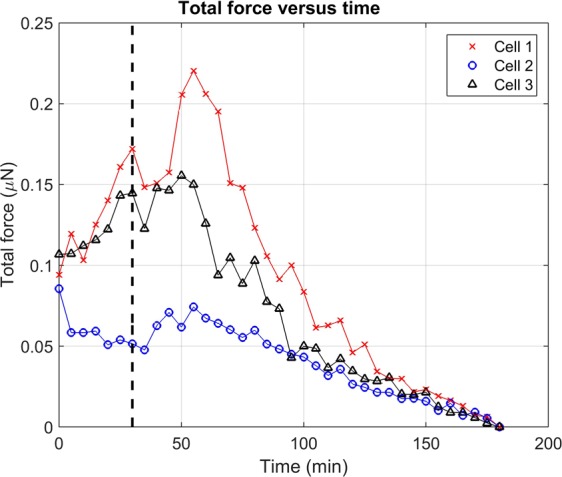
Cellular traction forces (CTFs) play an integral role in both physiological processes and disease, and are a topic of interest in mechanobiology. Traction force microscopy (TFM) is a family of methods used to quantify CTFs in a variety of settings. State-of-the-art 3D TFM methods typically rely on confocal fluorescence microscopy, which can impose limitations on acquisition speed, volumetric coverage, and temporal sampling or coverage. In this report, we present the first quantitative implementation of a new TFM technique: traction force optical coherence microscopy (TF-OCM). TF-OCM leverages the capabilities of optical coherence microscopy and computational adaptive optics (CAO) to enable the quantitative reconstruction of 3D CTFs in scattering media with minute-scale temporal sampling. We applied TF-OCM to quantify CTFs exerted by isolated NIH-3T3 fibroblasts embedded in Matrigel, with five-minute temporal sampling, using images spanning a 500 × 500 × 500 μm field-of-view. Due to the reliance of TF-OCM on computational imaging methods, we have provided extensive discussion of the equations, assumptions, and failure modes of these methods. By providing high-throughput, label-free, volumetric imaging in scattering media, TF-OCM is well-suited to the study of 3D CTF dynamics, and may prove advantageous for the study of large cell collectives, such as the spheroid models prevalent in mechanobiology.
细胞牵引力(CTFs)在生理过程和疾病中都起着重要作用,是机械生物学研究的一个热点。牵引力显微镜(TFM)是一系列用于在各种环境下量化 CTF 的方法。最先进的 3D TFM 方法通常依赖于共聚焦荧光显微镜,这可能会对采集速度、体积覆盖范围以及时间采样或覆盖范围施加限制。在本报告中,我们首次提出了一种新的 TFM 技术:牵引力光相干显微镜(TF-OCM)的定量实现方法。TF-OCM 利用光相干显微镜和计算自适应光学(CAO)的功能,实现了在具有微小时间采样的散射介质中定量重建 3D CTF 的能力。我们应用 TF-OCM 来量化嵌入 Matrigel 中的分离 NIH-3T3 成纤维细胞施加的 CTF,时间采样为五分钟,使用跨越 500×500×500 μm 视场的图像。由于 TF-OCM 依赖于计算成像方法,我们对这些方法的方程、假设和失效模式进行了广泛的讨论。通过在散射介质中提供高通量、无标记、体积成像,TF-OCM 非常适合研究 3D CTF 动力学,并且可能有利于研究大型细胞集合体,例如机械生物学中常见的球体模型。