Department of Materials Science and Engineering, Northwestern University, Evanston, IL 60208, USA.
Center for Bio-Integrated Electronics, Northwestern University, Evanston, IL 60208, USA.
Sci Adv. 2019 Mar 8;5(3):eaaw0873. doi: 10.1126/sciadv.aaw0873. eCollection 2019 Mar.
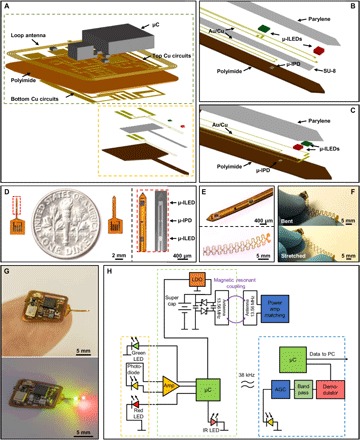
Monitoring regional tissue oxygenation in animal models and potentially in human subjects can yield insights into the underlying mechanisms of local O-mediated physiological processes and provide diagnostic and therapeutic guidance for relevant disease states. Existing technologies for tissue oxygenation assessments involve some combination of disadvantages in requirements for physical tethers, anesthetics, and special apparatus, often with confounding effects on the natural behaviors of test subjects. This work introduces an entirely wireless and fully implantable platform incorporating (i) microscale optoelectronics for continuous sensing of local hemoglobin dynamics and (ii) advanced designs in continuous, wireless power delivery and data output for tether-free operation. These features support in vivo, highly localized tissue oximetry at sites of interest, including deep brain regions of mice, on untethered, awake animal models. The results create many opportunities for studying various O-mediated processes in naturally behaving subjects, with implications in biomedical research and clinical practice.
监测动物模型中的区域组织氧合作用,并且可能在人体受试者中进行监测,可以深入了解局部氧介导的生理过程的潜在机制,并为相关疾病状态提供诊断和治疗指导。现有的组织氧合评估技术在物理系绳、麻醉剂和特殊设备的要求方面存在一些组合的缺点,这些技术往往对测试对象的自然行为产生干扰。这项工作介绍了一种完全无线和完全可植入的平台,该平台结合了 (i) 用于连续感测局部血红蛋白动力学的微尺度光电技术,以及 (ii) 用于无系绳操作的连续、无线功率输送和数据输出的先进设计。这些功能支持在无系绳、清醒的动物模型上,在感兴趣的部位(包括小鼠的深部脑区)进行体内、高度局部的组织血氧计测量。这些结果为在自然行为的研究对象中研究各种氧介导的过程创造了许多机会,这对生物医学研究和临床实践具有重要意义。