Alexander Kenechukwu Nwobodo, Li Man, An Lei, Cui Miaomiao, Wang Cailin, Wang Aili, Chen Yulin, Du Saijun, Feng Chenyao, Zhong Sijin, Gao Yuying, Cao Xueyan, Wang Li, Obinna Ezenwali Moses, Mei Xinyu, Song Yuanjian, Li Zongyun, Qi Dashi
Jiangsu Key Laboratory of Brain Disease Bioinformation, Xuzhou Medical University, Xuzhou, China.
Department of Genetics, Research Center for Neurobiology, Xuzhou Medical University, Xuzhou, China.
Front Genet. 2019 Mar 6;9:651. doi: 10.3389/fgene.2018.00651. eCollection 2018.
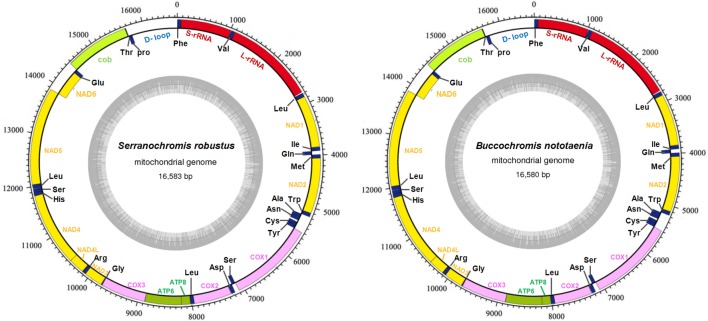
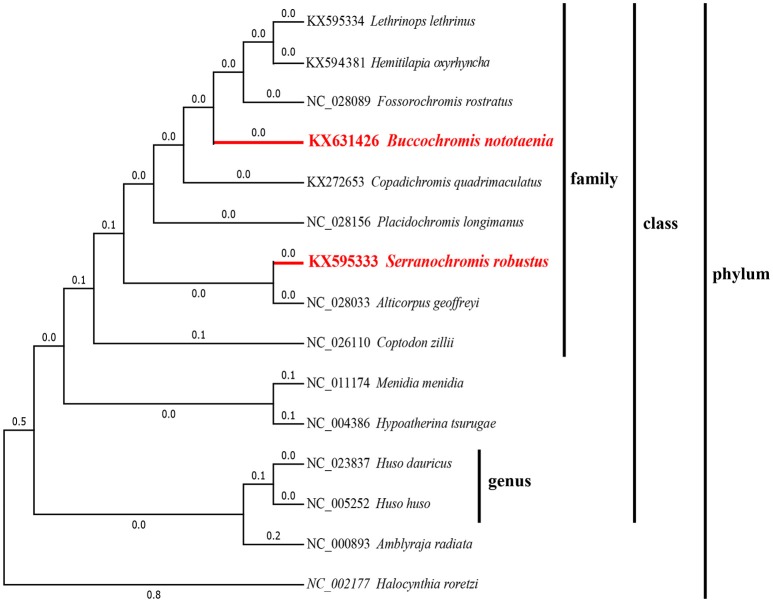
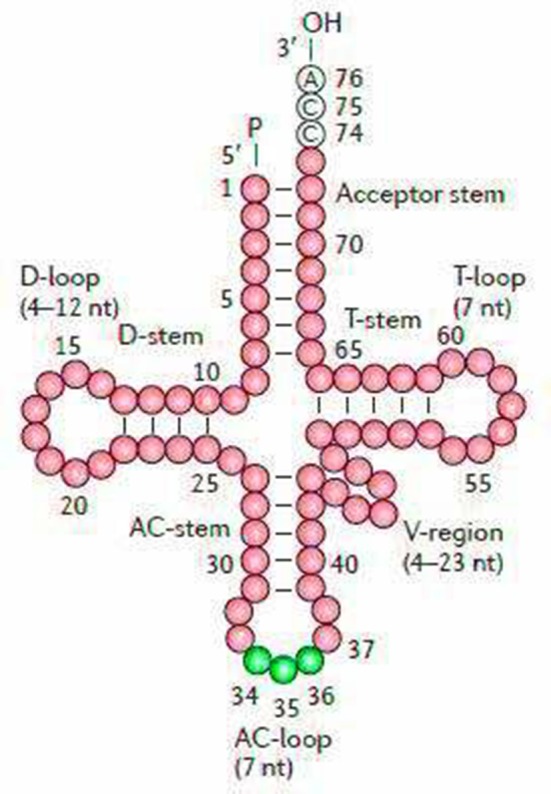
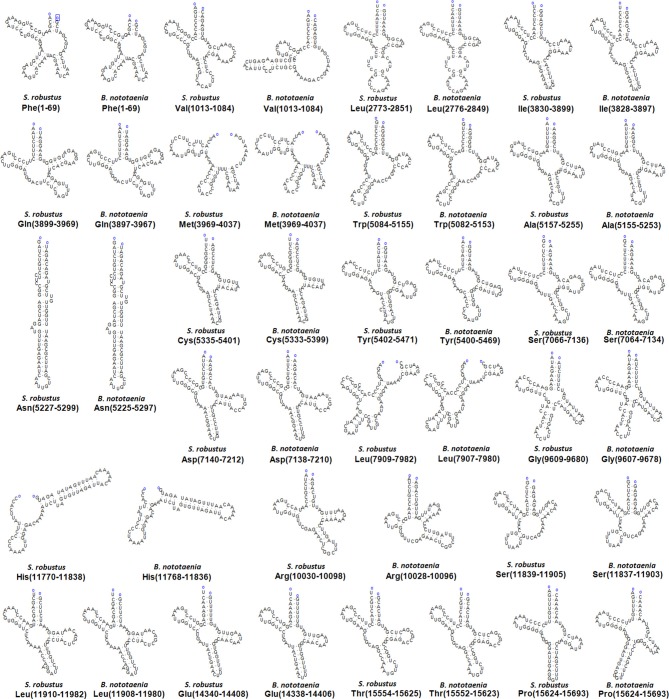
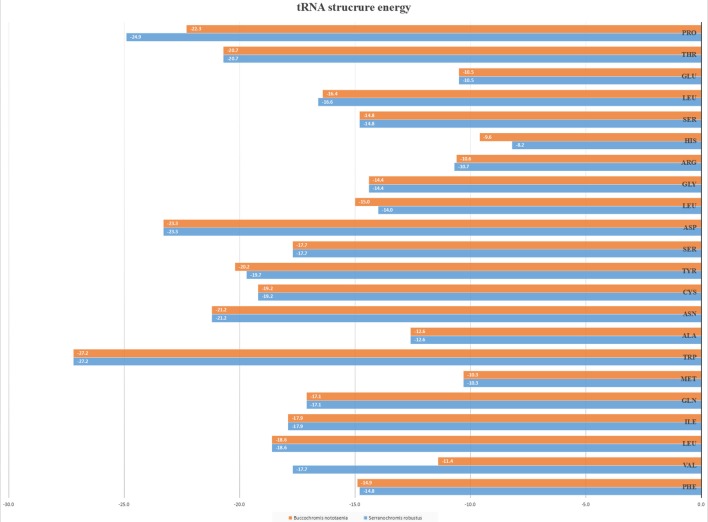
This present research work reports the comparative analysis of the entire nucleotide sequence of mitochondrial genomes of and and phylogenetic analyses of their protein-coding genes in order to establish their phylogenetic relationship within Cichlids. The mitochondrial genomes of and are 16,583 and 16,580 base pairs long, respectively, including 13 protein-coding genes (PCGs), 2 ribosomal RNA genes, 22 transfer RNA genes, and one control region (D-loop) which is 888 and 887 base pairs long, respectively, showing the same gene order and identical number of gene or regions with other well-elucidated mitogenomes of Cichlids. However, with exception of cytochrome-c oxidase subunit-1 () gene, all the identified PCGs were initiated by ATG-codons. Structurally, 11 tRNA genes in species and 9 tRNA genes in species, folded into typical clover-leaf secondary structure created by the regions of self-complementarity within tRNA. All the 22 tRNA genes in both species lack variable loop. Moreover, 28 genes which include 12-protein-coding genes are encoded on the H-strand and the remaining 9 genes including one protein-coding gene are encoded on the L-strand. Thirteen sequences of concatenated mitochondrial protein-coding genes were aligned using MUSCLE, and the phylogenetic analyses performed using maximum likelihood and Bayesian inference showed that and had a broad phylogenetic relationship. These results may be a useful tool in resolving higher-level relationships in organisms and a useful dataset for studying the evolution of the Cichlidae mitochondrial genome, since Cichlids are well-known model species in the study of evolutionary biology, because of their extreme morphological, biogeographical, parental care behavior for eggs and larvae and phylogenetic diversities.
本研究报告了[物种名称1]和[物种名称2]线粒体基因组的全核苷酸序列比较分析及其蛋白质编码基因的系统发育分析,以确定它们在丽鱼科中的系统发育关系。[物种名称1]和[物种名称2]的线粒体基因组长度分别为16,583和16,580个碱基对,包括13个蛋白质编码基因(PCGs)、2个核糖体RNA基因、22个转移RNA基因和一个长度分别为888和887个碱基对的控制区(D环),显示出与其他已充分阐明的丽鱼科有丝分裂基因组相同的基因顺序和相同数量的基因或区域。然而,除了细胞色素c氧化酶亚基-1(COX1)基因外,所有已鉴定的PCGs均由ATG密码子起始。在结构上,[物种名称1]物种中的11个tRNA基因和[物种名称2]物种中的9个tRNA基因折叠成由tRNA内自互补区域形成的典型三叶草叶二级结构。两个物种中的所有22个tRNA基因均缺乏可变环。此外,包括12个蛋白质编码基因的28个基因在重链上编码,其余9个基因包括一个蛋白质编码基因在轻链上编码。使用MUSCLE对13个串联的线粒体蛋白质编码基因序列进行比对,并使用最大似然法和贝叶斯推断进行系统发育分析,结果表明[物种名称1]和[物种名称2]具有广泛的系统发育关系。这些结果可能是解决生物体高级关系的有用工具,也是研究丽鱼科线粒体基因组进化的有用数据集,因为丽鱼科由于其极端的形态、生物地理、对卵和幼体的亲代照顾行为以及系统发育多样性,是进化生物学研究中著名的模式物种。