Jiang Yuanwen, Li Xiaojian, Liu Bing, Yi Jaeseok, Fang Yin, Shi Fengyuan, Gao Xiang, Sudzilovsky Edward, Parameswaran Ramya, Koehler Kelliann, Nair Vishnu, Yue Jiping, Guo KuangHua, Fang Yin, Tsai Hsiu-Ming, Freyermuth George, Wong Raymond C S, Kao Chien-Min, Chen Chin-Tu, Nicholls Alan W, Wu Xiaoyang, Shepherd Gordon M G, Tian Bozhi
Department of Chemistry, University of Chicago, Chicago, IL, USA.
The James Franck Institute, University of Chicago, Chicago, IL, USA.
Nat Biomed Eng. 2018 Jul;2(7):508-521. doi: 10.1038/s41551-018-0230-1. Epub 2018 Apr 30.
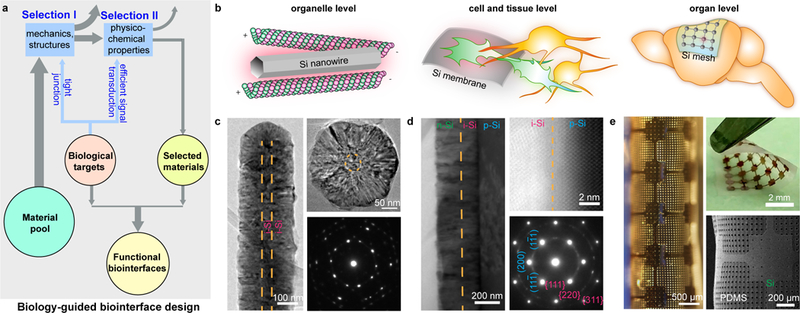
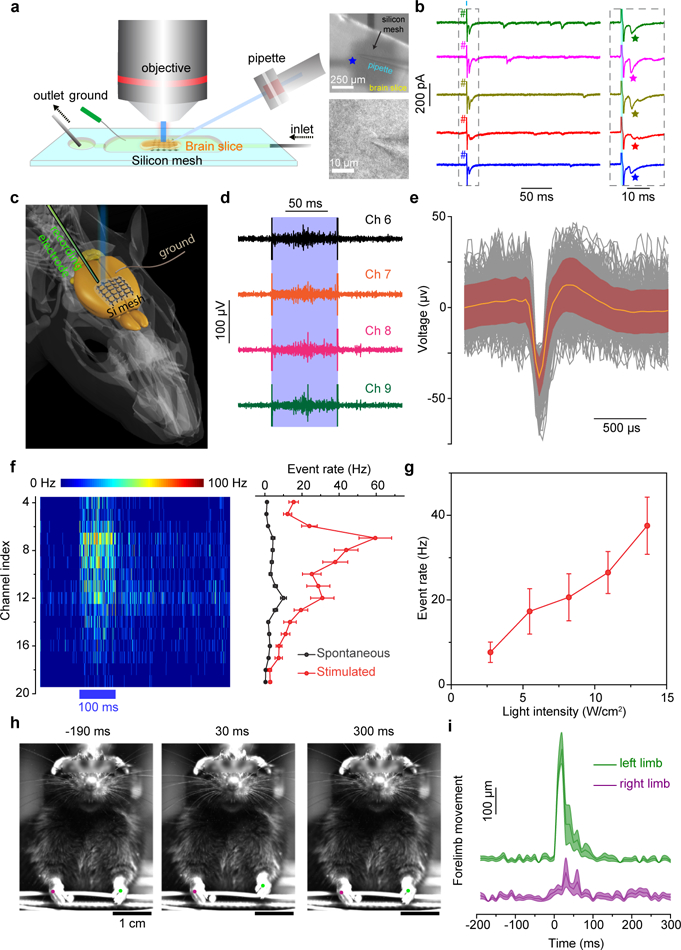
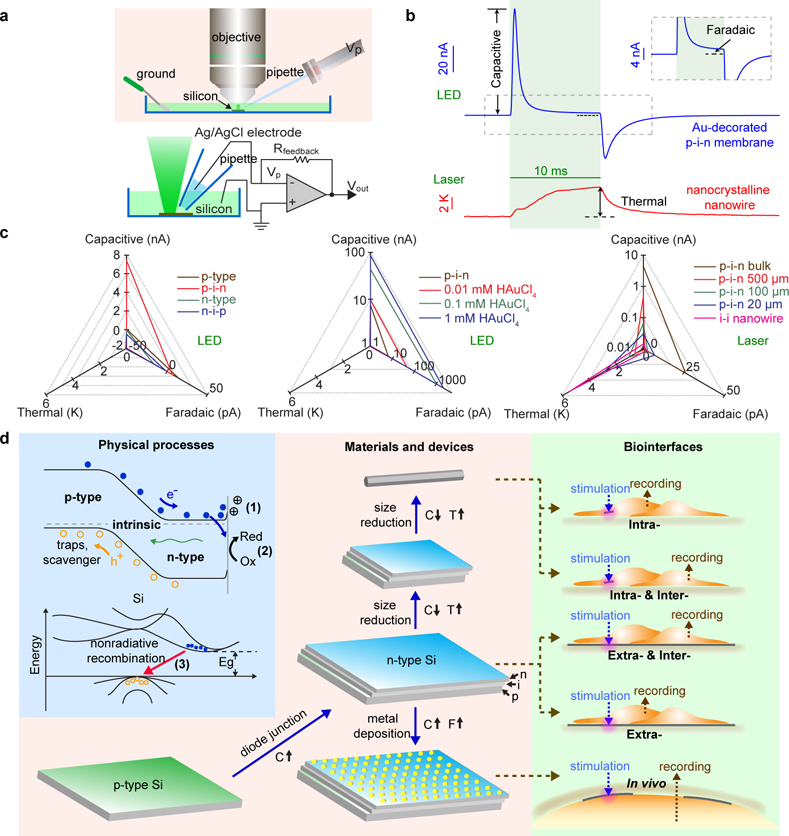
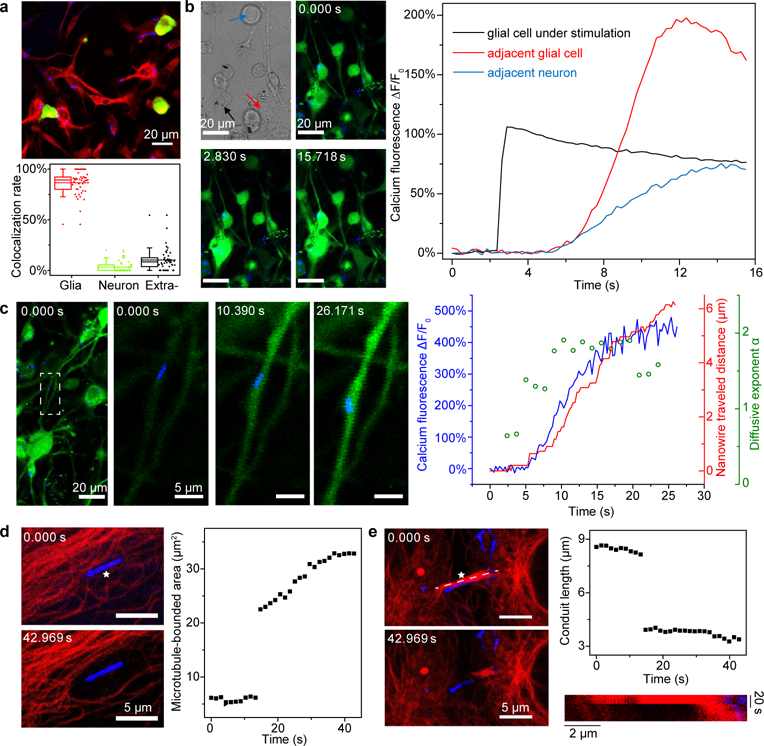
Silicon-based materials have been widely used. However, remotely controlled and interconnect-free silicon configurations have been rarely explored, because of limited fundamental understanding of the complex physicochemical processes that occur at interfaces between silicon and biological materials. Here, we describe rational design principles, guided by biology, for establishing intracellular, intercellular and extracellular silicon-based interfaces, where the silicon and the biological targets have matched properties. We focused on light-induced processes at these interfaces, and developed a set of matrices to quantify and differentiate the capacitive, Faradaic and thermal outputs from about 30 different silicon materials in saline. We show that these interfaces are useful for the light-controlled non-genetic modulation of intracellular calcium dynamics, of cytoskeletal structures and transport, of cellular excitability, of neurotransmitter release from brain slices, and of brain activity in vivo.
硅基材料已被广泛应用。然而,由于对硅与生物材料界面处发生的复杂物理化学过程的基本认识有限,远程控制且无互连的硅配置很少被探索。在此,我们描述了以生物学为指导的合理设计原则,用于建立细胞内、细胞间和细胞外的硅基界面,其中硅和生物靶点具有匹配的特性。我们专注于这些界面处的光诱导过程,并开发了一组矩阵来量化和区分盐溶液中约30种不同硅材料的电容性、法拉第和热输出。我们表明,这些界面可用于对细胞内钙动力学、细胞骨架结构和运输、细胞兴奋性、脑片神经递质释放以及体内脑活动进行光控非基因调控。