Nadeau Phillip, El-Damak Dina, Glettig Dean, Kong Yong Lin, Mo Stacy, Cleveland Cody, Booth Lucas, Roxhed Niclas, Langer Robert, Chandrakasan Anantha P, Traverso Giovanni
Department of Electrical Engineering and Computer Science, and the Microsystems Technology Laboratories, Massachusetts Institute of Technology, Cambridge, Massachusetts 02139, USA.
Department of Chemical Engineering and Koch Institute for Integrative Cancer Research, Massachusetts Institute of Technology, Cambridge, Massachusetts 02139, USA.
Nat Biomed Eng. 2017;1. doi: 10.1038/s41551-016-0022. Epub 2017 Feb 6.
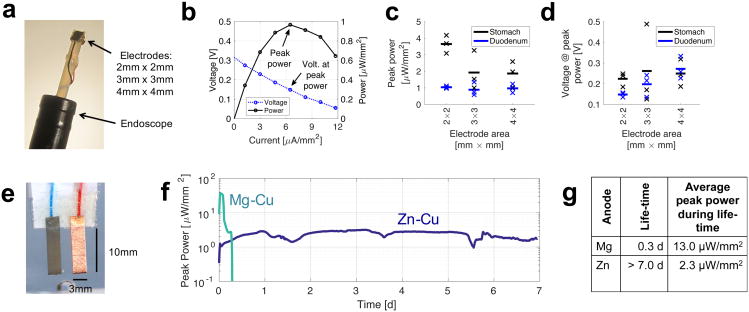
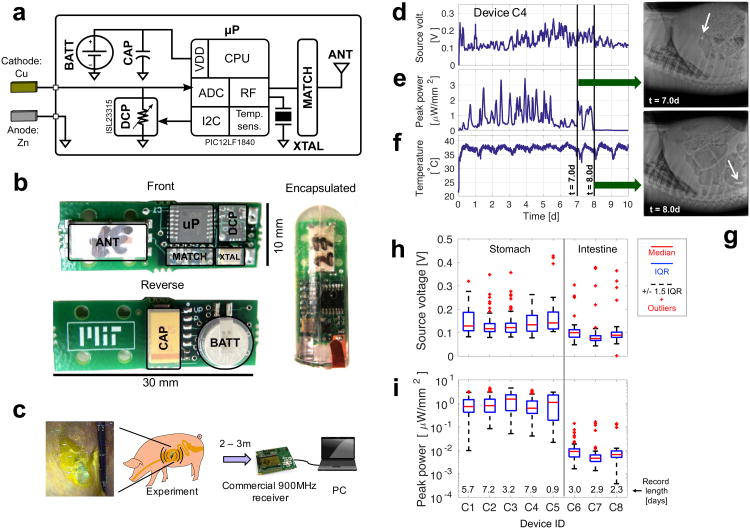
Ingestible electronics have revolutionized the standard of care for a variety of health conditions. Extending the capacity and safety of these devices, and reducing the costs of powering them, could enable broad deployment of prolonged monitoring systems for patients. Although prior biocompatible power harvesting systems for in vivo use have demonstrated short minute-long bursts of power from the stomach, not much is known about the capacity to power electronics in the longer term and throughout the gastrointestinal tract. Here, we report the design and operation of an energy-harvesting galvanic cell for continuous in vivo temperature sensing and wireless communication. The device delivered an average power of 0.23 μW per mm of electrode area for an average of 6.1 days of temperature measurements in the gastrointestinal tract of pigs. This power-harvesting cell has the capacity to provide power for prolonged periods of time to the next generation of ingestible electronic devices located in the gastrointestinal tract.
可摄入式电子设备已经彻底改变了多种健康状况下的护理标准。扩展这些设备的容量和安全性,并降低其供电成本,能够使长期监测系统广泛应用于患者。尽管先前用于体内的生物相容性能量收集系统已证明能从胃部产生短短几分钟的突发电力,但对于长期为整个胃肠道内的电子设备供电的能力,我们所知甚少。在此,我们报告了一种用于连续体内温度传感和无线通信的能量收集原电池的设计与运行情况。该设备在猪的胃肠道内进行平均6.1天的温度测量时,每平方毫米电极面积可提供0.23微瓦的平均功率。这种能量收集电池有能力为位于胃肠道内的下一代可摄入式电子设备长时间供电。