Department of Biology, Baylor University, Waco, TX 76798, USA.
Vedana Vaidhyanathan, Central Libraries Research Engagement, Baylor University, Waco, TX 76798, USA.
Viruses. 2019 Mar 23;11(3):294. doi: 10.3390/v11030294.
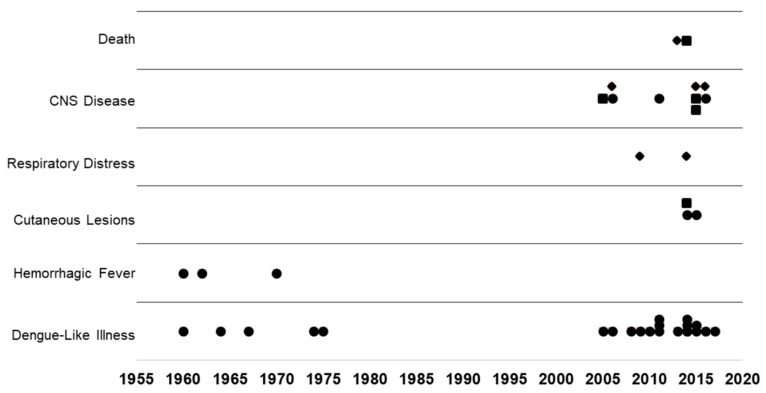
Chikungunya virus (CHIKV) was first extensively described in children during outbreaks in India and South Asia during the mid-1960s. Prior to the 2005 emergence of CHIKV on Reunion Island, CHIKV infection was usually described as a dengue-like illness with arthralgia in Africa and febrile hemorrhagic disease in Asia. Soon after the 2005 emergence, severe CNS consequences from vertical and perinatal transmission were described and as CHIKV continued to emerge in new areas over the next 10 years, severe manifestation of infection and sequelae were increasingly reported in infants and neonates. The following review describes the global reemergence and the syndromes of Chikungunya fever (CHIKF) in infants and children. The various manifestations of CHIKF are described and connected to the viral lineage that was documented in the area at the time the disease was described. The data show that certain manifestations of CHIKF occur with specific viral lineages and genetic motifs, which suggests that severe manifestations of CHIKF in the very young may be associated with the emergence of new viral lineages.
基孔肯雅热病毒(CHIKV)于 20 世纪 60 年代中期在印度和南亚的疫情中首次被广泛描述为儿童中爆发的疾病。在 2005 年留尼汪岛出现 CHIKV 之前,CHIKV 感染通常被描述为在非洲类似于登革热的疾病,在亚洲为发热性出血性疾病。在 2005 年出现后不久,就描述了垂直和围产期传播引起的严重中枢神经系统后果,随着 CHIKV 在接下来的 10 年中不断出现在新的地区,越来越多的报告表明在婴儿和新生儿中出现了严重的感染和后遗症。以下综述描述了基孔肯雅热(CHIKF)在婴儿和儿童中的全球再流行和综合征。描述了 CHIKF 的各种表现,并将其与在描述疾病时记录的该地区的病毒谱系联系起来。数据表明,CHIKF 的某些表现与特定的病毒谱系和遗传基序有关,这表明非常年幼的儿童中 CHIKF 的严重表现可能与新病毒谱系的出现有关。