INRA, Virologie et Immunologie Moléculaires, Université Paris-Saclay, 78352 Jouy-en-Josas, France.
Viruses. 2019 Mar 26;11(3):302. doi: 10.3390/v11030302.
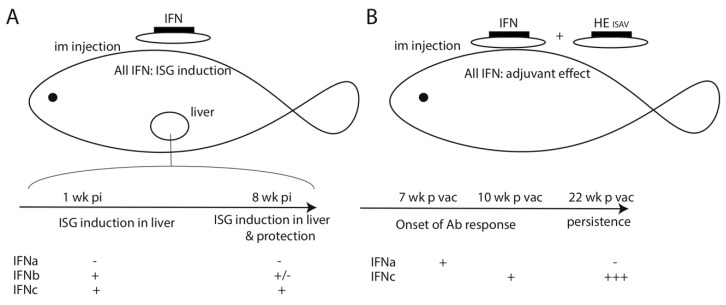
The overarching structure of the type I interferon (IFN) system is conserved across vertebrates. However, the variable numbers of whole genome duplication events during fish evolution offer opportunities for the expansion, diversification, and new functionalization of the genes that are involved in antiviral immunity. In this review, we examine how fish models provide new insights about the implication of virus-driven inflammation in immunity and hematopoiesis. Mechanisms that have been discovered in fish, such as the strong adjuvant effect of type I IFN that is used with DNA vaccination, constitute good models to understand how virus-induced inflammatory mechanisms can interfere with adaptive responses. We also comment on new discoveries regarding the role of pathogen-induced inflammation in the development and guidance of hematopoietic stem cells in zebrafish. These findings raise issues about the potential interferences of viral infections with the establishment of the immune system. Finally, the recent development of genome editing provides new opportunities to dissect the roles of the key players involved in the antiviral response in fish, hence enhancing the power of comparative approaches.
I 型干扰素(IFN)系统的总体结构在脊椎动物中是保守的。然而,鱼类进化过程中的全基因组重复事件的数量变化为参与抗病毒免疫的基因的扩张、多样化和新功能化提供了机会。在这篇综述中,我们研究了鱼类模型如何提供关于病毒驱动的炎症对免疫和造血影响的新见解。在鱼类中发现的机制,如与 DNA 疫苗联合使用的 I 型 IFN 的强大佐剂效应,构成了很好的模型,可以帮助我们了解病毒诱导的炎症机制如何干扰适应性反应。我们还评论了关于病原体诱导的炎症在斑马鱼造血干细胞发育和指导中的作用的新发现。这些发现提出了病毒感染与免疫系统建立之间潜在干扰的问题。最后,基因组编辑的最新发展为剖析鱼类抗病毒反应中关键参与者的作用提供了新的机会,从而增强了比较方法的力量。