Li Feng, An Xingjuan, Wu Deguang, Xu Jing, Chen Yuanyuan, Li Wenchao, Cao Yingxiu, Guo Xuewu, Lin Xue, Li Congfa, Liu Sixin, Song Hao
Key Laboratory of Systems Bioengineering (MOE), Frontier Science Center for Synthetic Biology, School of Chemical Engineering and Technology, Tianjin University, Tianjin, China.
Department of Brewing Engineering, Moutai Institute, Renhuai, China.
Front Microbiol. 2019 Mar 18;10:409. doi: 10.3389/fmicb.2019.00409. eCollection 2019.
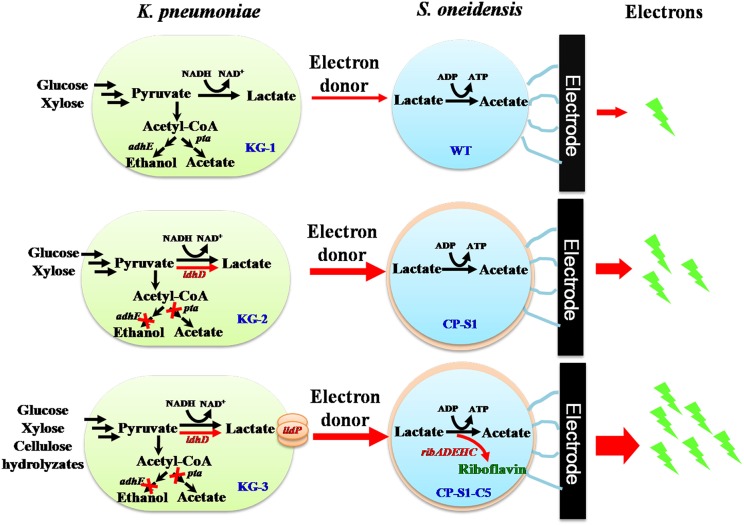
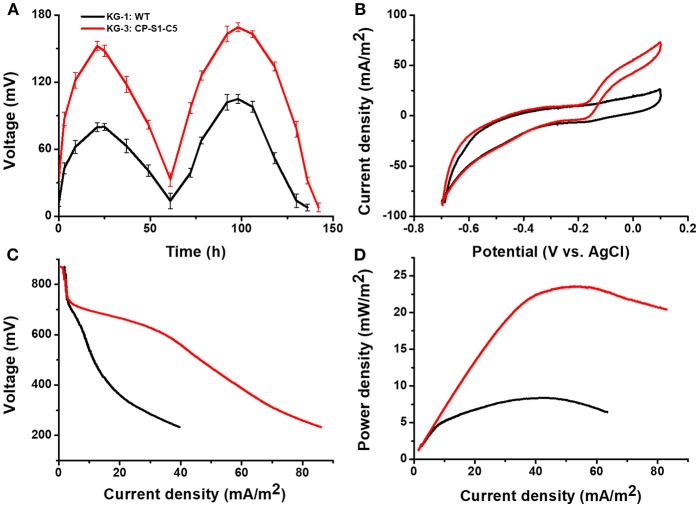
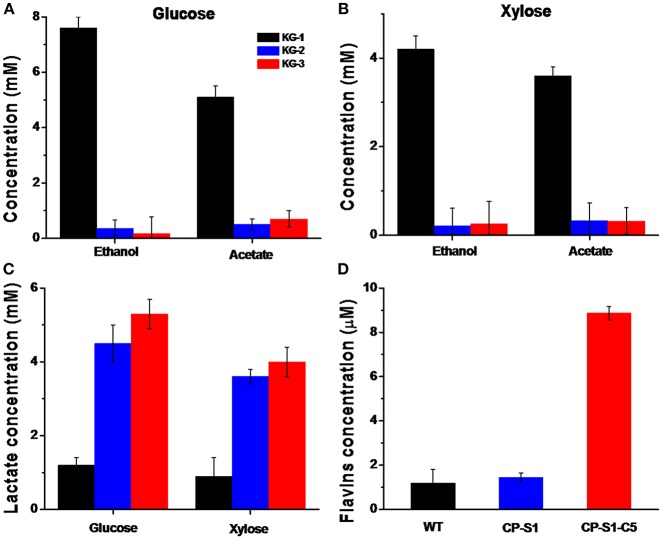
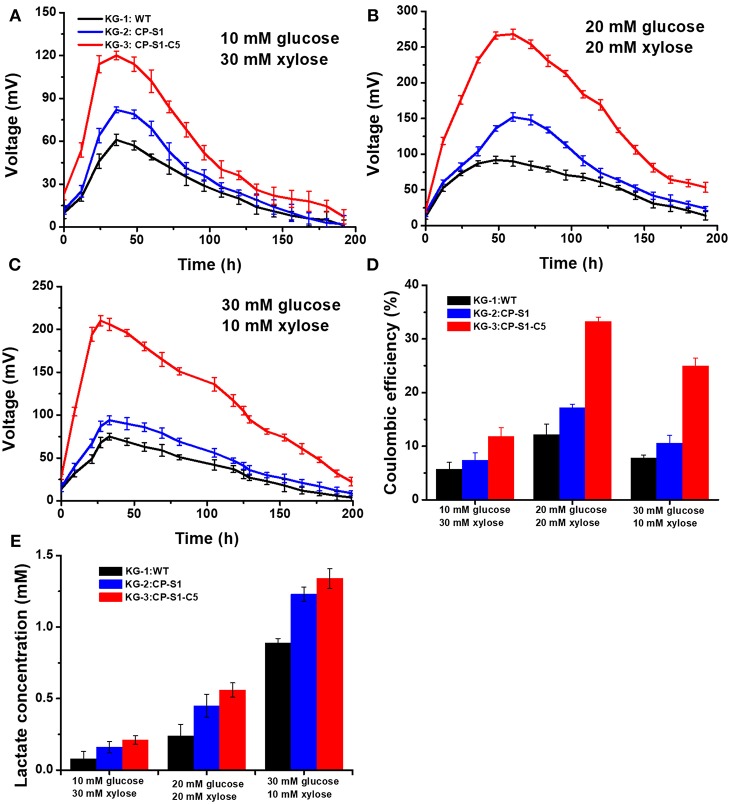
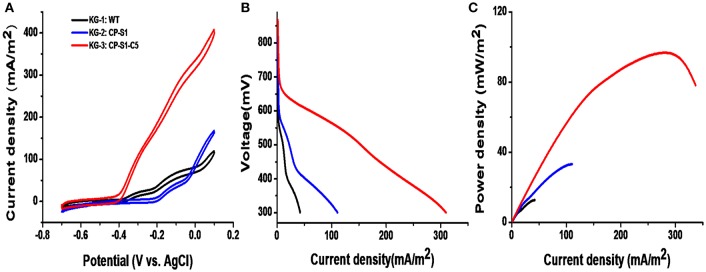
Microbial fuel cells (MFCs) are eco-friendly bio-electrochemical reactors that use exoelectrogens as biocatalyst for electricity harvest from organic biomass, which could also be used as biosensors for long-term environmental monitoring. Glucose and xylose, as the primary ingredients from cellulose hydrolyzates, is an appealing substrate for MFC. Nevertheless, neither xylose nor glucose can be utilized as carbon source by well-studied exoelectrogens such as . In this study, to harvest the electricity by rapidly harnessing xylose and glucose from corn stalk hydrolysate, we herein firstly designed glucose and xylose co-fed engineered microbial consortium, in which as the fermenter converted glucose and xylose into lactate to feed the exoelectrogens (). To produce more lactate in , we eliminated the ethanol and acetate pathway via deleting (phosphotransacetylase gene) and (alcohol dehydrogenase gene) and further constructed a synthesis and delivery system through expressing (lactate dehydrogenase gene) and (lactate transporter gene). To facilitate extracellular electron transfer (EET) of , a biosynthetic flavins pathway from was expressed in a highly hydrophobic CP-S1, which not only improved direct-contacted EET via enhancing adhesion to the carbon electrode but also accelerated the flavins-mediated EET via increasing flavins synthesis. Furthermore, we optimized the ratio of glucose and xylose concentration to provide a stable carbon source supply in MFCs for higher power density. The glucose and xylose co-fed MFC inoculated with the recombinant consortium generated a maximum power density of 104.7 ± 10.0 mW/m, which was 7.2-folds higher than that of the wild-type consortium (12.7 ± 8.0 mW/m). Lastly, we used this synthetic microbial consortium in the corn straw hydrolyzates-fed MFC, obtaining a power density 23.5 ± 6.0 mW/m.
微生物燃料电池(MFCs)是一种生态友好型生物电化学反应器,它利用外排电子菌作为生物催化剂从有机生物质中获取电能,也可用作长期环境监测的生物传感器。葡萄糖和木糖作为纤维素水解产物的主要成分,是MFC的一种有吸引力的底物。然而,木糖和葡萄糖都不能被诸如 等经过充分研究的外排电子菌用作碳源。在本研究中,为了通过快速利用玉米秸秆水解物中的木糖和葡萄糖来获取电能,我们首先设计了葡萄糖和木糖共进料的工程化微生物群落,其中 作为发酵菌将葡萄糖和木糖转化为乳酸来供外排电子菌( )利用。为了在 中产生更多乳酸,我们通过删除 (磷酸转乙酰酶基因)和 (乙醇脱氢酶基因)消除了乙醇和乙酸途径,并通过表达 (乳酸脱氢酶基因)和 (乳酸转运蛋白基因)进一步构建了一个合成和递送系统。为了促进 的细胞外电子传递(EET),来自 的生物合成黄素途径在高度疏水的 CP-S1中表达,这不仅通过增强 与碳电极的粘附改善了直接接触的EET,还通过增加黄素合成加速了黄素介导的EET。此外,我们优化了葡萄糖和木糖浓度的比例,以便在MFC中提供稳定的碳源供应以获得更高的功率密度。接种重组菌群的葡萄糖和木糖共进料MFC产生的最大功率密度为104.7±10.0 mW/m,比野生型菌群(12.7±8.0 mW/m)高7.2倍。最后,我们将这种合成微生物群落在以玉米秸秆水解物为进料的MFC中使用,获得了23.5±6.0 mW/m的功率密度。