Rathnayake Dilini, Chang Thashi, Udagama Preethi
Department of Zoology and Environment Sciences, Faculty of Science, University of Colombo, Colombo 3, Sri Lanka.
Department of Clinical Medicine, Faculty of Medicine, University of Colombo, Colombo 8, Sri Lanka.
BMC Neurol. 2019 Apr 6;19(1):56. doi: 10.1186/s12883-019-1286-6.
Dopaminergic neuronal loss begins years before motor symptoms appear in Parkinson disease (PD). Thus, reliable biomarkers for early diagnosis and prognosis of PD are an essential pre-requisite to develop disease modifying therapies. Inflammation-derived oxidative stress is postulated to contribute to nigrostriatal degeneration. We evaluated the role of selected serum immune mediators (IFNγ, TNFα, IL-10, and NOx) in PD progression and estimated their usefulness in preclinical diagnosis.
This case-control study recruited 72 PD patients with varying disease durations (< 1-year, n = 12 patients; 1-3 years, n = 30; > 3 years, n = 30) and 56 age- and gender-matched controls (26 with other neurological disorders as disease controls, and 30 healthy controls). Serum cytokine levels and NOx quantified using Sandwich Enzyme Linked Immunosorbent Assay kits, and the Griess test, respectively, were evaluated for diagnostic accuracy of optimal marker combinations by the CombiROC method. PD patients were clinically evaluated for motor and non-motor symptoms, and staged based on Hoehn and Yahr (H-Y) scale.
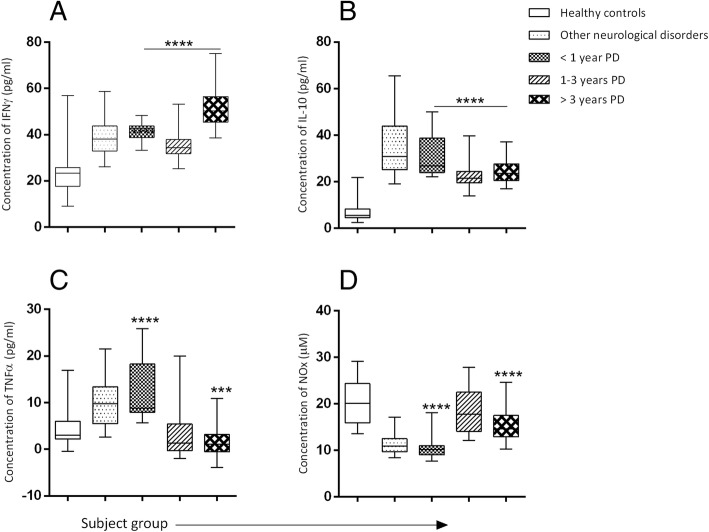
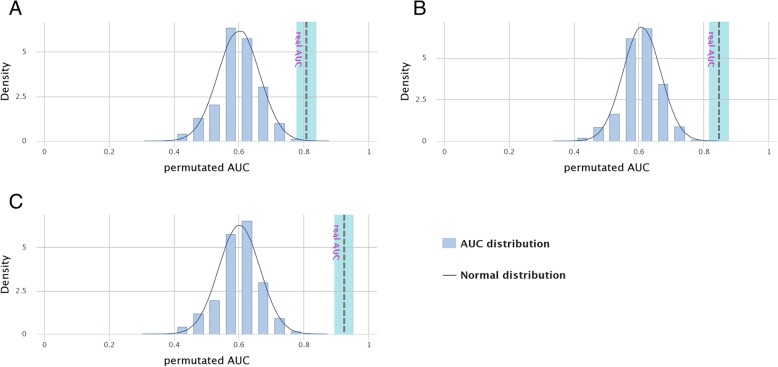
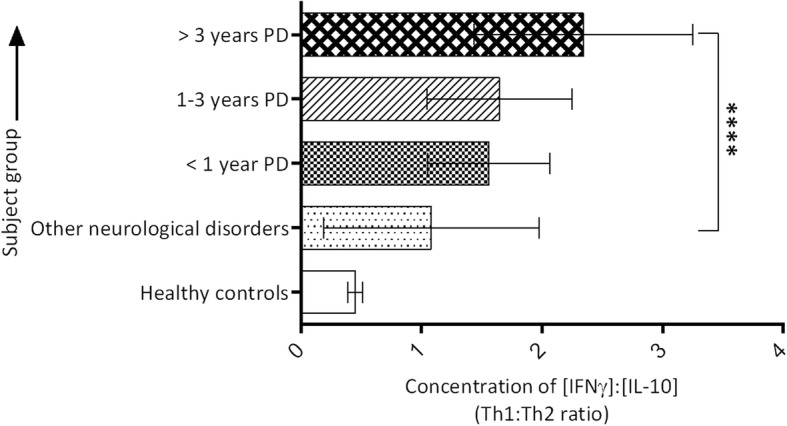
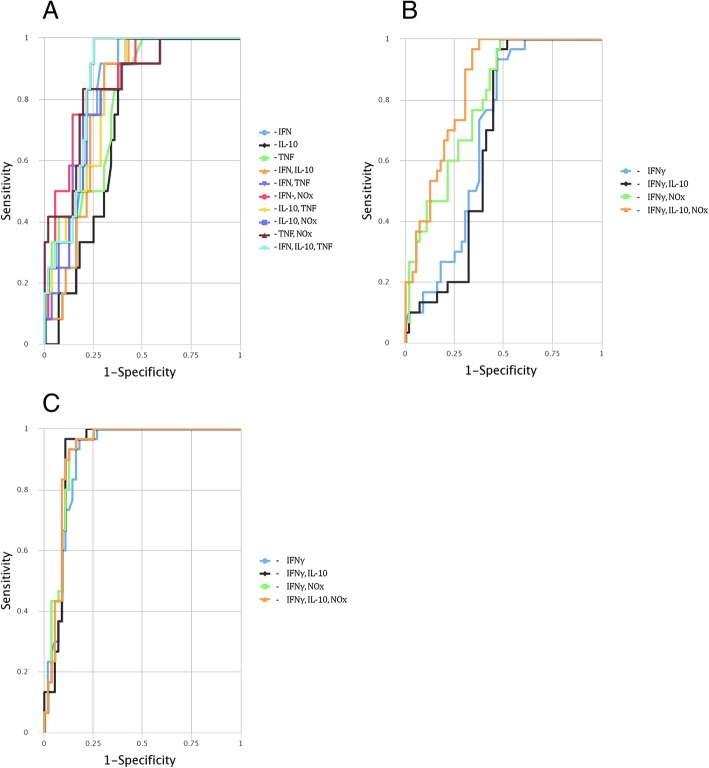
A significant increase in serum IFNγ and IL-10 was observed in PD compared to healthy controls (p < 0.001). The Th1: Th2 (IFNγ: IL-10) cytokine ratio was higher in PD of 3-12 years compared with PD < 1 year (p < 0.001). Highest levels of NOx manifested during early PD (1-3 years) through a subsequent decline with disease duration. TNFα level was highest at PD onset. A low serum NOx level was associated with cognitive impairment (p = 0.002). The potential of using multi-biomarker panel, IFNγ, IL-10 and TNFα, for detection of PD onset was evident (sensitivity [SE] = 83.3%, specificity [SP] =80.4%, area under curve [AUC] = 0.868), while for early and late PD the multi-biomarker signature of IFNγ, IL-10 and NOx appeared to be more promising (SE = 93.3%, SP = 87.5%, AUC = 0.924).
A Th1 cytokine-biased immune response predominates with PD progression. Both IFNγ and IL-10 are involved in disease severity. However, TNFα-mediated neurotoxicity appears to occur in early PD.
在帕金森病(PD)中,多巴胺能神经元的丧失在运动症状出现前数年就已开始。因此,用于PD早期诊断和预后的可靠生物标志物是开发疾病修饰疗法的必要前提。炎症衍生的氧化应激被认为是导致黑质纹状体变性的原因。我们评估了选定的血清免疫介质(IFNγ、TNFα、IL - 10和NOx)在PD进展中的作用,并估计了它们在临床前诊断中的效用。
本病例对照研究招募了72例病程各异的PD患者(病程<1年,n = 12例;1 - 3年,n = 30例;>3年,n = 30例)以及56例年龄和性别匹配的对照(26例患有其他神经系统疾病作为疾病对照,30例为健康对照)。分别使用夹心酶联免疫吸附测定试剂盒和格里斯试验对血清细胞因子水平和NOx进行定量,通过CombiROC方法评估最佳标志物组合的诊断准确性。对PD患者进行运动和非运动症状的临床评估,并根据霍恩和雅尔(H - Y)量表进行分期。
与健康对照相比,PD患者血清IFNγ和IL - 10显著升高(p < 0.001)。病程3 - 12年的PD患者中Th1:Th2(IFNγ:IL - 10)细胞因子比值高于病程<1年的PD患者(p < 0.001)。NOx在PD早期(1 - 3年)水平最高,随后随病程延长而下降。TNFα水平在PD发病时最高。血清NOx水平低与认知障碍相关(p = 0.002)。使用多生物标志物组合IFNγ、IL - 10和TNFα检测PD发病的潜力明显(敏感性[SE]=83.3%,特异性[SP]=80.4%,曲线下面积[AUC]=0.868),而对于早期和晚期PD,IFNγ、IL - 10和NOx的多生物标志物特征似乎更有前景(SE = 93.3%,SP = 87.5%,AUC = 0.924)。
随着PD进展,以Th1细胞因子为主导的免疫反应占主导地位。IFNγ和IL - 10均参与疾病严重程度。然而,TNFα介导的神经毒性似乎发生在PD早期。