Asok Arun, Hijazi Joud, Harvey Lucas R, Kosmidis Stylianos, Kandel Eric R, Rayman Joseph B
Department of Neuroscience, Jerome L. Greene Science Center, Columbia University, New York, NY, United States.
Zuckerman Mind Brain Behavior Institute, Columbia University, New York, NY, United States.
Front Behav Neurosci. 2019 Mar 22;13:56. doi: 10.3389/fnbeh.2019.00056. eCollection 2019.
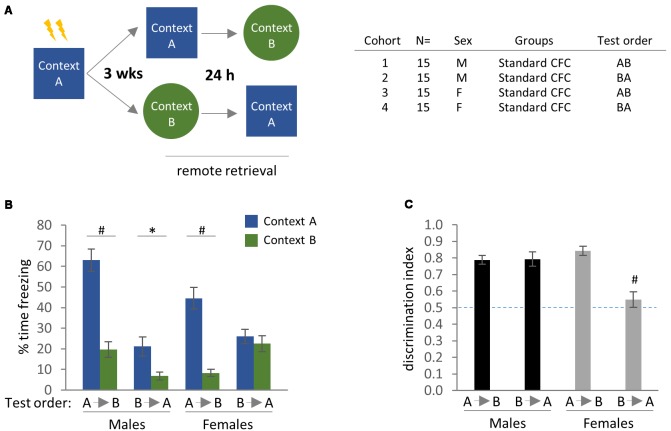
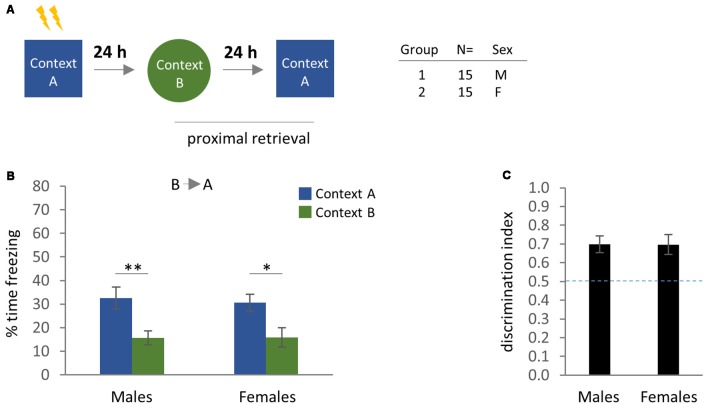
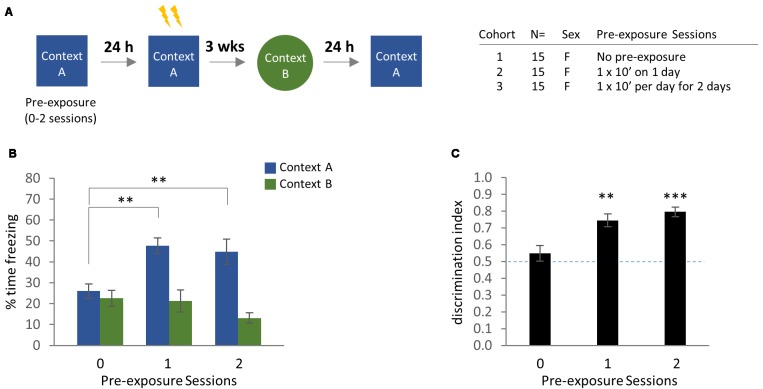
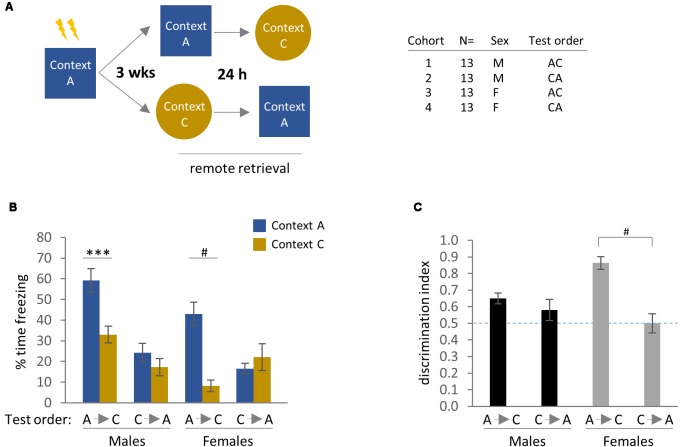
The generalization of fear is adaptive in that it allows an animal to respond appropriately to novel threats that are not identical to previous experiences. In contrast, the overgeneralization of fear is maladaptive and is a hallmark of post-traumatic stress disorder (PTSD), a psychiatric illness that is characterized by chronic symptomatology and a higher incidence in women compared to men. Therefore, understanding the neural basis of fear generalization at remote time-points in female animals is of particular translational relevance. However, our understanding of the neurobiology of fear generalization is largely restricted to studies employing male mice and focusing on recent time-points (i.e., within 24-48 h following conditioning). To address these limitations, we examined how male and female mice generalize contextual fear at remote time intervals (i.e., 3 weeks after conditioning). In agreement with earlier studies of fear generalization at proximal time-points, we find that the test order of training and generalization contexts is a critical determinant of generalization and context discrimination, particularly for female mice. However, tactile elements that are present during fear conditioning are more salient for male mice. Our study highlights long-term sex differences in defensive behavior between male and female mice and may provide insight into sex differences in the processing and retrieval of remote fear memory observed in humans.
恐惧的泛化具有适应性,因为它使动物能够对与先前经历不同的新威胁做出适当反应。相比之下,恐惧的过度泛化是适应不良的,是创伤后应激障碍(PTSD)的一个标志,PTSD是一种精神疾病,其特征是慢性症状,且女性发病率高于男性。因此,了解雌性动物在遥远时间点恐惧泛化的神经基础具有特殊的转化意义。然而,我们对恐惧泛化神经生物学的理解很大程度上局限于使用雄性小鼠且关注近期时间点(即条件反射后24 - 48小时内)的研究。为了解决这些局限性,我们研究了雄性和雌性小鼠在遥远时间间隔(即条件反射后3周)如何泛化情境恐惧。与早期关于近端时间点恐惧泛化的研究一致,我们发现训练和泛化情境的测试顺序是泛化和情境辨别(尤其是对雌性小鼠而言)的关键决定因素。然而,恐惧条件反射期间存在的触觉元素对雄性小鼠更为显著。我们的研究突出了雄性和雌性小鼠在防御行为上的长期性别差异,并可能为人类中观察到的遥远恐惧记忆加工和提取中的性别差异提供见解。