Tozetto-Mendoza Tania Regina, Avelino-Silva Vivian Iida, Fonseca Silvia, Claro Ingra Morales, Paula Anderson Vicente de, Levin Anna Sara, Sabino Ester Cerdeira, Mendes-Correa Maria Cassia, Figueiredo Walter Manso, Felix Alvina Clara, Souza Nathalia C Santiago, Costa Angela Aparecida, Inenami Marta, Silva Rosangela M Gasparetto da, Levi José Eduardo, Romano Camila Malta, Paranhos-Baccalà Glaucia, Segurado Aluisio Cotrim, Mayaud Philippe
Universidade de São Paulo, Instituto de Medicina Tropical de São Paulo, São Paulo, São Paulo, Brazil.
Universidade de São Paulo, Faculdade de Medicina, Departamento de Moléstias Infecciosas e Parasitárias, São Paulo, São Paulo, Brazil.
Rev Inst Med Trop Sao Paulo. 2019;61:e19. doi: 10.1590/S1678-9946201961019. Epub 2019 Apr 4.
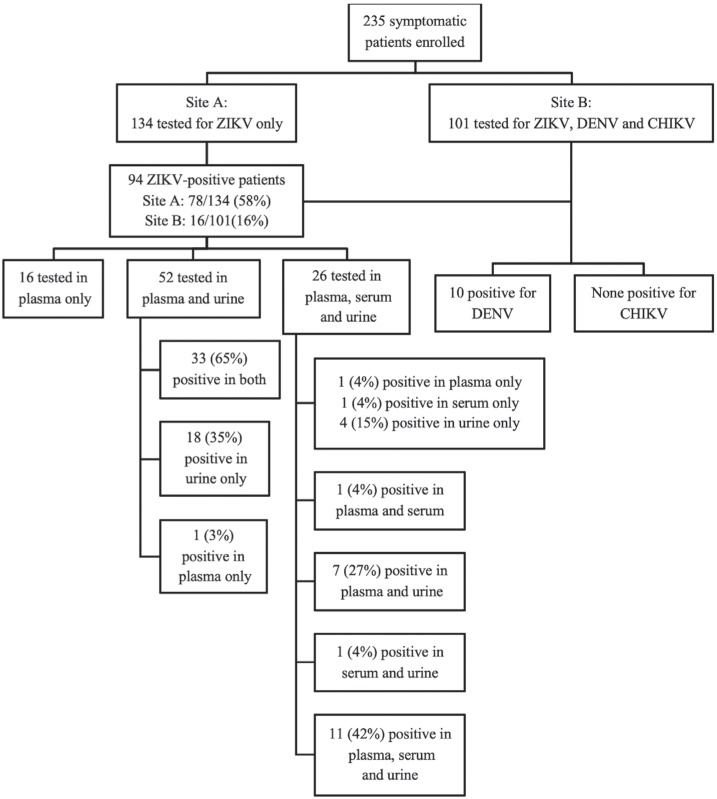
Zika virus (ZIKV) clinical presentation and frequency/duration of shedding need further clarification. Symptomatic ZIKV-infected individuals identified in two hospitals in Sao Paulo State, Brazil, were investigated regarding clinical characteristics, shedding in body fluids, and serodynamics. Ninety-four of 235 symptomatic patients (Site A: 58%; Site B: 16%) had Real-Time PCR-confirmed ZIKV infection; fever, headache and gastrointestinal symptoms were less frequent, and rash was more frequent compared to ZIKV-negative patients. Real-Time PCR in serum had worse performance compared to plasma, while urine had the highest sensitivity. Shedding in genital fluids and saliva was rare. IgM positivity was the highest <14 days after the symptoms onset (86%), decreasing >28 days (24%); IgG positivity increased >14 days (96%) remaining positive in 94% of patients >28 days. ZIKV prevalence varied importantly in two neighboring cities during the same transmission season. Urine Real-Time PCR can improve diagnostic sensitivity; serum testing is less useful. Accurate serological tests are needed to improve diagnosis and surveillance.
寨卡病毒(ZIKV)的临床表现以及病毒排出的频率/持续时间尚需进一步明确。对在巴西圣保罗州两家医院确诊的有症状的寨卡病毒感染个体,就其临床特征、体液排毒情况及血清动力学进行了调查。235例有症状患者中,94例(A医院:58%;B医院:16%)经实时荧光定量PCR确诊为寨卡病毒感染;与寨卡病毒阴性患者相比,发热、头痛及胃肠道症状出现频率较低,而皮疹出现频率较高。血清的实时荧光定量PCR检测性能不如血浆,而尿液检测灵敏度最高。生殖液和唾液排毒情况罕见。症状出现后<14天IgM阳性率最高(86%),>28天时下降(24%);IgG阳性率在>14天时升高(96%),>28天时94%的患者仍为阳性。在同一传播季节,两个相邻城市的寨卡病毒流行率差异很大。尿液实时荧光定量PCR检测可提高诊断灵敏度;血清检测用处较小。需要准确的血清学检测以改善诊断和监测。