Centre for Inflammation Research, School of Medicine and Veterinary Medicine, University of Edinburgh, Edinburgh EH16 4TJ, UK.
Mediators Inflamm. 2019 Mar 10;2019:8968943. doi: 10.1155/2019/8968943. eCollection 2019.
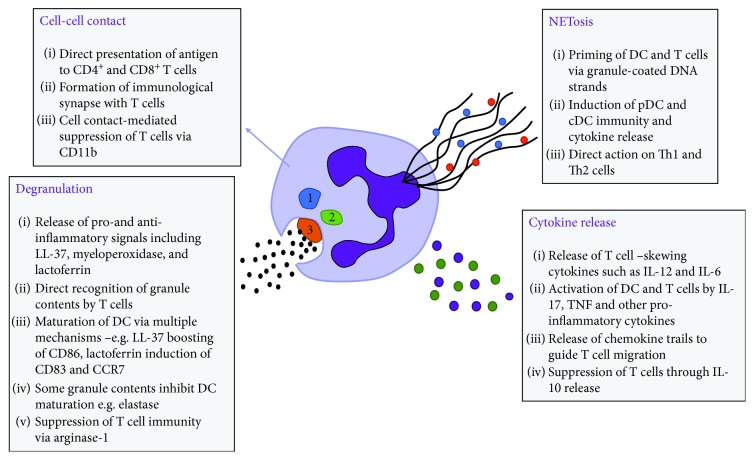
Neutrophils are the most abundant leukocytes in peripheral blood and respond rapidly to danger, infiltrating tissues within minutes of infectious or sterile injury. Neutrophils were long thought of as simple killers, but now we recognise them as responsive cells able to adapt to inflammation and orchestrate subsequent events with some sophistication. Here, we discuss how these rapid responders release mediators which influence later adaptive T cell immunity through influences on DC priming and directly on the T cells themselves. We consider how the release of granule contents by neutrophils-through NETosis or degranulation-is one way in which the innate immune system directs the phenotype of the adaptive immune response.
中性粒细胞是外周血中最丰富的白细胞,能迅速对危险做出反应,在感染或无菌损伤发生后的几分钟内渗透到组织中。长期以来,人们认为中性粒细胞是简单的杀伤细胞,但现在我们认识到它们是有反应能力的细胞,能够适应炎症,并通过一定的复杂性来协调随后的事件。在这里,我们讨论了这些快速反应者如何释放介质,通过影响树突状细胞的启动以及直接影响 T 细胞本身,从而影响随后的适应性 T 细胞免疫。我们考虑了中性粒细胞通过 NETosis 或脱颗粒释放颗粒内容物的方式,这是先天免疫系统指导适应性免疫反应表型的一种方式。