Arendt Johannes F W, Pircher Verdorfer Armin, Kugler Katharina G
Department of Psychology, Ludwig-Maximilians-Universität München, Munich, Germany.
TUM School of Management, Technical University of Munich, Munich, Germany.
Front Psychol. 2019 Mar 29;10:667. doi: 10.3389/fpsyg.2019.00667. eCollection 2019.
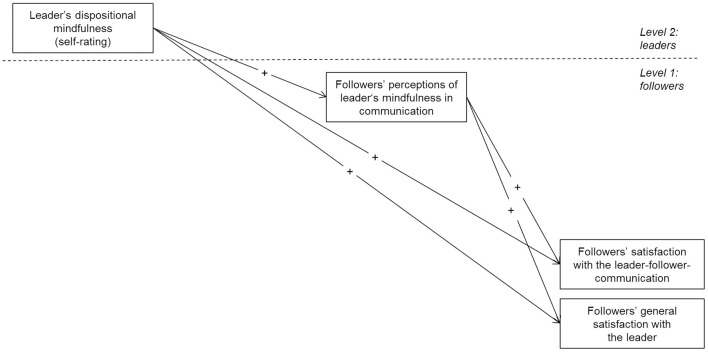
In recent years, the construct of mindfulness has gained growing attention in psychological research. However, little is known about the effects of mindfulness on interpersonal interactions and social relationships at work. Addressing this gap, the purpose of this study was to investigate the role of mindfulness in leader-follower relationships. Building on prior research, we hypothesize that leaders' mindfulness is reflected in a specific communication style ("mindfulness in communication"), which is positively related to followers' satisfaction with their leaders. We used nested survey data from 34 leaders and 98 followers from various organizations and tested mediation hypotheses using hierarchical linear modeling. Our hypotheses were confirmed by our data in that leaders' self-reported mindfulness showed a positive relationship with several aspects of followers' satisfaction. This relationship was fully mediated by leaders' mindfulness in communication as perceived by their followers. Our findings emphasize the potential value of mindfulness in workplace settings. They provide empirical evidence for a positive link between leaders' dispositional mindfulness and the wellbeing of their followers, indicating that mindfulness is not solely an individual resource but also fosters interpersonal skills. By examining leaders' mindfulness in communication as an explanatory process, we created additional clarification about leaders' mindfulness relates to followers' perceptions, offering a promising starting point for measuring behavioral correlates of leader mindfulness.
近年来,正念这一概念在心理学研究中越来越受到关注。然而,对于正念对工作中的人际互动和社会关系的影响却知之甚少。为填补这一空白,本研究旨在探讨正念在领导-下属关系中的作用。基于先前的研究,我们假设领导者的正念体现在一种特定的沟通风格(“沟通中的正念”)中,这种沟通风格与下属对领导者的满意度呈正相关。我们使用了来自不同组织的34位领导者和98位下属的嵌套调查数据,并使用分层线性模型检验了中介假设。我们的数据证实了我们的假设,即领导者自我报告的正念与下属满意度的几个方面呈正相关。这种关系完全由下属所感知的领导者沟通中的正念所中介。我们的研究结果强调了正念在工作场所环境中的潜在价值。它们为领导者的特质正念与下属的幸福感之间的积极联系提供了实证证据,表明正念不仅是一种个人资源,还能促进人际交往技能。通过将领导者沟通中的正念作为一个解释过程来考察,我们进一步阐明了领导者的正念与下属认知之间的关系,为测量领导者正念的行为相关因素提供了一个有前景的起点。