Wei Jason W, Wei Jerry W, Jackson Christopher R, Ren Bing, Suriawinata Arief A, Hassanpour Saeed
Department of Biomedical Data Science, Dartmouth College, Hanover, New Hampshire, USA.
Department of Computer Science, Dartmouth College, Hanover, New Hampshire, USA.
J Pathol Inform. 2019 Mar 8;10:7. doi: 10.4103/jpi.jpi_87_18. eCollection 2019.
Celiac disease (CD) prevalence and diagnosis have increased substantially in recent years. The current gold standard for CD confirmation is visual examination of duodenal mucosal biopsies. An accurate computer-aided biopsy analysis system using deep learning can help pathologists diagnose CD more efficiently.
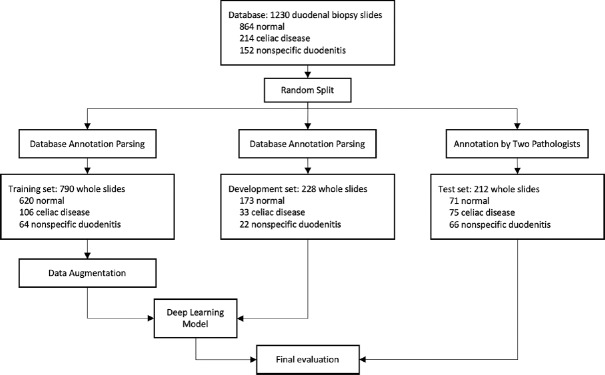
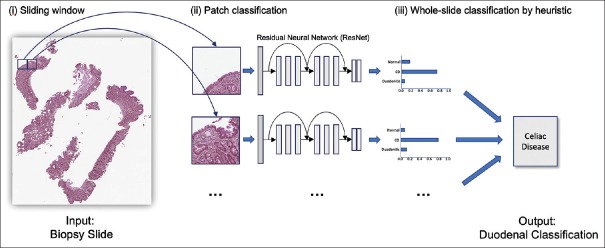
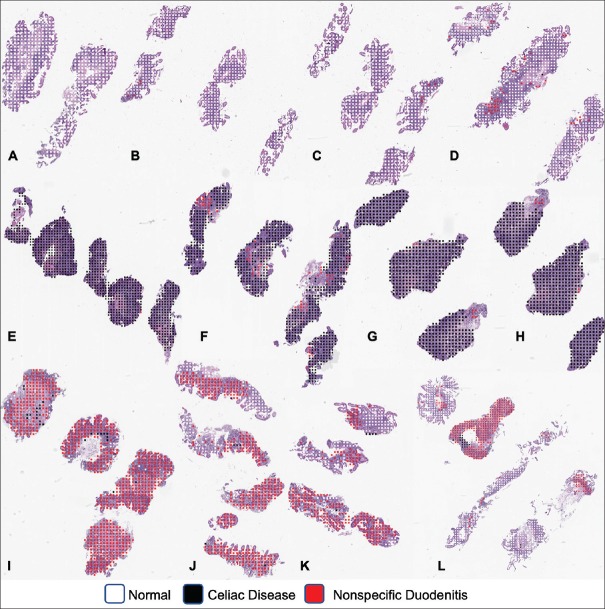
In this study, we trained a deep learning model to detect CD on duodenal biopsy images. Our model uses a state-of-the-art residual convolutional neural network to evaluate patches of duodenal tissue and then aggregates those predictions for whole-slide classification. We tested the model on an independent set of 212 images and evaluated its classification results against reference standards established by pathologists.
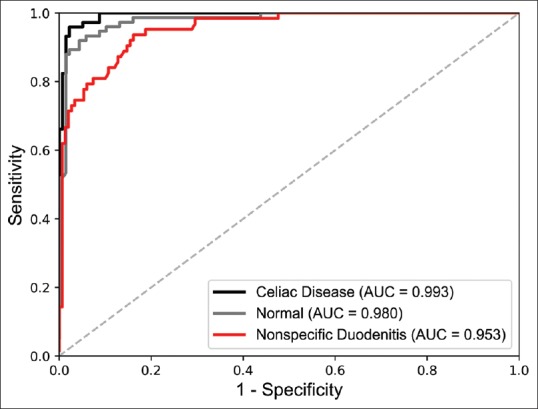
Our model identified CD, normal tissue, and nonspecific duodenitis with accuracies of 95.3%, 91.0%, and 89.2%, respectively. The area under the receiver operating characteristic curve was >0.95 for all classes.
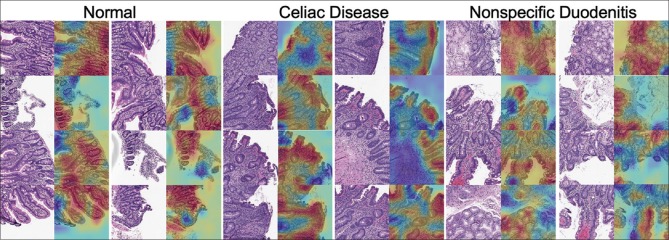
We have developed an automated biopsy analysis system that achieves high performance in detecting CD on biopsy slides. Our system can highlight areas of interest and provide preliminary classification of duodenal biopsies before review by pathologists. This technology has great potential for improving the accuracy and efficiency of CD diagnosis.
近年来,乳糜泻(CD)的患病率和诊断率大幅上升。目前确诊CD的金标准是十二指肠黏膜活检的视觉检查。使用深度学习的精确计算机辅助活检分析系统可以帮助病理学家更高效地诊断CD。
在本研究中,我们训练了一个深度学习模型来检测十二指肠活检图像上的CD。我们的模型使用先进的残差卷积神经网络来评估十二指肠组织切片,然后汇总这些预测结果以进行全玻片分类。我们在一组独立的212张图像上测试了该模型,并根据病理学家建立的参考标准评估其分类结果。
我们的模型识别CD、正常组织和非特异性十二指肠炎的准确率分别为95.3%、91.0%和89.2%。所有类别的受试者工作特征曲线下面积均>0.95。
我们开发了一种自动化活检分析系统,该系统在检测活检玻片上的CD方面具有高性能。我们的系统可以突出显示感兴趣的区域,并在病理学家审查之前对十二指肠活检进行初步分类。这项技术在提高CD诊断的准确性和效率方面具有巨大潜力。