Institute of Public Health and Nursing Research, Department of Social Epidemiology, University of Bremen 28359 Bremen, Germany.
Health Sciences Bremen, University of Bremen, 28359 Bremen, Germany.
Int J Environ Res Public Health. 2019 Apr 4;16(7):1216. doi: 10.3390/ijerph16071216.
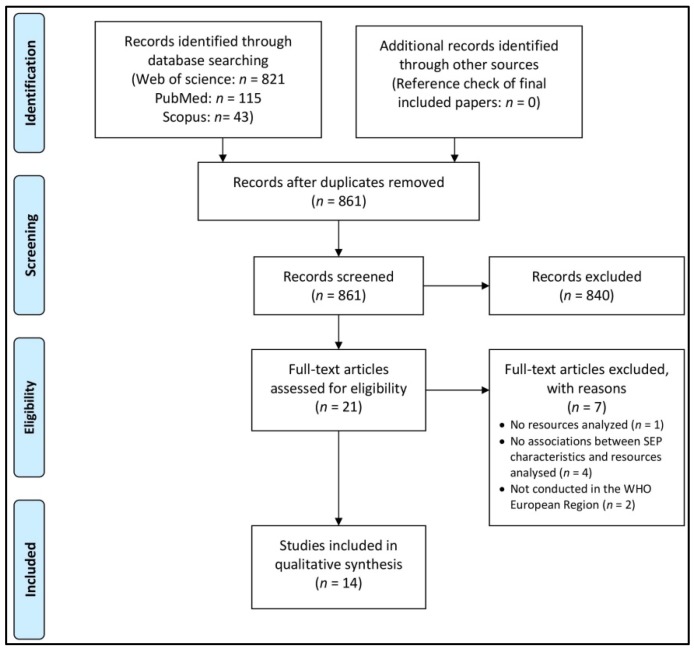
Residential green and blue spaces and their potential health benefits have received increasing attention in the context of environmental health inequalities, because an unequal social distribution of these resources may contribute to inequalities in health outcomes. This systematic review synthesised evidence of environmental inequalities, focusing on availability and accessibility measures of green and blue spaces. Studies in the World Health Organisation (WHO) European Region published between 2010 and 2017 were considered for the review. In total, 14 studies were identified, where most of them ( = 12) analysed inequalities of green spaces. The majority had an ecological study design that mostly applied deprivation indices on the small area level, whereas cross-sectional studies on the individual level mostly applied single social measures. Ecological studies consistently showed that deprived areas had lower green space availability than more affluent areas, whereas mixed associations were found for single social dimensions in cross-sectional studies on the individual level. In order to gain more insights into how various social dimensions are linked to the distribution of environmental resources within the WHO European Region, more studies are needed that apply comparable methods and study designs for analysing social inequalities in environmental resources.
居住绿色和蓝色空间及其潜在的健康益处,在环境健康不平等的背景下受到了越来越多的关注,因为这些资源的不平等社会分配可能导致健康结果的不平等。本系统综述综合了环境不平等的证据,重点关注绿色和蓝色空间的可用性和可及性措施。本综述考虑了世界卫生组织(世卫组织)欧洲区域在 2010 年至 2017 年期间发表的研究。共确定了 14 项研究,其中大多数(=12 项)分析了绿色空间的不平等。大多数研究采用生态研究设计,主要在小区域层面应用剥夺指数,而个体层面的横断面研究主要应用单一的社会措施。生态研究一致表明,贫困地区的绿色空间可用性低于富裕地区,而个体层面的横断面研究中单一社会维度则存在混合关联。为了更深入地了解各种社会维度如何与世卫组织欧洲区域内环境资源的分布相关联,需要更多应用可比方法和研究设计来分析环境资源社会不平等的研究。