Instituto de Biofísica Carlos Chagas Filho, Universidade Federal do Rio de Janeiro, Rio de Janeiro, RJ, 21941-902, Brazil.
National Institute of Science and Technology for Regenerative Medicine-REGENERE, Rio de Janeiro, Brazil.
Stem Cell Res Ther. 2019 Apr 17;10(1):121. doi: 10.1186/s13287-019-1226-9.
Retina and/or optic nerve injury may cause irreversible blindness, due to degeneration of retinal ganglion cells. We and others have previously shown that the intravitreal injection of mesenchymal stem cells (MSCs) protects injured retinal ganglion cells and stimulates their regeneration after optic nerve injury, but the long-term effects of this therapy are still unknown.
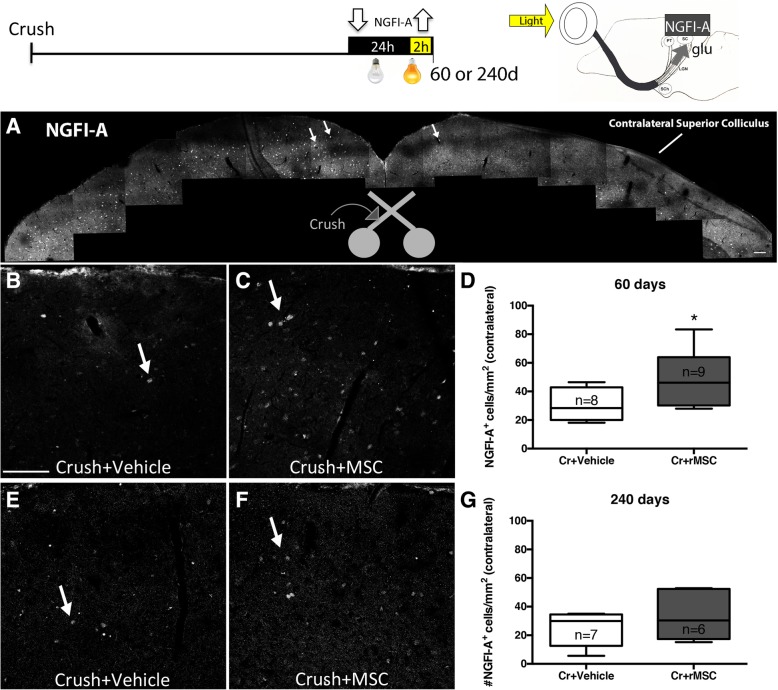
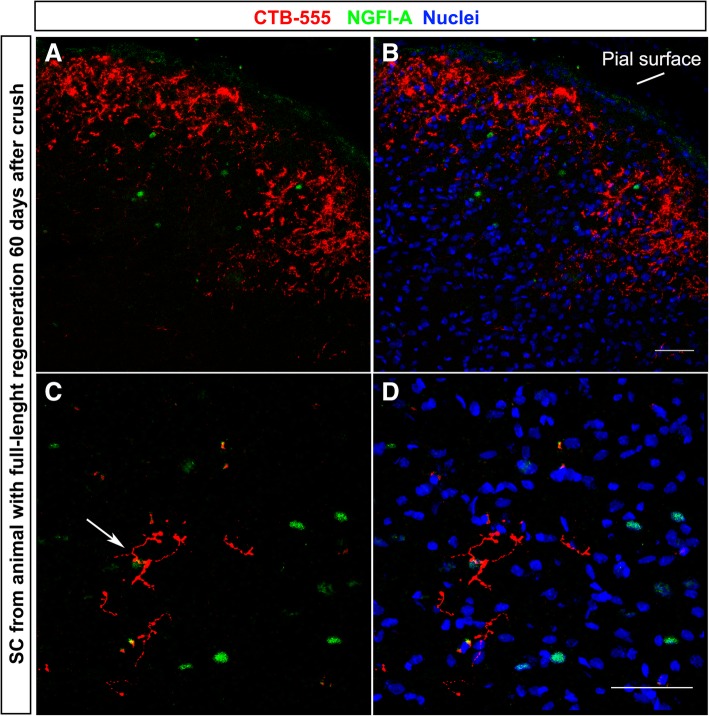
We injected rat MSC (rMSC) intravitreally in adult (3-5 months) Lister Hooded rats of either sex after optic nerve crush. Retinal ganglion cell survival, axonal regeneration, and reconnection were analyzed 60 and 240 days after crush by immunohistochemistry for Tuj1, anterograde labeling with cholera-toxin B and by immunohistochemistry for nerve growth factor-induced gene A (NGFI-A, driven by light stimulation) in the superior colliculus after a cycle of light deprivation-stimulation. Visual behaviors (optokinetic reflex, looming response, and preference for dark) were analyzed 70 days after crush.
rMSC treatment doubled the number of surviving retinal ganglion cells, preferentially of a larger subtype, and of axons regenerating up to 0.5 mm. Some axons regenerated to the lateral geniculate nucleus and superior colliculus. NGFI-A+ cells were doubled in rMSC-treated animals 60 days after crush, but equivalent to vehicle-injected animals 240 days after crush, suggesting that newly formed synapses degenerated. Animals did not recover visual behaviors.
We conclude that rMSC-induced neuroprotection is sustained at longer time points. Although rMSCs promoted long-term neuroprotection and long-distance axon regeneration, the reconnection of retinal ganglion cells with their targets was transitory, indicating that they need additional stimuli to make stable reconnections.
视网膜和/或视神经损伤可能导致视网膜神经节细胞变性而造成不可逆转的失明。我们和其他人之前已经表明,间质干细胞(MSCs)的玻璃体内注射可保护受伤的视网膜神经节细胞,并在视神经损伤后刺激其再生,但这种治疗的长期效果尚不清楚。
我们在成年(3-5 个月)Lister Hooded 大鼠视神经挤压后,将大鼠 MSC(rMSC)玻璃体内注射。通过免疫组织化学法检测 Tuj1、霍乱毒素 B 的顺行标记以及光剥夺-刺激后上丘中的神经生长因子诱导基因 A(NGFI-A,由光刺激驱动),分别在挤压后 60 天和 240 天分析视网膜神经节细胞的存活、轴突再生和再连接。在挤压后 70 天分析视觉行为(视动反射、突现反应和对暗的偏好)。
rMSC 治疗使存活的视网膜神经节细胞数量增加了一倍,优先是较大的亚型,并且再生的轴突长达 0.5mm。一些轴突再生到外侧膝状体核和上丘。rMSC 处理动物在挤压后 60 天,NGFI-A+细胞增加了一倍,但在挤压后 240 天与载体注射动物相当,表明新形成的突触退化。动物没有恢复视觉行为。
我们的结论是,rMSC 诱导的神经保护作用在较长时间内持续存在。尽管 rMSCs 促进了长期的神经保护和长距离轴突再生,但视网膜神经节细胞与靶细胞的重新连接是短暂的,这表明它们需要额外的刺激来建立稳定的连接。