Department of Preventive Medicine, Korea University College of Medicine, Seoul, Korea.
Urological Biomedicine Research Institute, Soonchunhyang University Hospital, Seoul, Korea.
Epidemiol Health. 2019;41:e2019007. doi: 10.4178/epih.e2019007. Epub 2019 Mar 28.
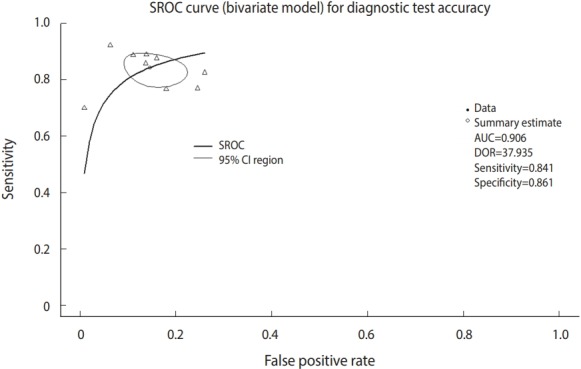
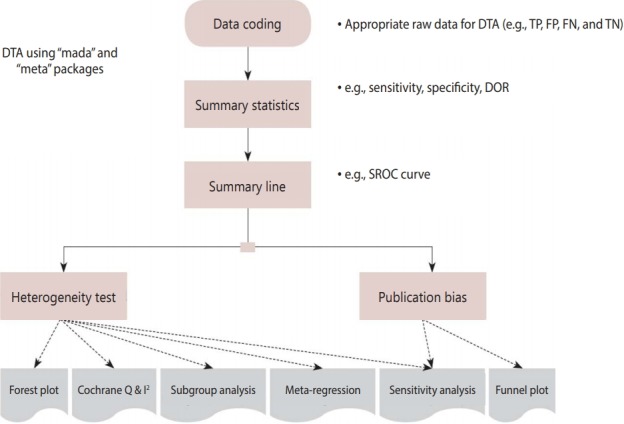
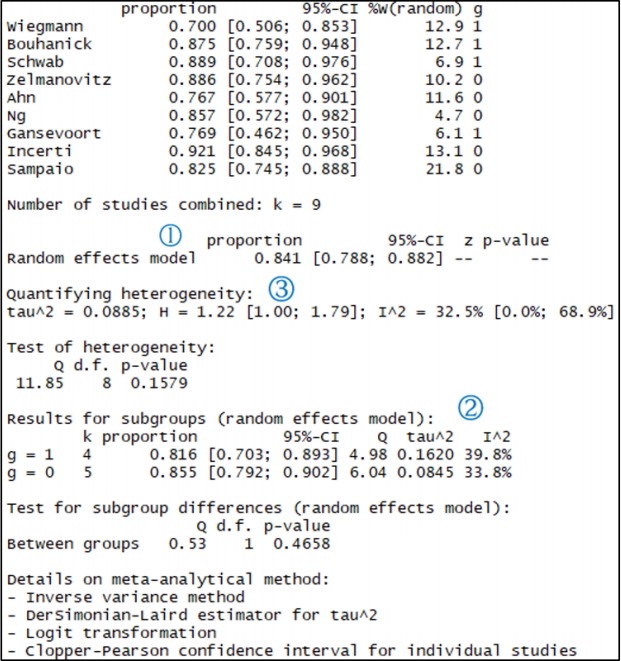
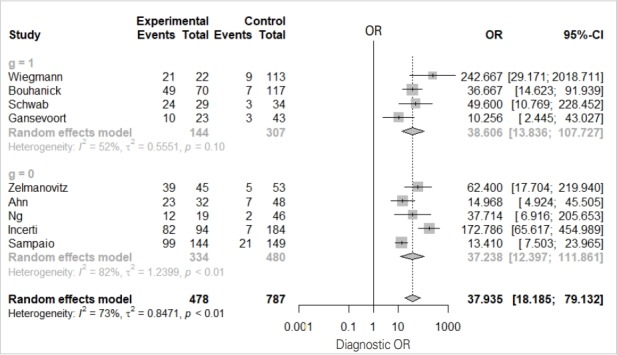
The objective of this paper is to describe general approaches of diagnostic test accuracy (DTA) that are available for the quantitative synthesis of data using R software. We conduct a DTA that summarizes statistics for univariate analysis and bivariate analysis. The package commands of R software were "metaprop" and "metabin" for sensitivity, specificity, and diagnostic odds ratio; forest for forest plot; reitsma of "mada" for a summarized receiver-operating characteristic (ROC) curve; and "metareg" for meta-regression analysis. The estimated total effect sizes, test for heterogeneity and moderator effect, and a summarized ROC curve are reported using R software. In particular, we focus on how to calculate the effect sizes of target studies in DTA. This study focuses on the practical methods of DTA rather than theoretical concepts for researchers whose fields of study were non-statistics related. By performing this study, we hope that many researchers will use R software to determine the DTA more easily, and that there will be greater interest in related research.
本文的目的是描述诊断测试准确性(DTA)的一般方法,这些方法可用于使用 R 软件对数据进行定量综合。我们进行了 DTA,总结了单变量分析和双变量分析的统计信息。R 软件的包命令为“metaprop”和“metabin”,用于灵敏度、特异性和诊断优势比;“forest”用于森林图;“reitsma”用于汇总接收者操作特征(ROC)曲线的“mada”;“metareg”用于元回归分析。使用 R 软件报告估计的总效应大小、异质性和调节效应检验以及汇总的 ROC 曲线。本研究特别关注如何在 DTA 中计算目标研究的效应大小。本研究侧重于 DTA 的实际方法,而不是与统计学无关的研究领域的研究人员的理论概念。通过进行这项研究,我们希望许多研究人员将能够更轻松地使用 R 软件来确定 DTA,并对相关研究产生更大的兴趣。