Roosen Joris, Curtis Daniel R
Utrecht University.
Leiden University.
Econ Hist Rev. 2019 Feb;72(1):32-56. doi: 10.1111/ehr.12667. Epub 2018 Feb 5.
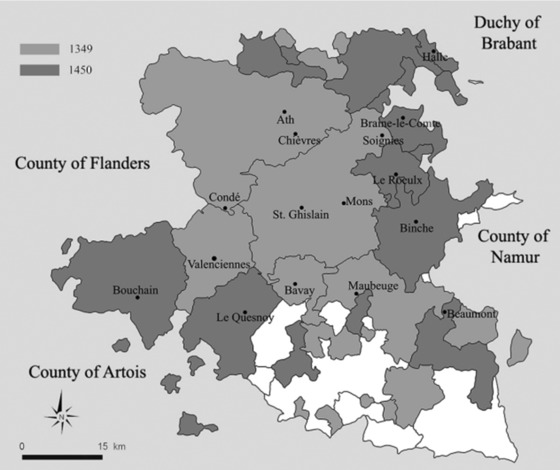
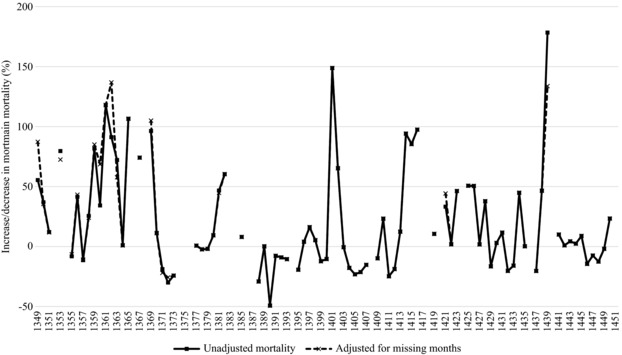
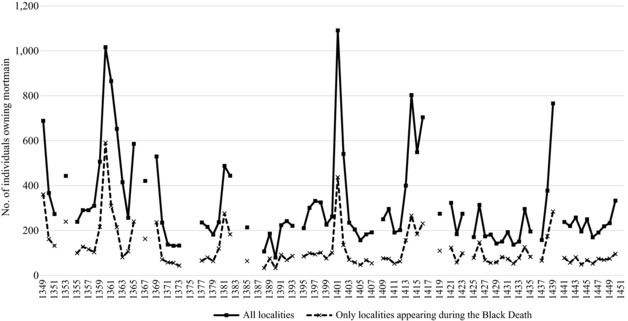
Although the fanciful notion that the Black Death bypassed the Low Countries has long been rejected, nevertheless a persistent view remains that the Low Countries experienced only a 'light touch' of the plague when placed in a broader European perspective, and recovered quickly and fully. However, in this article an array of dispersed sources for the Southern Netherlands together with a new mortmain accounts database for Hainaut show that the Black Death was severe, perhaps no less severe than other parts of western Europe; that serious plagues continued throughout the fourteenth and fifteenth centuries; and that the Black Death and recurring plagues spread over vast territories-including the countryside. The previous conception of a 'light touch' of plague in the Low Countries was created by the overprivileging of particular urban sources, and a failure to account for the rapid replenishment of cities via inward migration, which obscured demographic decimation. We suggest that the population of the Low Countries may not have recovered faster than other parts of western Europe but instead experienced a greater degree of post-plague rural-urban migration.
尽管黑死病绕过低地国家这一异想天开的观念早已被摒弃,但仍然存在一种顽固的观点,即从更广阔的欧洲视角来看,低地国家仅受到了鼠疫的“轻微影响”,并且迅速且完全地恢复了。然而,在本文中,一系列关于南荷兰的分散资料以及一个新的埃诺永久管业账户数据库表明,黑死病的影响是严重的,或许不亚于西欧其他地区;在 14 和 15 世纪,严重的鼠疫持续不断;而且黑死病和反复出现的鼠疫蔓延到了广大地区,包括农村。之前认为低地国家受到鼠疫“轻微影响”的观念,是由于过度重视特定的城市资料,以及未能考虑到通过向内迁移实现城市人口的快速补充,从而掩盖了人口的大量死亡。我们认为,低地国家的人口恢复速度可能并不比西欧其他地区快,反而经历了更大程度的鼠疫后农村向城市的迁移。