Yuan Shen, Cassman Kenneth G, Huang Jianliang, Peng Shaobing, Grassini Patricio
National Key Laboratory of Crop Genetic Improvement, MARA Key Laboratory of Crop Ecophysiology and Farming System in the Middle Reaches of the Yangtze River, College of Plant Science and Technology, Huazhong Agricultural University, Wuhan, Hubei, 430070, China.
Department of Agronomy and Horticulture, University of Nebraska-Lincoln, Lincoln, NE, 68583-0915, USA.
Field Crops Res. 2019 Mar 15;234:66-72. doi: 10.1016/j.fcr.2019.02.004.
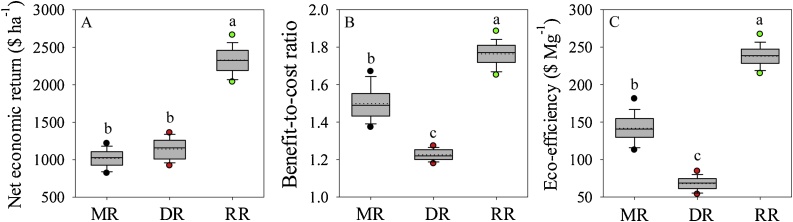
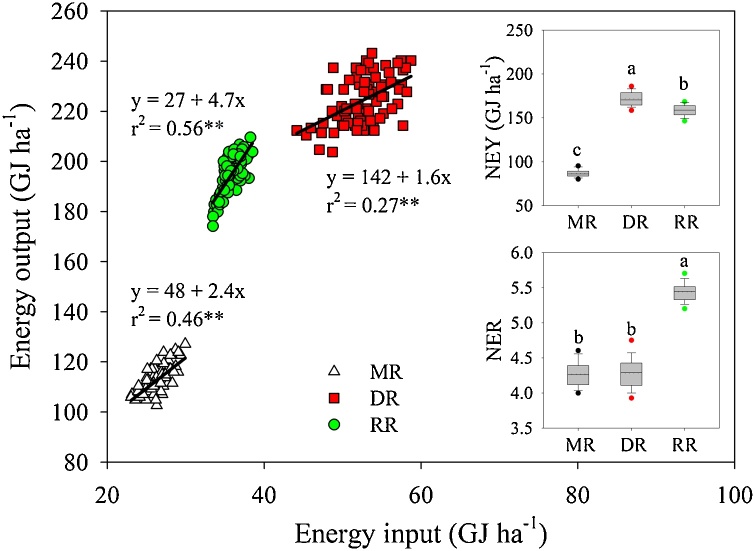
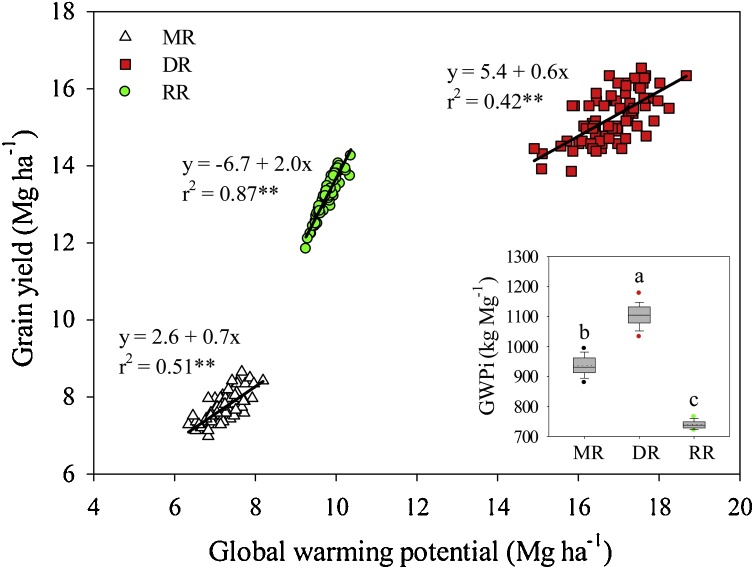
Identifying cropping systems with small global warming potential (GWP) per unit of productivity is important to ensure food security while minimizing environmental footprint. During recent decades, double-season rice (DR) systems in central China have progressively shifted into single-crop, middle-season rice (MR) due to high costs and labor requirements of double-season rice. Ratoon rice (RR) has been proposed as an alternative system that reconciliates both high annual productivity and relatively low costs and labor requirements. Here we used on-farm data collected from 240 farmer fields planted with rice in 2016 to evaluate annual energy balance, environmental impact, and net profit of MR, DR, and RR cropping systems in central China. Energy factors, emission values, and commodity prices obtained from literature and official statistics were used to estimate energy balance, GWP, and economic profit. Average annual yield was 7.7, 15.3. and 13.2 Mg ha for MR, DR, and RR systems, respectively. Average total annual energy input (36 GJ ha), GWP (9783 kg ha), and production cost (3057 $ ha) of RR were 35-48% higher than those of MR. However, RR achieved 72-129% higher annual grain yield (13.2 Mg ha), net energy yield (159 GJ ha), and net economic return (2330 $ ha) than MR. Compared with DR, RR produced statistically similar net energy yield while doubling the net economic return, with 32-42% lower energy input, production costs, and GWP. Consequently, RR exhibited significantly higher net energy ratio and benefit-to-cost ratio, and substantially lower yield-scaled GWP than the other two cropping systems. In the context of DR being replaced by MR, our analysis indicated that RR can be a viable option to achieve both high annual productivity and large positive energy balance and profit, while reducing the environmental impact.
识别每单位生产力具有较小全球变暖潜能值(GWP)的种植系统对于确保粮食安全同时最小化环境足迹非常重要。在最近几十年里,由于双季稻成本高且劳动力需求大,中国中部的双季稻(DR)系统已逐渐转变为单季中稻(MR)。再生稻(RR)已被提议作为一种替代系统,它既能实现较高的年生产力,又能降低成本和劳动力需求。在此,我们利用2016年从240块稻田收集的田间数据,评估了中国中部单季中稻、双季稻和再生稻种植系统的年度能量平衡、环境影响和净利润。从文献和官方统计数据中获取能量因子、排放值和商品价格,用于估算能量平衡、全球变暖潜能值和经济利润。单季中稻、双季稻和再生稻系统的年平均产量分别为7.7、15.3和13.2 Mg·ha。再生稻的年总能量输入(36 GJ·ha)、全球变暖潜能值(9783 kg·ha)和生产成本(3057美元·ha)平均比单季中稻高35 - 48%。然而,再生稻的年粮食产量(13.2 Mg·ha)、净能量产量(159 GJ·ha)和净经济回报(2330美元·ha)比单季中稻高72 - 129%。与双季稻相比,再生稻产生的净能量产量在统计学上相似,但净经济回报翻倍,且能量输入、生产成本和全球变暖潜能值降低32 - 42%。因此,与其他两种种植系统相比,再生稻的净能量比和效益成本比显著更高,产量规模全球变暖潜能值显著更低。在双季稻被单季中稻取代的背景下,我们的分析表明,再生稻可以成为实现高年生产力、大量正能量平衡和利润,同时减少环境影响的可行选择。