Abdel-All Marwa, Angell Blake, Jan Stephen, Praveen D, Joshi Rohina
1The George Institute for Global Health, Missenden Road, PO Box M 201, Camperdown, NSW 2050 Australia.
2Sydney Medical School, University of Sydney, Sydney, New South Wales Australia.
Arch Public Health. 2019 Apr 17;77:20. doi: 10.1186/s13690-019-0346-0. eCollection 2019.
Discrete choice experiment (DCE) is a quantitative technique which helps determine preferences from a definite set of choices. DCEs have been widely used to inform health services in high-income country settings and is gradually being used in low and middle-income countries (LMICs). There are challenges in deploying this method in LMIC settings due to the contextual, cultural and language related barriers. Most DCEs are conducted using paper-based tools. With mobile technology readily accessible across LMICs, we developed an Android-based platform to conduct a DCE among community health workers (CHWs) in rural India.
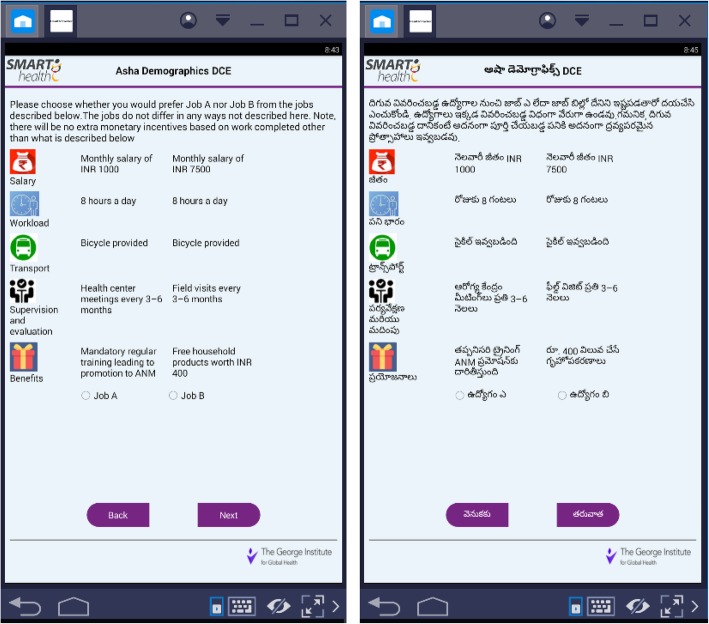
This paper describes the development of a DCE for low-literacy community health workers (CHWs) in low-resourced setting on an Android platform. We illustrate the process of identifying realistic and locally relevant attributes, finalising the tool and cognitively testing it among respondents with an average of 10 years of education using 'think aloud' and 'verbal probing' techniques. The Android application was tested in two rounds, first by the research team and second, by the CHWs. The 'think aloud' and 'verbal probing' techniques were essential in assessing the comprehension of the CHWs to the DCE choices.
The CHWs did not take much time to familiarize themselves with the Android application. Compared to the paper based DCE, the time required for data collection using the Android application was reduced by 50%. We found the Android-based app to be more efficient and time saving as it reduced errors in data collection, eliminated the process of data entry and presented the data for analysis in real time.
Electronic administration of DCE on Android computer tablets to CHWs with basic education is more efficient, time-saving than paper-based survey designs once the application is provided. It is feasible to use technology to develop and implement DCEs among participants with basic education in resource poor settings.
离散选择实验(DCE)是一种定量技术,有助于从一组确定的选择中确定偏好。DCE已在高收入国家环境中广泛用于为卫生服务提供信息,并且正在逐渐在低收入和中等收入国家(LMIC)中得到应用。由于背景、文化和语言相关障碍,在LMIC环境中部署此方法存在挑战。大多数DCE使用纸质工具进行。鉴于移动技术在LMIC中易于获取,我们开发了一个基于安卓的平台,用于在印度农村的社区卫生工作者(CHW)中开展DCE。
本文描述了在资源匮乏环境下,为低识字率社区卫生工作者(CHW)在安卓平台上开发DCE的过程。我们阐述了识别现实且与当地相关属性的过程、确定工具并使用“出声思考”和“口头探查”技术在平均受教育年限为10年的受访者中对其进行认知测试。安卓应用程序进行了两轮测试,第一轮由研究团队进行,第二轮由CHW进行。“出声思考”和“口头探查”技术对于评估CHW对DCE选择的理解至关重要。
CHW熟悉安卓应用程序所需时间不多。与基于纸质的DCE相比,使用安卓应用程序进行数据收集所需时间减少了50%。我们发现基于安卓的应用程序更高效且节省时间,因为它减少了数据收集错误,消除了数据录入过程,并实时呈现数据以供分析。
一旦提供应用程序,在安卓平板电脑上对具有基础教育水平的CHW进行DCE的电子化管理比基于纸质的调查设计更高效、更节省时间。在资源匮乏环境中,利用技术为具有基础教育水平的参与者开发和实施DCE是可行的。