Eriksson Jennifer, Amonkar Mayur, Al-Jassar Gemma, Lambert Jeremy, Malmenäs Mia, Chase Monica, Sun Lucy, Kollmar Linda, Vichnin Michelle
ICON plc, 111 64 Stockholm, Sweden.
Merck & Co., Inc., 19454 North Wales, PA, USA.
J Clin Med. 2019 Apr 24;8(4):558. doi: 10.3390/jcm8040558.
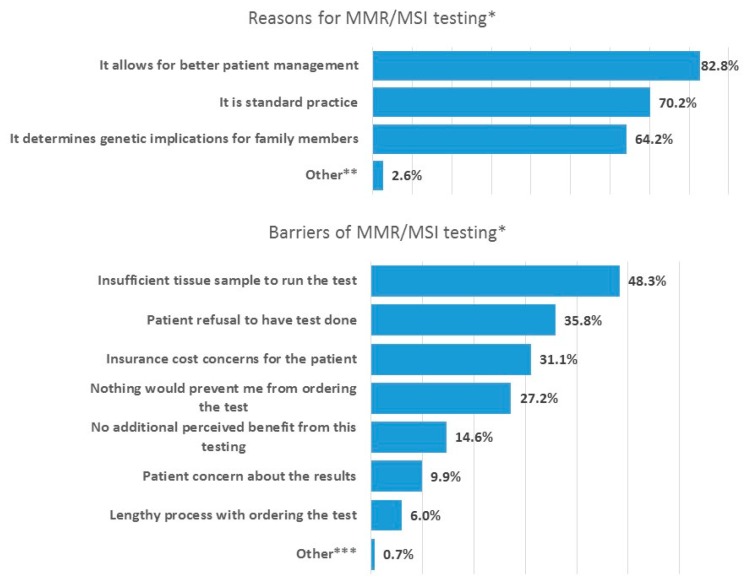
The study objective was to assess US physicians' Mismatch Repair/Microsatellite Instability (MMR/MSI) testing practices for metastatic colorectal cancer (mCRC) patients. A non-interventional, cross-sectional online survey was conducted among 151 physicians (91 oncologists, 15 surgeons and 45 pathologists) treating mCRC patients in the US. Eligible physicians were US-based with at least 5 years of experience treating CRC patients, had at least one mCRC patient in their routine care in the past 6 months, and had ordered at least one MMR/MSI test for CRC in the past 6 months. Descriptive and logistic regression analyses were performed. Awareness of specific MMR/MSI testing guidelines was high (n = 127, 84.1%). Of those, 93.7% (119/127) physicians had awareness of specific published guidelines with majority 67.2% (80/119) being aware of National Comprehensive Cancer Network (NCCN) guidelines. Universal testing for all CRC patients was performed by 68.9% (104/151) physicians, while 29.8% (45/151) selectively order the test for some CRC patients. Key barriers for testing included insufficient tissue sample (48.3%, 73/151), patient declined to have the test done (35.8%, 54/151) and insurance cost concerns for patients (31.1%, 47/151), while 27.2% (41/151) reported no barriers. The survey demonstrated high awareness and compliance with MMR/MSI testing guidelines although universal testing rates seem to be suboptimal.
该研究的目的是评估美国医生针对转移性结直肠癌(mCRC)患者的错配修复/微卫星不稳定性(MMR/MSI)检测实践。在美国,对151名治疗mCRC患者的医生(91名肿瘤学家、15名外科医生和45名病理学家)进行了一项非干预性横断面在线调查。符合条件的医生需在美国工作,至少有5年治疗CRC患者的经验,在过去6个月的常规诊疗中有至少1名mCRC患者,且在过去6个月中至少为CRC患者开具过1次MMR/MSI检测。进行了描述性和逻辑回归分析。对特定MMR/MSI检测指南的知晓率较高(n = 127,84.1%)。其中,93.7%(119/127)的医生知晓特定的已发表指南,大多数(67.2%,80/119)知晓美国国立综合癌症网络(NCCN)指南。68.9%(104/151)的医生对所有CRC患者进行普遍检测,而29.8%(45/151)的医生会选择性地为部分CRC患者开具检测。检测的主要障碍包括组织样本不足(48.3%,73/151)、患者拒绝检测(35.8%,54/151)以及患者对保险费用的担忧(31.1%,47/151),而27.2%(41/151)的医生表示没有障碍。该调查表明,尽管普遍检测率似乎未达最佳水平,但医生对MMR/MSI检测指南的知晓率和遵循率较高。