Elhfnawy Ahmed Mohamed, Heuschmann Peter U, Pham Mirko, Volkmann Jens, Fluri Felix
Department of Neurology, University Hospital Würzburg, Würzburg, Germany.
Institute of Clinical Epidemiology and Biometry, University of Würzburg, Würzburg, Germany.
Front Neurol. 2019 Apr 9;10:317. doi: 10.3389/fneur.2019.00317. eCollection 2019.
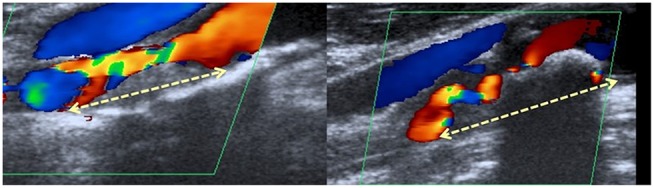
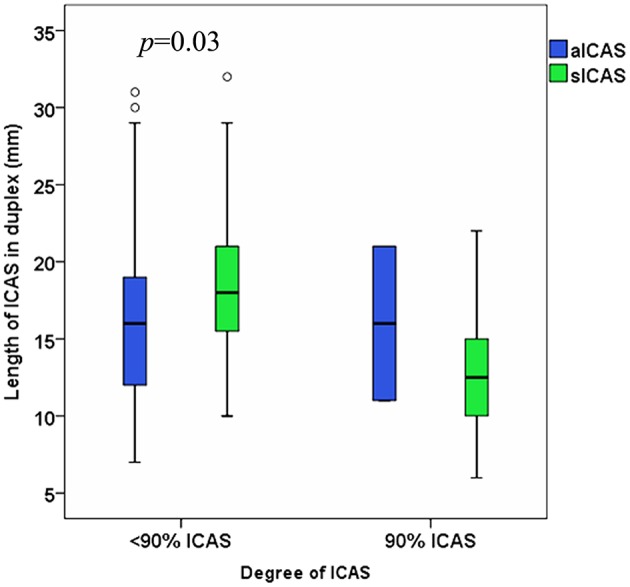
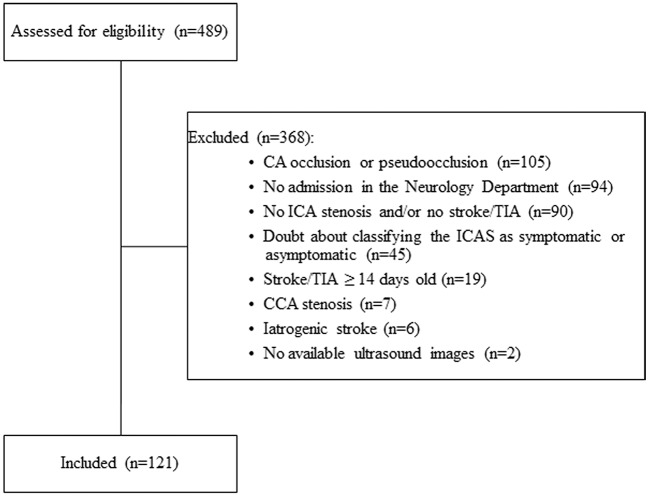
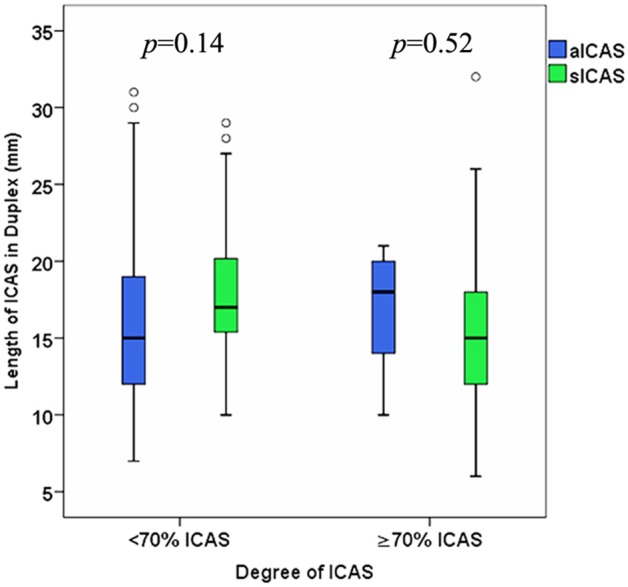
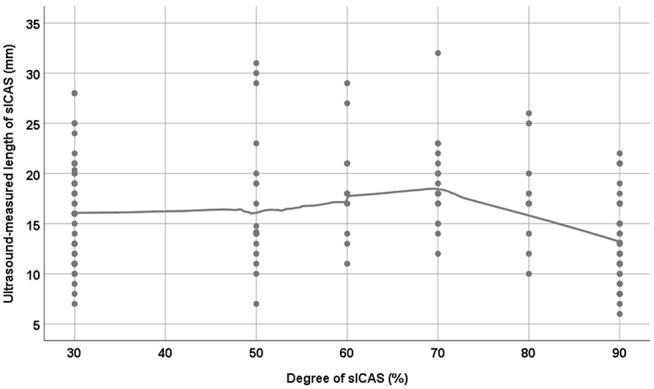
Internal carotid artery stenosis (ICAS)≥70% is a leading cause of ischemic cerebrovascular events (ICVEs). However, a considerable percentage of stroke survivors with symptomatic ICAS (sICAS) have <70% stenosis with a vulnerable plaque. Whether the length of ICAS is associated with high risk of ICVEs is poorly investigated. Our main aim was to investigate the relation between the length of ICAS and the development of ICVEs. In a retrospective cross-sectional study, we identified 95 arteries with sICAS and another 64 with asymptomatic internal carotid artery stenosis (aICAS) among 121 patients with ICVEs. The degree and length of ICAS as well as plaque echolucency were assessed on ultrasound scans. A statistically significant inverse correlation between the ultrasound-measured length and degree of ICAS was detected for sICAS≥70% (Spearman correlation coefficient ρ = -0.57, < 0.001, = 51) but neither for sICAS<70% (ρ = 0.15, = 0.45, = 27) nor for aICAS (ρ = 0.07, = 0.64, = 54). The median (IQR) length for sICAS<70% and ≥70% was 17 (15-20) and 15 (12-19) mm ( = 0.06), respectively, while that for sICAS<90% and sICAS 90% was 18 (15-21) and 13 (10-16) mm, respectively ( < 0.001). Among patients with ICAS <70%, a cut-off length of ≥16 mm was found for sICAS rather than aICAS with a sensitivity and specificity of 74.1% and 51.1%, respectively. Irrespective of the stenotic degree, plaques of the sICAS compared to aICAS were significantly more often echolucent (43.2 vs. 24.6%, = 0.02). We found a statistically insignificant tendency for the ultrasound-measured length of sICAS<70% to be longer than that of sICAS≥70%. Moreover, the ultrasound-measured length of sICAS<90% was significantly longer than that of sICAS 90%. Among patients with sICAS≥70%, the degree and length of stenosis were inversely correlated. Larger studies are needed before a clinical implication can be drawn from these results.
颈内动脉狭窄(ICAS)≥70%是缺血性脑血管事件(ICVEs)的主要原因。然而,相当一部分有症状的颈内动脉狭窄(sICAS)的卒中幸存者狭窄程度<70%且伴有易损斑块。ICAS的长度是否与ICVEs的高风险相关尚缺乏充分研究。我们的主要目的是研究ICAS长度与ICVEs发生之间的关系。在一项回顾性横断面研究中,我们在121例ICVEs患者中确定了95条有sICAS的动脉以及另外64条有无症状颈内动脉狭窄(aICAS)的动脉。通过超声扫描评估ICAS的程度和长度以及斑块回声。对于sICAS≥70%,检测到超声测量的ICAS长度与程度之间存在统计学显著的负相关(Spearman相关系数ρ = -0.57,P < 0.001,n = 51),但对于sICAS<70%(ρ = 0.15,P = 0.45,n = 27)和aICAS(ρ = 0.07,P = 0.64,n = 54)均未检测到这种相关性。sICAS<70%和≥70%的中位(四分位间距)长度分别为17(15 - 20)和15(12 - 19)mm(P = 0.06),而sICAS<90%和sICAS 90%的分别为18(15 - 21)和13(10 - 16)mm(P < 0.001)。在ICAS<70%的患者中,发现sICAS的截断长度≥16 mm,而aICAS并非如此,其敏感性和特异性分别为74.1%和51.1%。无论狭窄程度如何,与aICAS相比,sICAS的斑块更常为低回声(43.2%对24.6%,P = 0.02)。我们发现超声测量的sICAS<70%的长度有比sICAS≥70%的长度更长的趋势,但无统计学意义。此外,超声测量的sICAS<90%的长度显著长于sICAS 90%的长度。在sICAS≥70%的患者中,狭窄程度与长度呈负相关。在从这些结果得出临床意义之前,需要进行更大规模的研究。