Laboratorio de Eco-Epidemiología, Facultad de Ciencias Exactas y Naturales, Universidad de Buenos Aires, Ciudad Universitaria, C1428EHA, Buenos Aires, Argentina.
Instituto de Ecología, Genética y Evolución de Buenos Aires, Consejo Nacional de Investigaciones Científicas y Técnicas, Ciudad Universitaria, C1428EHA, Buenos Aires, Argentina.
Parasit Vectors. 2019 Apr 27;12(1):184. doi: 10.1186/s13071-019-3444-5.
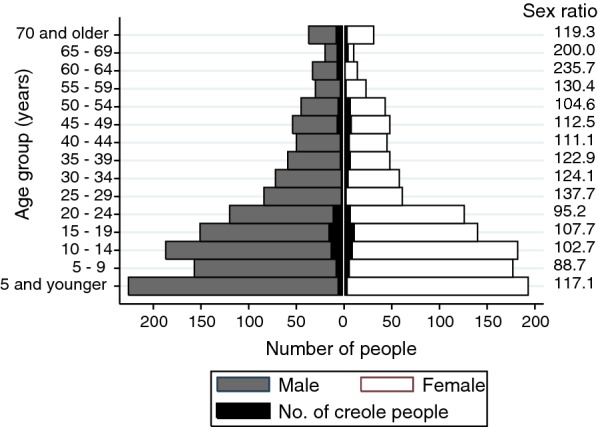
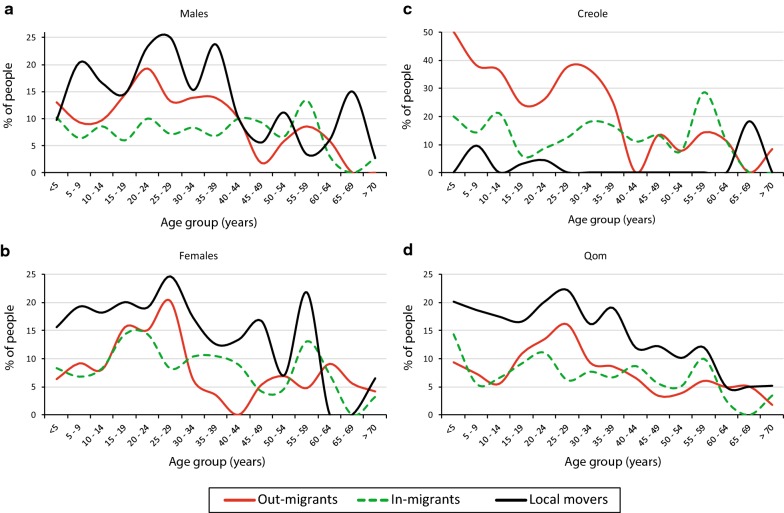
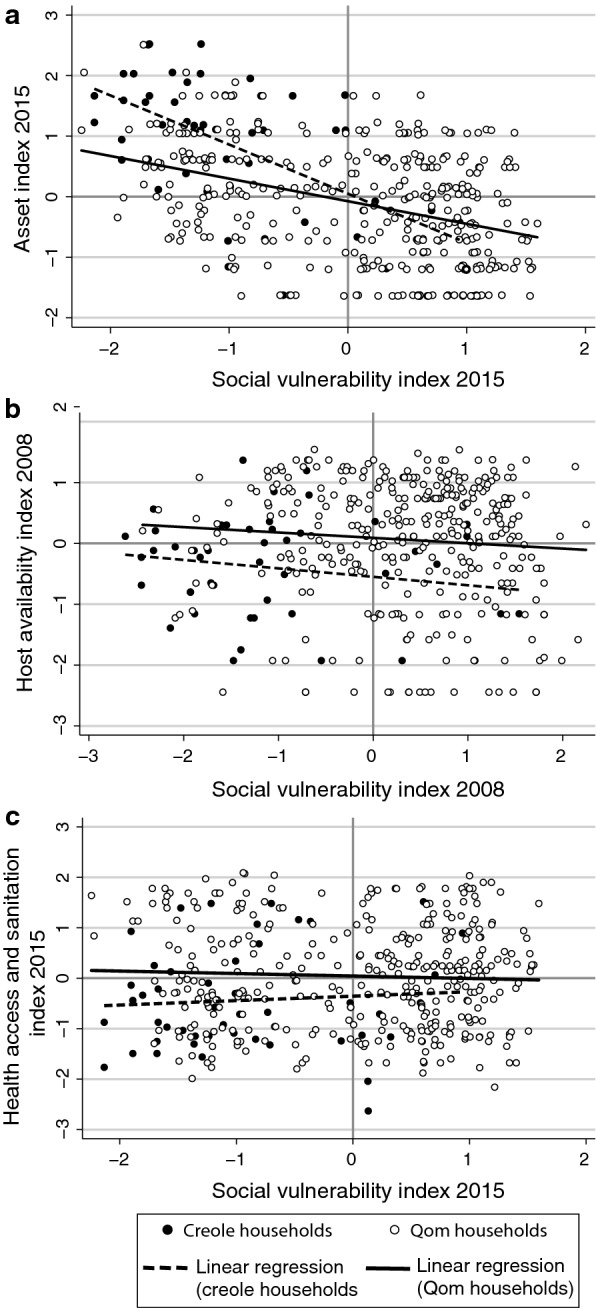
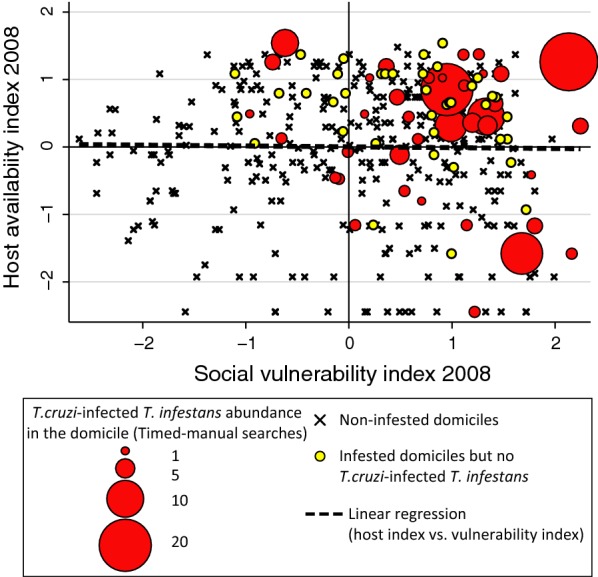
The social determinants of health (SDHs) condition disease distribution and the ways they are handled. Socio-economic inequalities are closely linked to the occurrence of neglected tropical diseases, but empirical support is limited in the case of Chagas disease, caused by the protozoan Trypanosoma cruzi. Herein we assessed the relationship between key structural SDHs and the risk of T. cruzi vector-borne transmission in rural communities of the Argentine Chaco occupied by creoles and an indigenous group (Qom). We used multiple correspondence analysis to quantify the household-level socio-economic position (social vulnerability and assets indices), access to health and sanitation services, and domestic host availability. We identified the most vulnerable population subgroups by comparing their demographic profiles, mobility patterns and distribution of these summary indices, then assessed their spatial correlation and household-level effects on vector domiciliary indices as transmission risk surrogates.
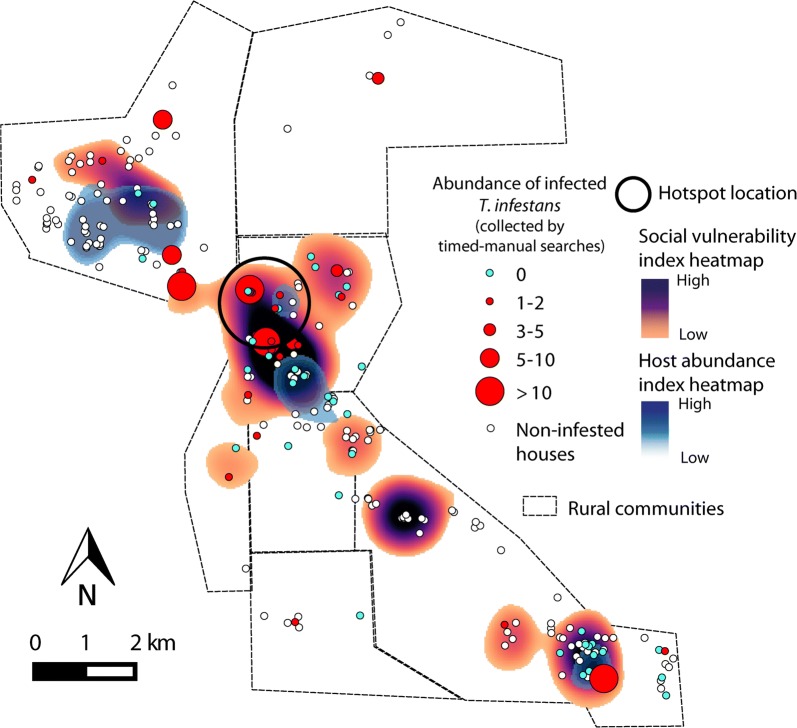
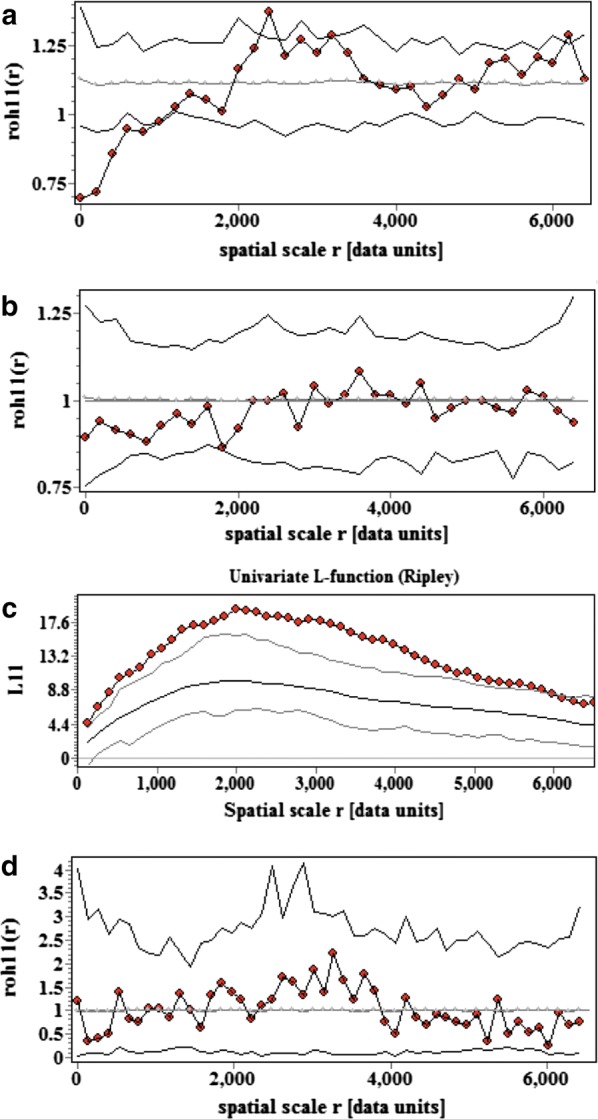
Qom households had higher social vulnerability and fewer assets than creoles, as did local movers and migrant households compared with non-movers. We found significantly positive effects of social vulnerability and domestic host availability on infected Triatoma infestans abundance, after adjusting for ethnicity. Access to health and sanitation services had no effect on transmission risk. Only social vulnerability displayed significant global spatial autocorrelation up to 1 km. A hotspot of infected vectors overlapped with an aggregation of most vulnerable households.
This synthetic approach to assess socio-economic related inequalities in transmission risk provides key information to guide targeted vector control actions, case detection and treatment of Chagas disease, towards sustainability of interventions and greater reduction of health inequalities.
健康的社会决定因素(SDHs)决定了疾病的分布和处理方式。社会经济不平等与被忽视的热带病的发生密切相关,但在由原生动物克氏锥虫引起的恰加斯病的情况下,实证支持有限。在此,我们评估了关键结构性 SDHs 与阿根廷查科地区农村社区中克氏锥虫媒介传播风险之间的关系,这些社区由克里奥尔人和一个土著群体(科姆人)居住。我们使用多元对应分析来量化家庭层面的社会经济地位(社会脆弱性和资产指数)、获得卫生和卫生服务的情况以及家庭中宿主的可用性。我们通过比较这些综合指数的人口统计特征、流动模式和分布,确定了最脆弱的人群亚组,然后评估了它们的空间相关性以及对媒介家庭指数的家庭层面效应,作为传播风险的替代指标。
与克里奥尔人相比,科姆人的社会脆弱性更高,资产更少,与非流动人口相比,当地流动人口和移民家庭的社会脆弱性和资产更少。我们发现,在调整了种族因素后,社会脆弱性和家庭中宿主的可用性与受感染的三带喙库蚊丰度呈显著正相关。获得卫生和卫生服务对传播风险没有影响。只有社会脆弱性显示出直到 1 公里的显著全局空间自相关。受感染的媒介热点与大多数弱势家庭的聚集区重叠。
这种评估传播风险相关社会经济不平等的综合方法提供了关键信息,可指导有针对性的媒介控制措施、恰加斯病的病例发现和治疗,以实现干预措施的可持续性和减少卫生不平等。