Department of Psychology,University of California,Riverside, California,USA.
Helen Wills Neuroscience Institute, University of California,Berkeley, California,USA.
J Int Neuropsychol Soc. 2019 Jul;25(6):583-594. doi: 10.1017/S1355617719000183. Epub 2019 Apr 29.
Reduction in the amount of information (storage capacity) retained in working memory (WM) has been associated with sleep loss. The present study examined whether reduced WM capacity is also related to poor everyday sleep quality and, more importantly, whether the effects of sleep quality could be dissociated from the effects of depressed mood and age on WM.
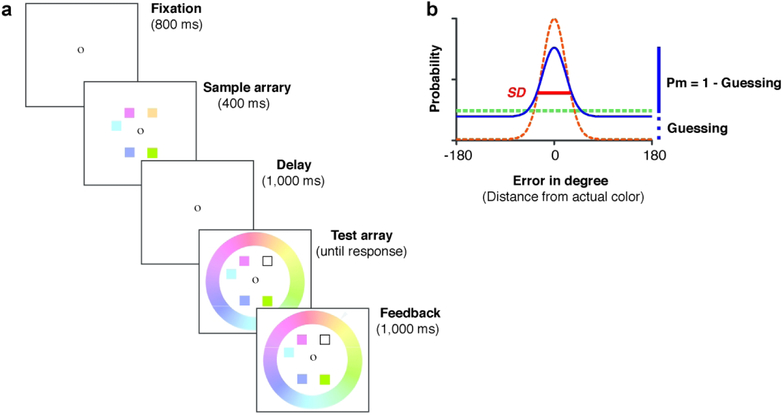
In two studies, WM was assessed using a short-term recall task, producing behavioral measures for both the amount of retained WM information (capacity) and how precise the retained WM representations were (precision). Self-report measures of sleep quality and depressed mood were obtained using questionnaires.
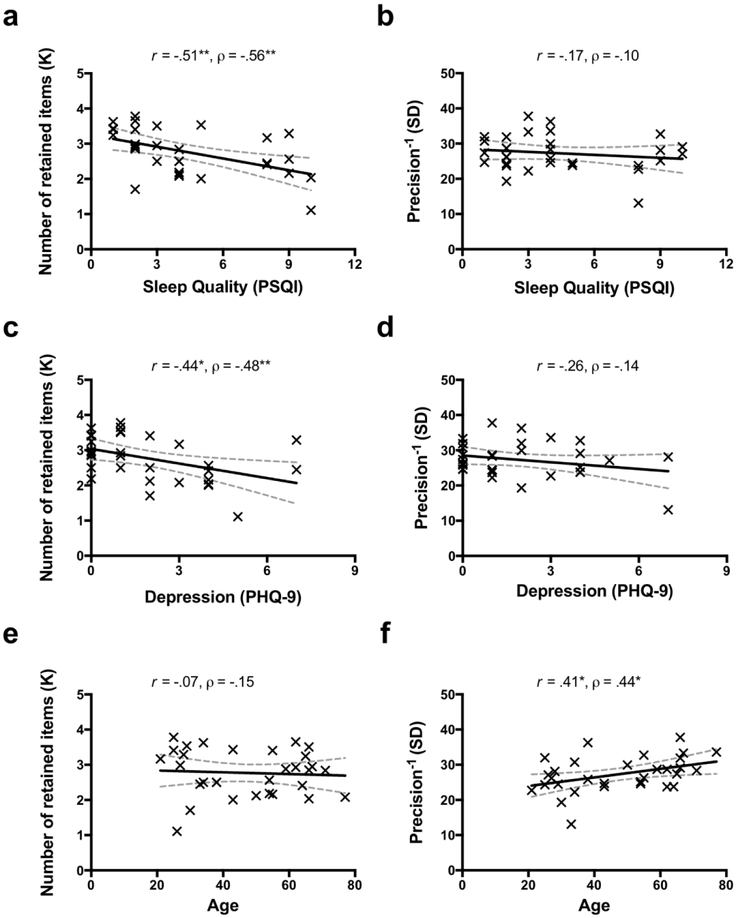
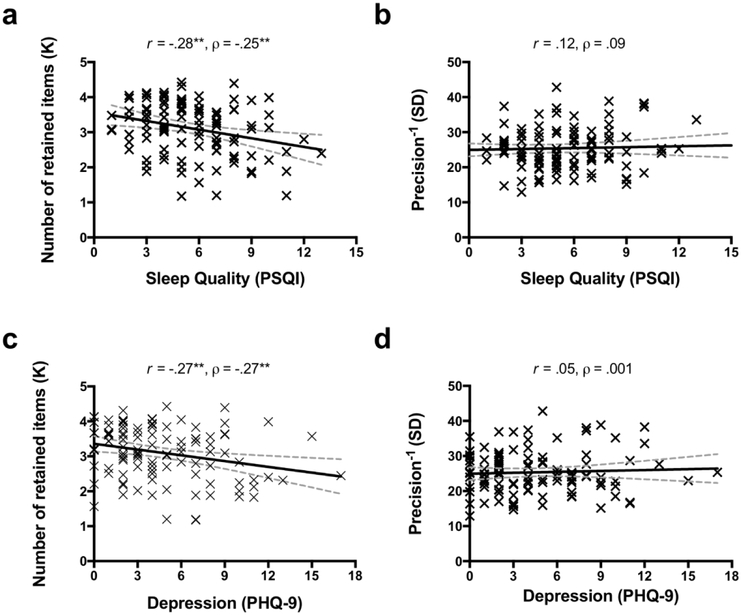
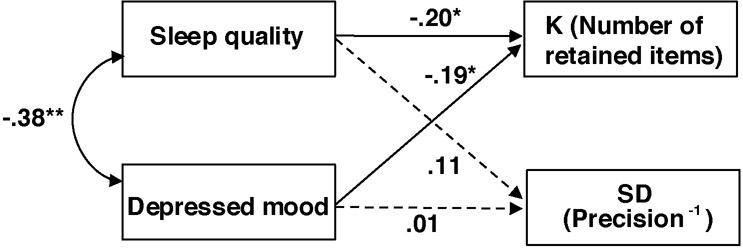
In a sample of college students, Study 1 found that poor sleep quality and depressed mood could independently predict reduced WM capacity, but not WM precision. Study 2 generalized these sleep- and mood-related WM capacity effects to a community sample (aged 21-77 years) and further showed that age was associated with reduced WM precision.
Together, these findings demonstrate dissociable effects of three health-related factors (sleep, mood, and age) on WM representations and highlighte the importance of assessing different aspects of WM representations (e.g., capacity and precision) in future neuropsychological research.
工作记忆(WM)中信息(存储容量)减少与睡眠不足有关。本研究旨在探讨 WM 容量减少是否也与较差的日常睡眠质量有关,更重要的是,睡眠质量的影响是否可以与情绪低落和年龄对 WM 的影响区分开来。
在两项研究中,使用短期回忆任务评估 WM,为保留的 WM 信息的数量(容量)和保留的 WM 表示的精确程度(精度)产生行为测量。使用问卷获得睡眠质量和抑郁情绪的自我报告测量。
在一项大学生样本中,研究 1 发现,睡眠质量差和情绪低落可以独立预测 WM 容量减少,但不能预测 WM 精度。研究 2 将这些与睡眠和情绪相关的 WM 容量效应推广到社区样本(年龄 21-77 岁),并进一步表明年龄与 WM 精度降低有关。
这些发现共同表明,三个与健康相关的因素(睡眠、情绪和年龄)对 WM 表示有可分离的影响,并强调了在未来神经心理学研究中评估 WM 表示的不同方面(例如,容量和精度)的重要性。