Ricci Clarisse G, Chen Janice S, Miao Yinglong, Jinek Martin, Doudna Jennifer A, McCammon J Andrew, Palermo Giulia
Department of Pharmacology, Department of Chemistry and Biochemistry, and National Biomedical Computation Resource, University of California San Diego, La Jolla, California 92093, United States.
Department of Molecular and Cell Biology, Department of Chemistry, Howard Hughes Medical Institute, Innovative Genomics Institute, and Molecular Biophysics and Integrated Bioimaging Division, Lawrence Berkeley National Laboratory, University of California Berkeley, Berkeley, California 94720, United States.
ACS Cent Sci. 2019 Apr 24;5(4):651-662. doi: 10.1021/acscentsci.9b00020. Epub 2019 Mar 7.
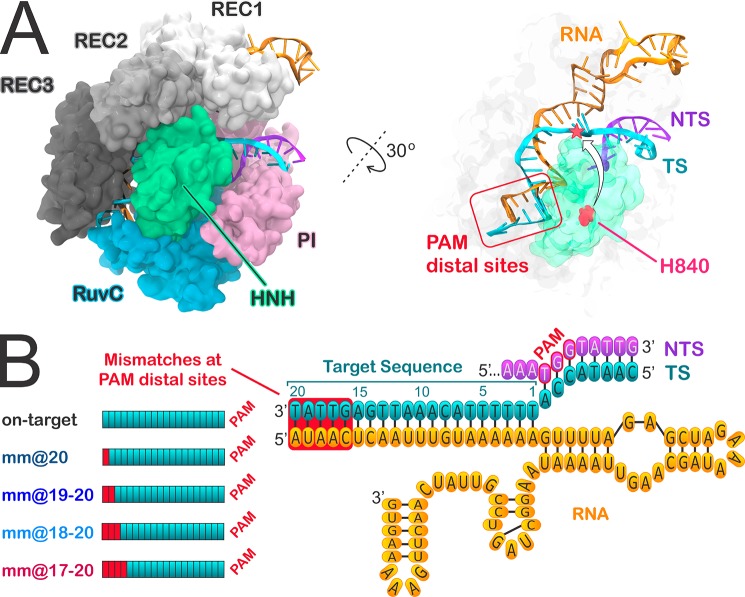
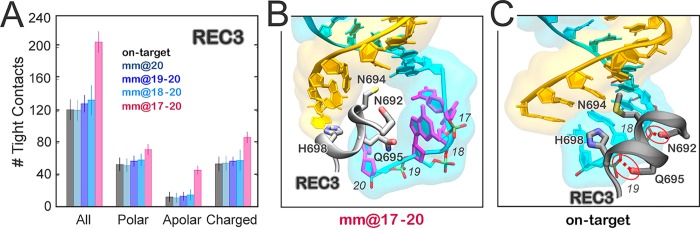
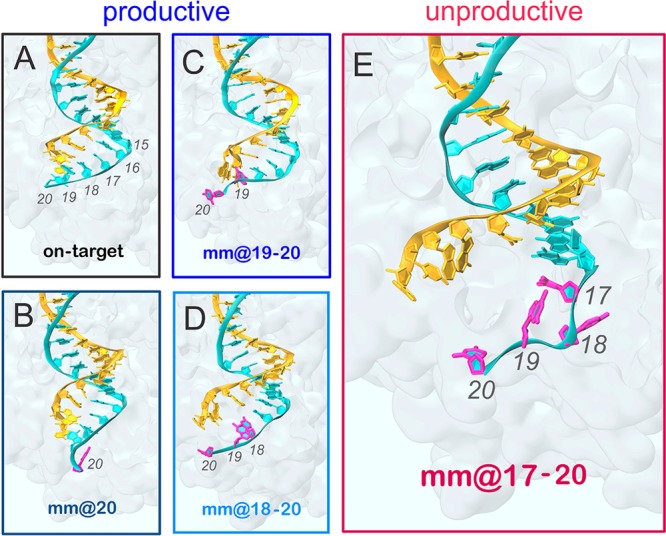
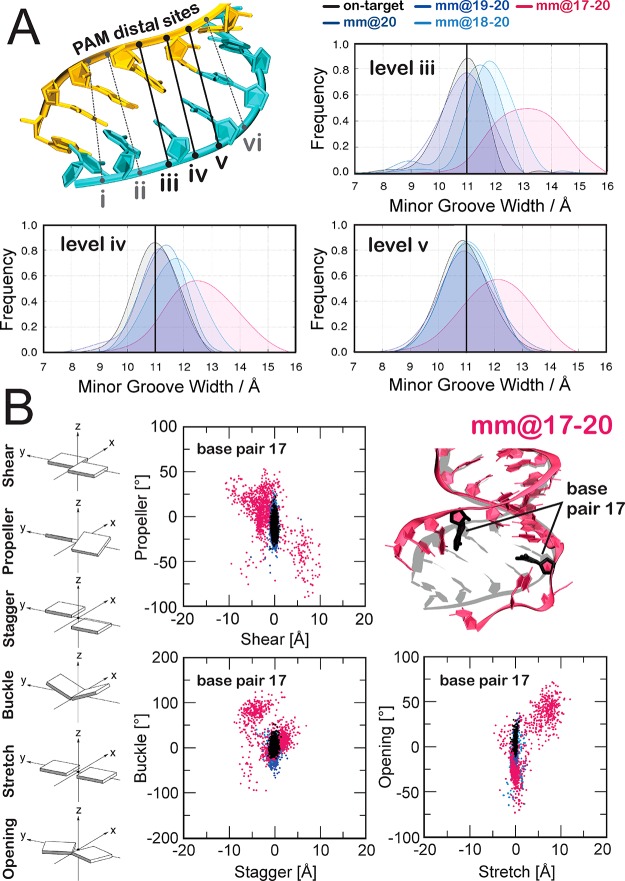
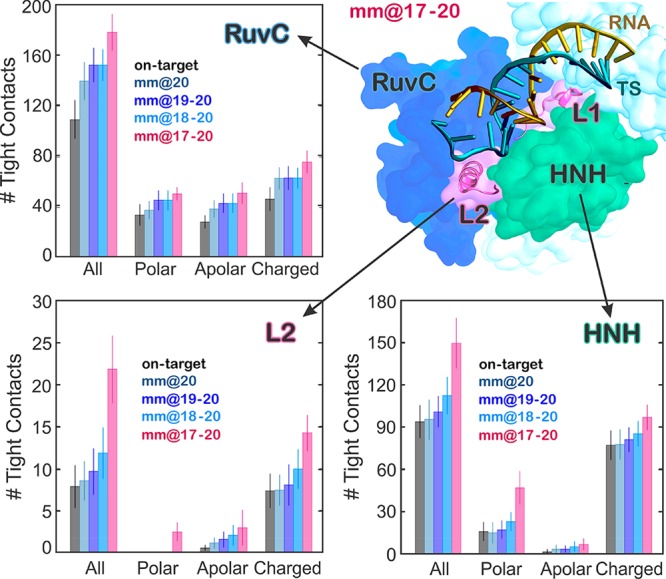
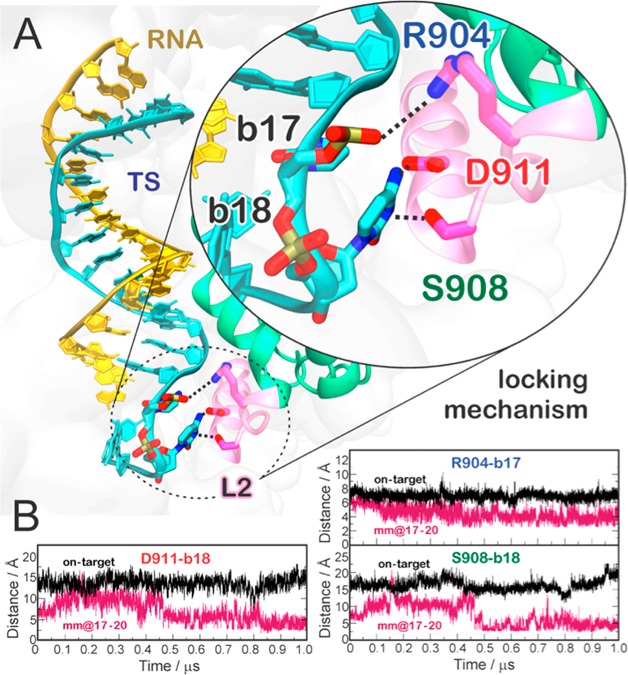
CRISPR-Cas9 is the state-of-the-art technology for editing and manipulating nucleic acids. However, the occurrence of off-target mutations can limit its applicability. Here, all-atom enhanced molecular dynamics (MD) simulations-using Gaussian accelerated MD (GaMD)-are used to decipher the mechanism of off-target binding at the molecular level. GaMD reveals that base pair mismatches in the target DNA at distal sites with respect to the protospacer adjacent motif (PAM) can induce an extended opening of the RNA:DNA heteroduplex, which leads to newly formed interactions between the unwound DNA and the L2 loop of the catalytic HNH domain. These conserved interactions constitute a "lock" effectively decreasing the conformational freedom of the HNH domain and hampering its activation for cleavage. Remarkably, depending on their positions at PAM distal sites, DNA mismatches responsible for off-target cleavages are unable to "lock" the HNH domain, thereby leading to the unselective cleavage of DNA sequences. In consistency with the available experimental data, the ability to "lock" the catalytic HNH domain in an inactive "conformational checkpoint" is shown to be a key determinant in the onset of off-target effects. This mechanistic rationale contributes in clarifying a long lasting open issue in the CRISPR-Cas9 function and poses the foundation for designing novel and more specific Cas9 variants, which could be obtained by magnifying the "locking" interactions between HNH and the target DNA in the presence of any incorrect off-target sequence, thus preventing undesired cleavages.
CRISPR-Cas9是用于编辑和操纵核酸的最先进技术。然而,脱靶突变的发生可能会限制其适用性。在此,使用高斯加速分子动力学(GaMD)的全原子增强分子动力学(MD)模拟用于在分子水平上解读脱靶结合的机制。GaMD显示,相对于原间隔相邻基序(PAM),靶DNA远端位点的碱基对错配可诱导RNA:DNA异源双链体的扩展开放,这导致解开的DNA与催化性HNH结构域的L2环之间形成新的相互作用。这些保守的相互作用构成一个“锁”,有效地降低了HNH结构域的构象自由度并阻碍其切割激活。值得注意的是,取决于它们在PAM远端位点的位置,导致脱靶切割的DNA错配无法“锁定”HNH结构域,从而导致DNA序列的非选择性切割。与现有实验数据一致,将催化性HNH结构域“锁定”在无活性“构象检查点”的能力被证明是脱靶效应发生的关键决定因素。这种机制原理有助于阐明CRISPR-Cas9功能中一个长期存在的开放性问题,并为设计新型且更具特异性的Cas9变体奠定基础,这可以通过在存在任何不正确的脱靶序列时放大HNH与靶DNA之间的“锁定”相互作用来实现,从而防止不期望的切割。