Department of Endocrinology, University of Groningen, University Medical Center Groningen, Groningen, the Netherlands.
Department of Laboratory Medicine, University of Groningen, University Medical Center Groningen, Groningen, the Netherlands.
J Anal Toxicol. 2019 Jul 24;43(6):452-464. doi: 10.1093/jat/bkz027.
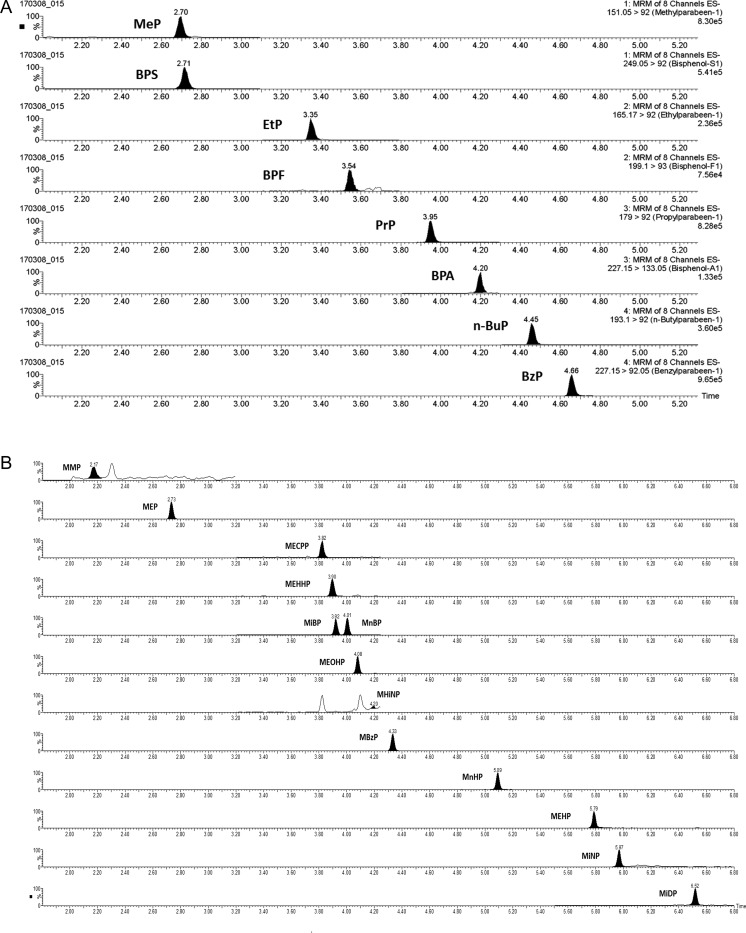
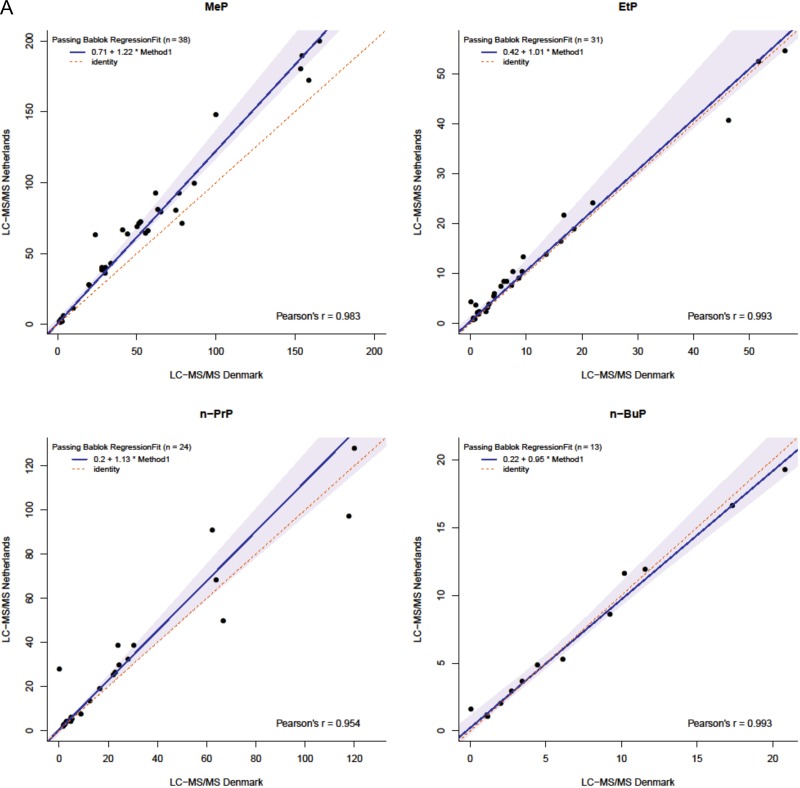
People are constantly exposed to a wide variety of chemicals. Some of these compounds, such as parabens, bisphenols and phthalates, are known to have endocrine disrupting potencies. Over the years, these endocrine disrupting chemicals (EDCs) have been a rising cause for concern. In this study, we describe setup and validation of two methods to measure EDCs in human urine, using ultra-performance liquid chromatography tandem mass spectrometry. The phenol method determines methyl-, ethyl-, propyl-, n-butyl- and benzylparaben and bisphenol A, F and S. The phthalate method determines in total 13 metabolites of dimethyl, diethyl, diisobutyl, di-n-butyl, di(2-ethylhexyl), butylbenzyl, diiso-nonyl and diisodecyl phthalate. Runtime was 7 and 8 min per sample for phenols and phthalates, respectively. The methods were validated by the National Institute of Standards & Technology (NIST) for 13 compounds. In addition, EDCs were measured in forty 24-h urine samples, of which 12 EDCs were compared with the same samples measured in an established facility (Rigshospitalet, Copenhagen, Denmark). The intra-assay coefficient of variability (CV) was highest at 10% and inter-assay CV was highest at 12%. Recoveries ranged from 86 to 115%. The limit of detection ranged from 0.06 to 0.43 ng/mL. Of 21 compounds, 10 were detected above limit of detection in ≥93% of the samples. Eight compounds were in accordance to NIST reference concentrations. Differences in intercept were found for two compounds whereas slope differed for six compounds between our method and that used in the Danish facility. In conclusion, we set up and validated two high-throughput methods with very short runtime capable of measuring 5 parabens, 3 bisphenols and 13 different metabolites of 8 phthalates. Sensitivity of the phenol method was increased by using ammonium fluoride in the mobile phase.
人们不断接触到各种各样的化学物质。其中一些化合物,如对羟基苯甲酸酯、双酚类和邻苯二甲酸酯,已知具有内分泌干扰能力。多年来,这些内分泌干扰化学物质(EDCs)一直是人们日益关注的问题。在这项研究中,我们描述了使用超高效液相色谱串联质谱法测量人尿液中 EDCs 的两种方法的建立和验证。苯酚法测定甲基、乙基、丙基、正丁基和苄基对羟基苯甲酸酯和双酚 A、F 和 S。邻苯二甲酸酯法共测定了邻苯二甲酸二甲酯、二乙酯、二异丁酯、二正丁酯、二(2-乙基己基)酯、丁基苄基酯、二异壬基酯和二异癸基酯的 13 种代谢物。苯酚和邻苯二甲酸酯的每个样品的运行时间分别为 7 分钟和 8 分钟。该方法已由美国国家标准与技术研究院(NIST)针对 13 种化合物进行了验证。此外,在 40 份 24 小时尿液样本中测量了 EDCs,其中 12 种 EDCs与在丹麦一家成熟机构(哥本哈根的 Rigshospitalet)测量的相同样本进行了比较。内标测定的变异系数(CV)最高为 10%,而批间 CV 最高为 12%。回收率范围为 86%至 115%。检测限范围为 0.06 至 0.43ng/mL。在所测的 21 种化合物中,有 10 种在 93%以上的样本中检测到超过检测限。8 种化合物的浓度与 NIST 参考浓度一致。我们的方法与丹麦机构使用的方法相比,在两个化合物的截距方面存在差异,而在 6 个化合物的斜率方面存在差异。结论:我们建立并验证了两种高通量方法,运行时间非常短,能够测量 5 种对羟基苯甲酸酯、3 种双酚类和 8 种邻苯二甲酸酯的 13 种不同代谢物。在流动相中使用氟化物铵可以提高苯酚法的灵敏度。