Social Determinants in Health Promotion Research Center, Hormozgan University of Medical Sciences, Bandar Abbas, Iran.
Department of Medical Entomology and Vector Control, Faculty of Health, Hormozgan University of Medical Sciences, P.O. Box: 79145-3838, Bandar Abbas, Iran.
Malar J. 2019 May 2;18(1):157. doi: 10.1186/s12936-019-2795-x.
Despite decreases in incidence, malaria remains a major public health challenge in south and southeast Iran, where vector control is considered one of the main strategies for elimination of the disease. The efficacy of this strategy depends on understanding malaria vector ecology, which varies by species. This study was conducted to determine the species composition, seasonal abundance and distribution of potential anopheline vectors in Bashagard County, one of the important malaria-endemic areas in south Iran.
In this cross-sectional study, four typical foothill and mountainous villages were selected by simple random sampling. Anopheline mosquitoes were collected by the standard dipping method for larvae and total catch for adults. Anopheline specimens were morphologically identified using taxonomic keys. Statistical analyses were performed using SPSS ver.20 software.
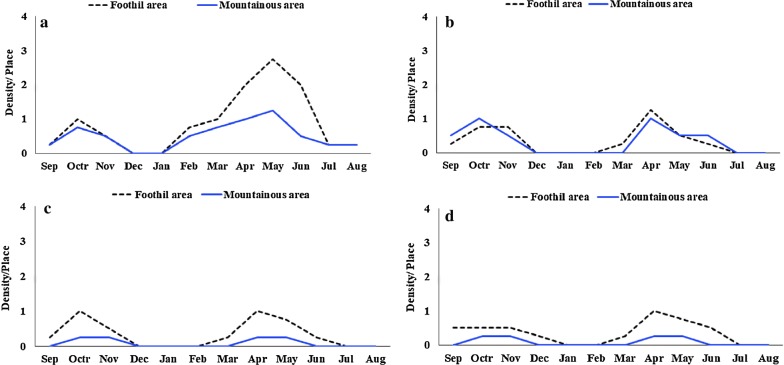
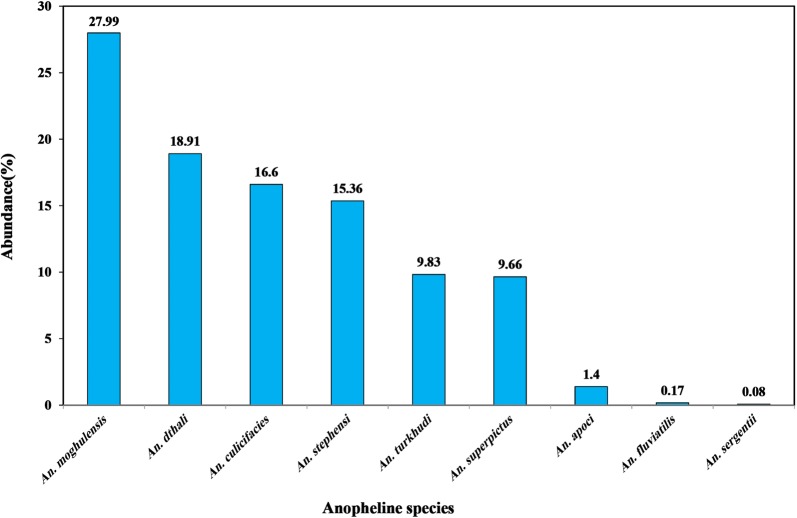
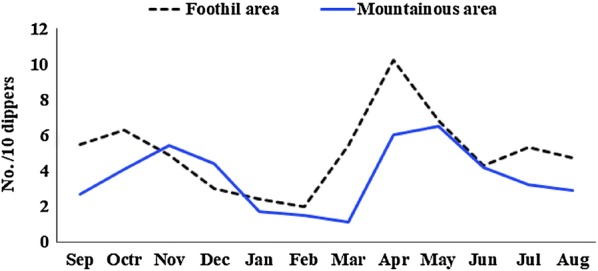
In total, 1211 anopheline specimens, including 1055 (87.12%) larvae and 156 (12.88%) adults, were collected and identified. They consisted of 9 species: Anopheles moghulensis (27.89%), Anopheles dthali (18.91%), Anopheles culicifacies (16.60%), Anopheles stephensi (15.38%), Anopheles turkhudi (9.83%), Anopheles superpictus (9.66%), Anopheles apoci (1.40%), Anopheles fluviatilis (0.17%), and Anopheles sergentii (0.08%). The most prevalent species in adult catches were An. culicifacies (44.23%), An. dthali (21.15%) and An. stephensi (16.03%), and the most prevalent species caught as larvae were An. moghulensis (31.94%), An. dthali (18.85%) and An. stephensi (15.26%). Most of the anopheline species were distributed in different topographical areas and two proven malaria vectors, An. culicifacies and An. superpictus, were significantly associated with altitude and collected more frequently in the foothill regions. Most of the anopheline species were present almost throughout the year with a major peak in April and a smaller peak in October.
The results of this study revealed that there are five malaria vectors in Bashagard County and some of them are more abundant in areas with special topographic features and are reproductively active throughout the year. These findings can be applied to successful planning and providing effective control measures in problematic areas during the malaria elimination phase in Iran.
尽管发病率有所下降,但疟疾仍是伊朗南部和东南部的一个主要公共卫生挑战,在这些地区,病媒控制被认为是消除该疾病的主要策略之一。该策略的有效性取决于对疟疾媒介生态学的理解,而这因物种而异。本研究旨在确定伊朗南部一个重要疟疾流行地区——巴沙加尔德县潜在按蚊媒介的物种组成、季节丰度和分布。
在这项横断面研究中,通过简单随机抽样选择了四个典型的山麓和山区村庄。幼虫采用标准浸渍法采集按蚊,成虫采用总捕集法采集。按蚊标本采用分类学鉴定。使用 SPSS 版本 20 软件进行统计分析。
共采集并鉴定了 1211 只按蚊标本,其中幼虫 1055 只(87.12%),成虫 156 只(12.88%)。它们由 9 个物种组成:淡色库蚊(27.89%)、喜山库蚊(18.91%)、三带喙库蚊(16.60%)、致倦库蚊(15.38%)、褐足库蚊(9.83%)、史氏按蚊(9.66%)、中华按蚊(9.66%)、阿萨姆按蚊(1.40%)、河流型按蚊(0.17%)和辛普森按蚊(0.08%)。成虫捕获中最常见的物种是三带喙库蚊(44.23%)、喜山库蚊(21.15%)和致倦库蚊(16.03%),幼虫捕获中最常见的物种是淡色库蚊(31.94%)、喜山库蚊(18.85%)和致倦库蚊(15.26%)。大多数按蚊种分布在不同的地形区域,两种已证实的疟疾传播媒介——三带喙库蚊和史氏按蚊——与海拔高度显著相关,在山麓地区更为常见。大多数按蚊种几乎全年存在,主要高峰在 4 月,较小高峰在 10 月。
本研究结果表明,巴沙加尔德县有 5 种疟疾传播媒介,其中一些在具有特殊地形特征的地区更为丰富,并在全年内具有繁殖活性。这些发现可应用于伊朗消除疟疾阶段在有问题的地区成功规划和提供有效控制措施。