Ugur Kader, Aydin Suleyman
Department of Internal Medicine (Endocrinology and Metabolism Diseases), School of Medicine, Fırat University, 23119 Elazig, Turkey.
Department of Medical Biochemistry and Clinical Biochemistry, (Firat Hormones Research Group), Medical School, Fırat University, 23119 Elazig, Turkey.
Int J Endocrinol. 2019 Mar 27;2019:2521096. doi: 10.1155/2019/2521096. eCollection 2019.
The aim was to investigate the amounts of saliva and serum asprosin in order to determine whether it is related to obesity and whether salivary glands synthesize asprosin or not.
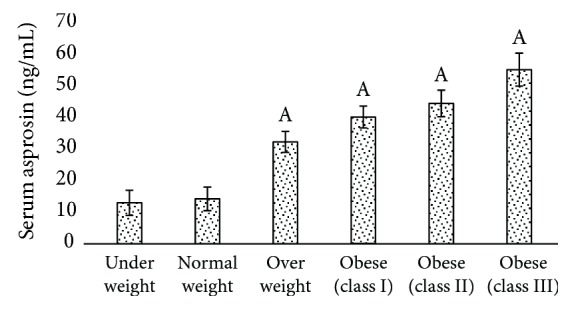
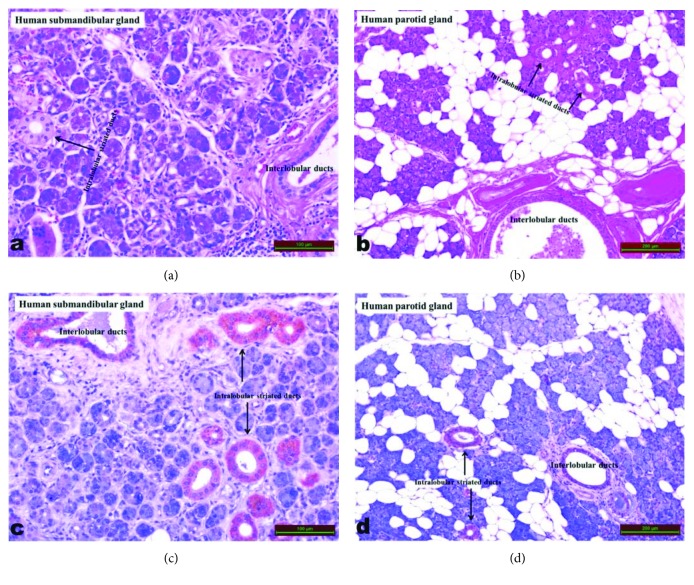
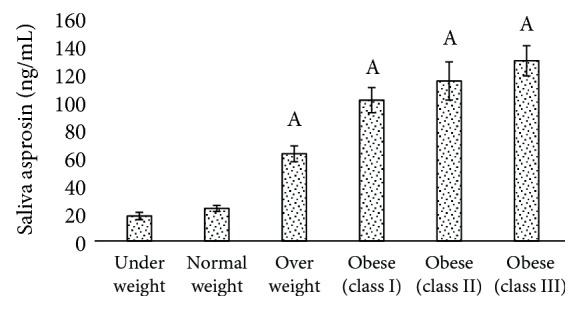
A total of 116 underweight, normal weight, overweight, and obese (class I, class II, and class III) volunteers participated in the study. Saliva and blood samples were collected simultaneously from the participants. The amounts of asprosin in saliva, salivary gland tissue supernatants, and bloods were determined by ELISA, whereas asprosin synthesis sites of salivary gland tissues were determined immunohistochemically.
The amount of asprosin from the lowest to the highest was in the order as follows: underweight, normal weight (control), overweight, and obese classes I and III. The lowest level of asprosin was detected in underweight individuals. It was also found that the interlobular striated ducts and the interlobular ducts of the submandibular and parotid salivary glands produce asprosin. According to these data, the asprosin level is related with obesity as the amount increases in accordance with increasing body mass index (BMI). On the other hand, there is also a relationship between the underweight and asprosin because the amount decreases with BMI decrease.
Asprosin, a new adipokine, may be a novel indicator of adipose tissue mass. Therefore, we anticipate that antiasprosin preparations may be an alternative in the treatment of obesity in the future.
目的是研究唾液和血清中阿普洛辛的含量,以确定其是否与肥胖相关,以及唾液腺是否合成阿普洛辛。
共有116名体重过轻、正常体重、超重和肥胖(I类、II类和III类)志愿者参与了该研究。同时从参与者中采集唾液和血液样本。通过酶联免疫吸附测定法(ELISA)测定唾液、唾液腺组织上清液和血液中的阿普洛辛含量,而通过免疫组织化学法确定唾液腺组织的阿普洛辛合成部位。
阿普洛辛含量从低到高依次为:体重过轻、正常体重(对照)、超重以及肥胖的I类和III类。在体重过轻的个体中检测到最低水平的阿普洛辛。还发现下颌下腺和腮腺的小叶间纹状管和小叶间导管产生阿普洛辛。根据这些数据,阿普洛辛水平与肥胖相关,因为其含量随着体重指数(BMI)的增加而增加。另一方面,体重过轻与阿普洛辛之间也存在关系,因为其含量随着BMI的降低而减少。
阿普洛辛作为一种新的脂肪因子,可能是脂肪组织量的一种新型指标。因此,我们预计抗阿普洛辛制剂未来可能成为治疗肥胖的一种选择。